What Is an AI-Designed Clubface? Does It Actually Help? (2026)
Every major golf brand now talks about AI in their clubface design. Callaway has Ai Smart Face. Cobra has H.O.T. Face. TaylorMade uses computational modeling for Twist Face. The marketing makes it sound like a supercomputer is personally engineering your next driver. But what does “AI-designed” actually mean in a golf club — and does it make your shots better?
We handle thousands of drivers, fairway woods, and irons at Golf Club Brokers — pre-AI and post-AI models from every brand. Here’s what the technology actually does, how each brand implements it, and what it means for you when you’re buying equipment.
AI-designed clubfaces use machine learning to optimize variable face thickness — making certain areas thinner or thicker to maximize ball speed across the entire face, not just the center. The result is better performance on mishits. It’s real technology with measurable benefits, but the improvement is incremental, not transformational. If you’re buying used, clubs from 2019 onward generally have some form of AI face design.
What “AI-Designed” Actually Means
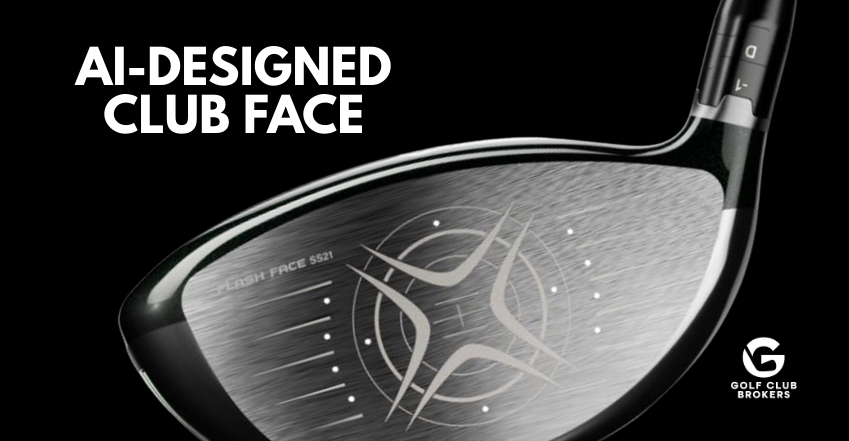
When manufacturers say a clubface is “AI-designed,” they’re referring to a process where machine learning algorithms optimize the variable face thickness (VFT) pattern of the clubface.
Here’s the basic concept:
- Start with constraints — The algorithm is given physical limits: maximum face thickness, minimum face thickness, overall head weight, COR limit (0.830 per USGA rules), material properties of the face alloy.
- Simulate thousands of impacts — The AI runs simulations of ball strikes across the entire face — center hits, toe hits, heel hits, high hits, low hits — thousands of impact locations.
- Optimize for ball speed — The algorithm adjusts the thickness at each point on the face to maximize ball speed across the widest possible area while staying within the COR limit.
- Iterate — The process runs through thousands or even millions of iterations, refining the thickness map until it finds the optimal pattern.
The result is a face that isn’t uniformly thick or uniformly thin, but has a complex pattern of variable thickness — thicker in some areas, thinner in others — designed to maintain ball speed even when you don’t hit the center.
Before AI, engineers designed VFT patterns by hand or with basic computer modeling. They could test maybe a few hundred variations. AI testing millions of variations in the same timeframe is where the advantage comes in.
How Each Brand Uses AI
Every major manufacturer has adopted AI face design, but each implements it differently and brands it with their own terminology.
| Brand | Technology Name | What It Does | First Used |
|---|---|---|---|
| Callaway | Ai Smart Face | Optimizes face thickness for ball speed and spin across the entire face; each head size gets its own unique pattern | 2019 (Epic Flash) |
| Cobra | H.O.T. Face | Highly Optimized Topology — AI-generated thickness pattern across 15 zones of the face for consistent COR | 2021 (Radspeed) |
| TaylorMade | Twist Face + Computational Modeling | Face curvature adjusted by AI to correct gear effect on off-center hits; high-toe and low-heel get different loft/bulge | 2018 (M3/M4) |
| Ping | Variable Face Thickness (VFT) | Proprietary modeling for face thickness optimization; less marketing emphasis on “AI” but uses similar computational methods | 2019 (G410) |
| Titleist | Speed Ring VFT | Concentric ring pattern of variable thickness radiating from the center; optimized for maximum COR across a wider area | 2019 (TS series) |
| Cleveland / Srixon | AI-sim Face | Simulation-driven face design optimizing for ball speed, spin rate, and launch angle on off-center strikes | 2020 (ZX series) |
The names are different, but the core idea is the same: use machine learning to generate a face thickness pattern that a human engineer couldn’t design manually. The patterns often look organic and asymmetrical — not what an engineer would draw by hand — because the algorithm doesn’t care about aesthetics, only performance.
Does It Actually Make Clubs Better?
Yes — but with important context.
Where AI face design helps most
Mishit performance: This is the single biggest benefit. AI-optimized faces maintain more ball speed on off-center hits than conventionally designed faces. If you tend to miss toward the toe or heel, you’ll lose fewer yards with an AI-designed face. Independent testing consistently shows 1–3 mph more ball speed on mishits with AI faces vs. pre-AI designs of the same era.
Spin consistency: AI faces can be designed to reduce unwanted spin variation across the face. A center hit and a slight toe hit will produce more similar spin numbers, leading to more consistent carry distances.
Launch optimization: Some implementations (especially TaylorMade’s Twist Face) adjust not just thickness but face curvature, which affects launch angle and spin axis on off-center strikes. This can reduce the curve on mishits.
Where it doesn’t help as much as marketing suggests
Center-hit ball speed: The USGA’s COR limit (0.830) caps maximum ball speed on a perfect center strike. AI can’t make the center of the face hotter than the rules allow. Every driver from every brand is already at or near this limit in the sweet spot. The gains are on the edges, not the center.
Total distance for consistent ball strikers: If you already hit the center most of the time, the benefit of AI face design is minimal. You’re already getting near-maximum ball speed. The technology helps more as your strike pattern becomes more scattered.
Game-changing improvement: AI face design is not going to turn a slice into a draw or add 30 yards to your drive. It’s a refinement that produces incremental improvement — a few yards saved on bad swings, slightly tighter dispersion on average swings. Real, measurable, but not miraculous.
Marketing vs. Reality
Here’s the honest take from handling clubs across every generation:
AI face design is legitimate technology with real R&D behind it. The performance difference between pre-AI and post-AI faces is measurable on a launch monitor, especially on off-center hits. We’re not talking about snake oil here.
But the marketing amplifies the benefit beyond what most golfers will notice in a round. The difference between the 2024 Callaway Ai Smart Face and the 2023 version is marginal. The difference between either of those and the 2019 Epic Flash face (the first Ai face) is more noticeable — but it’s still not the leap that year-over-year marketing implies.
The biggest jump in performance was when brands first implemented AI face design. Each generation since has been an incremental refinement. If you’re upgrading from a 2016 driver to a 2024 driver, the AI face is part of why you’ll see improvement. If you’re upgrading from a 2022 to a 2025, the difference attributable to the face alone is small.
What This Means for Buying Used
Here’s the practical takeaway for anyone shopping the used market:
- 2019 and newer drivers from Callaway, TaylorMade, Ping, Titleist, Cobra, and Cleveland/Srixon all have some form of AI or advanced computational face design. You’re getting the core technology regardless of which specific year you buy.
- The sweet spot on the used market is typically 1–2 generations back. You get AI face design, modern construction, and a significant price discount compared to the latest release.
- Don’t pay a premium for the newest AI iteration unless you’ve tested it on a launch monitor and seen meaningful personal improvement. The year-over-year face optimization gains are small enough that most golfers won’t notice the difference in actual play.
- Pre-2019 clubs are still great golf clubs. They just don’t have the optimized mishit performance that AI faces provide. If you strike the ball well, you may not notice the difference.
Frequently Asked Questions
Does AI face design make drivers non-conforming?
No. All AI-designed faces must still meet USGA and R&A rules, including the 0.830 COR limit. The AI optimizes performance within the legal limits, not beyond them. Every driver sold by major manufacturers is conforming.
Which brand has the best AI face technology?
They’re all competitive. Callaway has invested the most in AI marketing and was among the first to adopt it. Cobra’s H.O.T. Face has tested well in independent reviews. TaylorMade’s Twist Face addresses a different aspect (face curvature, not just thickness). No brand has a decisive advantage — they’re all solving the same problem slightly differently.
Can I feel the difference between an AI face and a non-AI face?
On a pure center hit, probably not. The difference shows up on mishits — you’ll retain more ball speed and get slightly better results when you miss the sweet spot. It’s most noticeable with a launch monitor tracking ball speed across multiple strikes.
Is AI face design used in irons too?
Yes. Callaway uses Ai in their Paradym and Apex iron faces. Cobra uses H.O.T. Face technology in their Darkspeed irons. TaylorMade uses computational optimization in the P790 face. The principle is the same — optimize face thickness for ball speed on mishits — just applied to a smaller face area.
How many years does an AI face design advantage last before it’s obsolete?
AI face technology doesn’t become “obsolete” — a 2019 AI-designed face is still better optimized than any pre-AI face. Each generation gets marginally better, but the differences shrink over time. A driver from 2019–2021 still provides the core benefits of AI face design.
Should I upgrade just for a newer AI face?
If your current driver is from 2019 or later, probably not. The incremental gain from a slightly newer AI face iteration is unlikely to show up in your scores. If your driver is pre-2019, upgrading to any modern AI-designed face will likely show measurable improvement on off-center hits.
The Bottom Line
AI-designed clubfaces are real engineering, not marketing fiction. They measurably improve performance on off-center hits by optimizing variable face thickness in ways human engineers couldn’t achieve manually. But the benefit is incremental — better mishit performance, slightly tighter dispersion — not a revolution in how far or straight you hit the ball.
For used club buyers, the practical takeaway is simple: if you’re shopping for a driver from 2019 or newer, you’re getting AI face design regardless of brand. Focus on fit, feel, and value rather than chasing the absolute latest AI iteration.
Find Your Next Driver
Every driver at Golf Club Brokers is inspected, authenticated, and graded. Modern AI faces, verified performance, honest pricing.