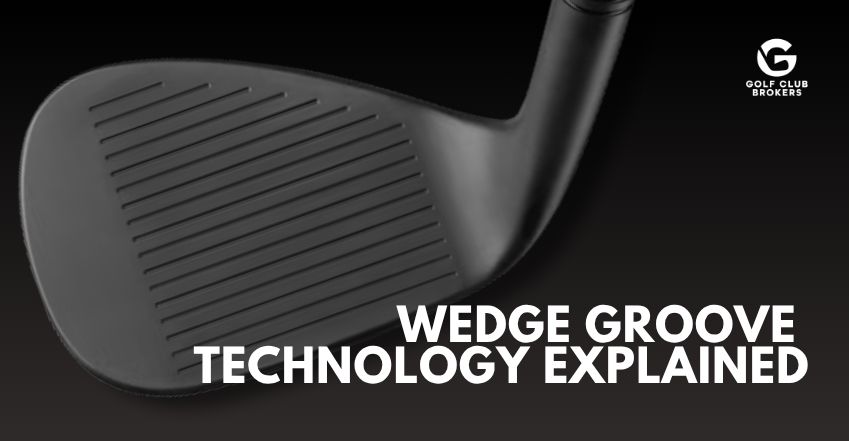
Wedge Groove Technology Explained: Why Fresh Grooves Matter in 2026
Here's something that surprises most golfers who bring wedges into our shop: the face looks fine, the club sounds fine at impact, and the player has no idea they're losing over 1,000 RPM of spin on every shot. Groove wear is sneaky. Grips get slick, shafts get dents, paint chips off drivers — but worn grooves? You can barely see the damage, and yet it's probably the single most performance-critical wear item in your bag.
We handle thousands of wedges every year at Golf Club Brokers — trade-ins, buyouts, consignments — and we see the full range. Pristine lightly-used Vokeys. Completely fried sand wedges that still look okay from two feet away. Counterfeits with grooves that were never legal to begin with. This guide pulls together what we've learned from all that volume plus what Titleist, Cleveland, TaylorMade, and independent testers like MyGolfSpy have published about groove performance.
You'll learn how groove technology actually works, why the USGA changed the rules back in 2010, how fast grooves really wear out, and — most importantly — when it's genuinely time to replace your wedge versus when you can keep playing it.
What Are Wedge Grooves and What Do They Actually Do?
Grooves are the horizontal lines cut into the face of your wedge. Their job isn't to "grab" the ball the way most people picture it. Grooves work more like the tread on a tire — they give water, grass, sand, and moisture somewhere to go so they don't get trapped between the ball and the face.
Clean contact equals friction. Friction equals spin. Simple as that.
On a dry fairway with a clean ball and a clean face, grooves barely matter. Plugged In Golf's groove testing confirmed this — launch and spin numbers were almost identical between a brand new wedge and one that had hit 1,000 bunker shots, as long as everything was bone dry. But introduce water, dew, mud, or grass from a rough lie, and the picture changes completely. Even one spray of water on a fresh clubface caused a 30 percent drop in spin on a full wedge shot in that same test.
So grooves earn their keep in exactly the conditions where you need spin the most: shots from the rough, wet mornings, flyer lies, and anywhere there's stuff between the ball and the face.
The Anatomy of a Modern Wedge Groove
Every groove has three dimensions that manufacturers engineer for maximum conforming spin:
- Width: How wide the top of the groove is. The USGA caps this — grooves can't be wider than 0.035 inches.
- Depth: How deep the groove channel goes. Deeper grooves move more debris.
- Edge radius: How sharp the top edge of the groove is. This is where the friction actually happens, and it's where the 2010 rule change hit hardest.
The best modern wedges push every one of these right up to the legal limit. TaylorMade's Milled Grind 5, released for 2026, uses what the brand calls Saw-Milled grooves — which Golf Monthly's testing notes are designed to sit as close as possible to the USGA's maximum specification. Titleist's Vokey SM11 adds a directional face texture angled toward the leading edge to generate even more friction on short shots.
The USGA Groove Rule: What Changed in 2010 and Why It Matters
Before 2010, wedge grooves were wilder. Manufacturers were producing square-edged U-grooves on irons and wedges that generated huge amounts of spin, especially from the rough. Tour pros were essentially ignoring driving accuracy — hit it in the hay, no problem, the grooves would still rip spin off the ball onto the green. That's not what the game is supposed to reward.
The USGA and R&A announced a change in 2008 and rolled it out on January 1, 2010. The rule didn't ban U-grooves or square grooves entirely — that's a persistent myth. What it actually did was two things:
- 1. Capped groove volume. The cross-sectional area divided by groove spacing (area/pitch) was limited, making grooves smaller overall on clubs with 25+ degrees of loft.
- 2. Limited edge sharpness. The top corners of the grooves had to have a minimum radius, meaning they couldn't be razor-sharp anymore. This applies to clubs 25+ degrees — so essentially every wedge and most irons from about the 5-iron down.
Here's the important part for anyone shopping used: the rule only applies if you're competing under USGA Model Local Rule G-2, which covers PGA Tour events, USGA championships, and most elite amateur competitions. For the rest of us — weekend rounds, club events, most state and regional tournaments — pre-2010 wedges with the old square grooves remained legal. The USGA originally set 2024 as the earliest date that the post-2010 specs could become universal, but they've since pushed that to 2028 at the earliest.
Translation: if you're not playing in high-level competition, the USGA groove rule has basically no impact on whether your wedges are legal. Any wedge from any era is fair game for recreational play.
Pre-2010 vs. Post-2010 Grooves
| Groove Spec | Pre-2010 Rules | Post-2010 Rules (25°+ loft) |
|---|---|---|
| Max groove width | 0.035 inches | 0.035 inches (unchanged) |
| Groove volume (area/pitch) | Higher allowance | Reduced limit (~25% less volume) |
| Edge radius | Could be near-sharp | Minimum radius required |
| Effective on full shots | Big difference from rough | Still works, less dramatic |
| Effective around greens | Extreme spin generation | High but more controlled spin |
| Used market legality (recreational) | Still legal for most play | Always legal |
| Competition legality (G-2 events) | Non-conforming post-2014 | Conforming |
How Do Wedge Grooves Actually Wear Out?
Grooves don't wear evenly. They wear from the inside out and from the bottom up, and the deterioration happens in two places at once — and both cost you spin.
1. Groove Volume Shrinks
Every shot drags sand, grass, and ball cover material through the groove channels. Over hundreds of swings, that abrasion rounds off the bottom corners of the grooves and fills in depth. Less depth means less capacity to channel debris away from impact. Wet or rough shots get a flyer effect — no friction, high launch, no stopping power.
2. Edge Radius Increases
This is the bigger killer. The top edge of each groove — the edge that actually bites into the ball cover — gets progressively more rounded with use. Titleist's Kevin Tassistro, director of wedge development, puts it simply: a more rounded edge means the face can't grab the ball at impact, and spin drops.
Here's the tire-tread analogy Cleveland and Titleist both use: slick tires work fine on a dry track. Add any moisture and you spin out. Fresh grooves work like fresh tread. Worn grooves work like bald tires — fine in perfect conditions, disastrous when it's wet or the lie isn't clean.
Bunker Shots Are the Fastest Killer
Plugged In Golf's Golf Myths Unplugged testing separated groove wear by shot type. They hit 500 pitches off a mat — almost no measurable wear. 500 bunker shots? The wedge lost 700+ RPM on full swings. 1,000 bunker shots dropped spin by over 1,000 RPM.
The sand is essentially doing what groove sharpening tools can't: it's abrading steel at the microscopic level, dulling edges, and filling channels with debris. If you've got one wedge you rely on for every bunker shot and every greenside chip, that club is wearing roughly two to four times faster than the rest of the set. Prioritize replacing your sand wedge first, always.
When Should You Replace Your Wedges? The Real Timeline
Titleist's testing — which remains the most widely cited benchmark in the industry — shows wedge performance noticeably falls off around 75 rounds of play. By 125 rounds, a wedge is generating roughly 30 percent less spin and more than double the rollout of a fresh one.
But "75 rounds" isn't a universal number. Here's what actually drives the timeline:
| Factor | Wears Grooves Faster | Wears Grooves Slower |
|---|---|---|
| Ball type | Urethane premium balls (Pro V1, Chrome Soft) | Surlyn distance balls |
| Practice surface | Bunker sand, firm turf, beaten range balls | Clean fairway lies, lush turf |
| Finish | Raw / unplated carbon steel | Chrome or black PVD plating |
| Club construction | Softer forged carbon steel | Harder cast stainless |
| Loft / usage role | 56°, 58°, 60° (high volume) | 46°, 50° (lower volume) |
| Groove cleaning habits | Aggressive wire brushing | Light towel wiping |
Interesting note: Cleveland's VP of R&D John Rae told Plugged In Golf that aggressive use of groove cleaners actually shortens groove life — the metal brushes abrade the groove edges over time. Worth keeping in mind if you're a religious wire-brusher.
Six Signs It's Time for New Wedges
- 1. The fingernail test fails. Drag your thumbnail across the grooves. On a fresh wedge, your nail catches and drops into each groove with a satisfying click. On a worn wedge, it skates across.
- 2. Your peak height is creeping up. Launch monitors show worn wedges produce 3 to 5 yards more peak height than your irons do — a sign the face is slipping at impact and the ball is ballooning.
- 3. Pitches release too much. That stock hop-and-stop pitch is now running out 8 to 12 feet past your target. Classic groove-wear symptom.
- 4. Rough shots fly the green. You used to be able to stop a wedge from the rough. Now everything comes out hot and low-spin.
- 5. Finish is worn through the impact area. If the chrome or PVD plating has rubbed off down to bare steel in the center of the face, you're probably past 75 rounds.
- 6. Your grip is slick. Grip life and groove life run on roughly the same clock. If your grip feels glazed, the face probably is too.
Quick heuristic we use at the shop: if you play 30 to 40 rounds a year and practice moderately, expect to replace your 56° or 60° wedge every 18 to 24 months. If you practice bunker shots a lot, cut that in half. If you play once a month with a distance ball, your wedges will probably outlast your interest in them.
Modern Wedge Groove Technology: What the Big Names Are Doing in 2026
Every major manufacturer is chasing the same ceiling — maximum legal spin, maximum durability — but they're doing it in interestingly different ways.
Titleist Vokey: Spin Milled Precision
The Vokey SM10 and SM11 are the benchmark for most tour pros. Titleist's Spin Milled process cuts each groove individually to extremely tight tolerances, and the factory inspects every groove on every wedge before it ships. The SM11 adds a new directional face texture — tiny parallel lines between the grooves angled toward the leading edge — to create additional friction on partial shots. Titleist also claims the SM11's heat treatment doubles the durability of previous generations, which if true would stretch the replacement timeline meaningfully.
Cleveland RTZ: Z-Alloy and UltiZip
The new RTZ from Cleveland replaces the long-running RTX line. The "Z" is for Z-Alloy, a new forged steel blend that Cleveland says offers softer feel at impact. Their UltiZip grooves are sharper, deeper, and narrower than previous generations, with tighter spacing for more groove contact per shot. The HydraZip face texture attacks the wet-condition problem directly — the single biggest spin killer in normal play.
TaylorMade Milled Grind 5: Saw-Milled Grooves
TaylorMade's MG5 for 2026 uses a manufacturing technique they call Saw-Milled grooves, cut on a dedicated milling rig that pushes groove dimensions right up against the USGA's legal limit. Six grind options let you match the sole to your swing and turf conditions.
Ping s259
Ping's s259 takes a different approach — tighter groove pattern with a more traditional tour-shaped head. Less aggressive than the others on paper, but with consistent performance numbers.
Bottom line on modern tech: all four companies are within margins of each other on pure spin. If a launch monitor says one is 100 RPM higher than another, that's not the number you should be chasing. Fit, feel, grind, and sole geometry matter more to most golfers than a small spin difference between fresh wedges.
How to Make Your Grooves Last Longer
You can't stop groove wear — but you can slow it down and preserve performance between replacements.
- Clean before every shot that matters. A brand-new wedge with mud in the grooves performs worse than a worn wedge that's clean. A damp towel clips to your bag for a reason — use it.
- Skip the aggressive wire brushes. A stiff nylon brush handles 95 percent of cleaning. Wire brushes speed up groove degradation, particularly on softer forged heads.
- Never use groove sharpeners. They'll make your wedges non-conforming under USGA rules, and the precision required to cut grooves correctly (measured to the fourth decimal, per Golf Digest reporting) is not something you're achieving with a handheld tool in your garage.
- Rotate your wedges if you practice a lot. Tour pros like Bubba Watson reportedly never practice with their gamer wedge. Keep an older wedge for range and bunker practice, save the fresh one for the course.
- Store dry. Water accelerates oxidation, especially on raw or worn finishes. Wipe the face dry before putting clubs away.
What This Means for Buying Used Wedges at Golf Club Brokers
Here's where our shop-floor perspective actually matters. When we evaluate a used wedge, groove condition is the single most important factor — more than looks, finish, or even the year of the model. A chrome-shiny SM10 with worn grooves is worth less to us than a beat-up SM8 with fresh grooves. Pretty on the outside means nothing if the business end is done.
What we look for when grading wedges:
- Groove edge sharpness. We run the fingernail test on every wedge that comes through. Sharp catch = fresh. Skating = worn.
- Impact area finish. Dark splotches where the chrome has rubbed off means heavy use. On raw wedges, we look for rust discoloration that signals age rather than a few rounds of surface oxidation.
- Groove depth under magnification. On questionable wedges, we pull out a loupe to check how much groove volume is left.
- Leading edge wear. Heavy leading edge wear on the sole points to lots of full-shot volume or aggressive turf interaction.
When you shop used wedges from GCB, we grade them honestly on groove condition — not just cosmetic condition. A "Very Good" wedge from us has grooves that haven't crossed the 75-round performance line yet. A "Good" wedge is typically in the 75 to 125 round window where you'll still get solid performance, just not peak spin. Below that, we generally don't resell — those wedges go to our recycling channel rather than onto a customer's bag.
The used wedge market is one of the best values in all of golf equipment, if you buy smart. Wedge technology moves slowly. A 2021 SM8 with fresh grooves will perform essentially identically to a 2025 SM11. The difference is usually whether the previous owner replaced it at the right time. That's where buying from a trusted dealer beats eBay every time — you know someone competent has actually inspected the grooves before you hit "buy."
Key Takeaways: The Wedge Groove Cheat Sheet
- Grooves work like tire tread — they channel debris and moisture away from impact. They only matter when the face or ball aren't perfectly clean and dry.
- The 2010 USGA rule limited groove volume and edge sharpness for competition play. Your recreational rounds aren't affected.
- Performance drops around 75 rounds. Spin drops roughly 30 percent and rollout increases 140 percent by 125 rounds.
- Bunker shots wear wedges 2–4x faster than fairway or mat practice. Your sand wedge needs replacing first.
- The fingernail test is the fastest way to check groove condition at home.
- Urethane balls, raw finishes, and softer forged heads all speed up groove wear.
- Modern grooves from Vokey, Cleveland, TaylorMade, and Ping are all within a small margin on pure spin — fit, feel, and grind matter more than brand.
- Buy used smart: a fresh-grooved older wedge beats a worn-out newer one every time.
Frequently Asked Questions
How many rounds do wedge grooves last?
Titleist's wedge testing shows noticeable performance decline starts around 75 rounds, with spin dropping roughly 30 percent by 125 rounds. Practice habits, ball type, turf conditions, and how often you play from sand all shift this number. Heavy practicers can burn through grooves in a single season, while casual players might keep wedges performing well for several years.
Are square grooves illegal?
No, square grooves are not illegal. The 2010 USGA rule change limited groove volume and edge sharpness on clubs with 25 degrees of loft or more, but U-shaped and square grooves that meet the new specifications remain legal. Pre-2010 wedges are also still legal for recreational play — the rule only applies in competitions that have adopted Model Local Rule G-2.
Can I sharpen my wedge grooves myself?
We don't recommend it. Handheld groove sharpeners can't match the precision of factory milling, which cuts grooves to tolerances measured in the fourth decimal of an inch. More importantly, any sharpening that changes groove dimensions beyond what was manufactured makes the wedge non-conforming under USGA rules. Replace worn wedges instead.
Do groove sharpeners actually work?
They can restore some sharpness to the top edge of the groove, but they don't rebuild groove volume that's been lost to wear. And as noted above, they make the club non-conforming for tournament play. Cleveland's R&D team has also said that aggressive groove cleaners accelerate wear over time, so even "maintenance" tools can shorten groove life.
Which wedge wears out first?
Your sand wedge — typically the 56° or 58° — wears fastest, followed by the lob wedge. Sand shots abrade groove edges dramatically faster than turf shots, so any wedge you use consistently from bunkers should be the first in your bag you replace. Pitching wedges and gap wedges usually last much longer because they see less sand and less greenside use.
Do urethane golf balls wear grooves faster than surlyn balls?
Urethane balls do create more friction against the groove edges — that's why they spin more — so over time they do accelerate groove wear versus harder surlyn-covered distance balls. But the spin advantage on shots around the green is significant enough that most serious players accept the faster groove wear as the cost of playing a premium ball.
How do I tell if a used wedge has fresh grooves?
Run your thumbnail across the face perpendicular to the grooves. Fresh grooves catch firmly at each edge with a distinct click. Worn grooves feel smoother, almost like your nail is skating across. Also inspect the impact area for chrome wear-through and look at the groove depth — deeper shadows mean more remaining volume. When in doubt, buy from a dealer who grades on groove condition rather than from an unverified online seller.
Ready to Upgrade Your Wedges?
If your grooves are past their best, you've got options. Shop our current inventory of used wedges — every club graded honestly on groove condition by our team. Selling your current wedges? We buy wedges from every major manufacturer, and we pay fair prices based on actual performance condition, not just cosmetic grade.