Forged vs. Cast Irons: What's the Real Difference?
If you've spent any time shopping for irons—new or used—you've probably seen the words "forged" and "cast" thrown around. Sometimes it sounds like forged irons are reserved for touring professionals and cast irons are for beginners. That's not quite right, and the reality is more nuanced than most golf content makes it seem.
We handle thousands of iron sets every year at Golf Club Brokers, and we see forged blades from Mizuno and Titleist sitting alongside cast game-improvement irons from Callaway and Ping—plus a growing number of irons that use both processes in the same clubhead. The forged-vs.-cast decision matters, but probably not for the reasons you think.
In this guide, we'll explain how each manufacturing process actually works, what it means for feel and performance, bust a few myths, and help you figure out which construction is right for your game and skill level.
How Forged Irons Are Made
Forging is the older process—it's been used to make tools and weapons for centuries. In golf, it starts with a solid billet of steel, typically 1025 or 8620 carbon steel. That billet is heated to around 1,200°C and then pressed or stamped into shape using massive hydraulic presses that apply thousands of tons of force.
The key distinction: the metal is never melted. It's heated until it's malleable, then physically shaped under extreme pressure. This process compresses the grain structure of the steel, aligning it in a consistent direction throughout the clubhead. That grain alignment is what gives forged irons their characteristic feel—a sensation that players often describe as soft, buttery, or connected.
Mizuno's Grain Flow Forging process is the gold standard here. At their Chuo forge in Hiroshima, Japan, they bend the billet into the lie angle before pressing, ensuring that the grain flows continuously through the hosel, face, and sole without interruption. Other manufacturers forge their irons through similar (though not identical) processes.
Because forging involves pressing a single piece of metal into shape, there are design limitations. Complex internal cavities, extreme perimeter weighting, and multi-material constructions are difficult (or impossible) to achieve through forging alone. That's why traditional forged irons tend to be compact: musclebacks, thin cavity backs, or simple player's designs.
How Cast Irons Are Made
Casting (specifically, investment casting) takes a fundamentally different approach. Instead of pressing solid metal into shape, casting melts the metal completely—turning it into liquid—and pours it into a ceramic mold. The mold is created from a wax model of the desired clubhead shape, which is coated in ceramic and then melted away, leaving a precise negative impression.
Once the liquid metal is poured in and cooled, the ceramic mold is broken away, revealing the clubhead. The head is then ground, polished, and finished. Casting typically uses 17-4 stainless steel or 431 stainless steel, which are harder than the carbon steels used in forging.
The advantage of casting is design freedom. Because you're pouring liquid metal into any shape you want, you can create deep undercut cavities, extreme perimeter weighting, internal tungsten pockets, hollow bodies, and other complex geometries that would be impossible to forge. This is why virtually every game-improvement and super game-improvement iron on the market is cast—the physics of forgiveness require weight distribution that forging can't achieve.
Casting is also faster and less labor-intensive than forging, which generally makes cast irons less expensive to produce. That cost difference gets passed along to the consumer in many (though not all) cases.
Forged vs. Cast: Side-by-Side Comparison
| Forged | Cast | |
|---|---|---|
| Manufacturing | Solid metal heated & pressed into shape | Liquid metal poured into a ceramic mold |
| Typical Materials | 1025 carbon steel, 8620 carbon steel, S20C | 17-4 stainless steel, 431 stainless steel |
| Feel | Softer, more connected; tighter grain structure | Firmer, more solid; less vibration feedback |
| Design Flexibility | Limited—compact shapes, simple cavities | Unlimited—deep cavities, hollow bodies, complex weighting |
| Forgiveness | Lower—smaller heads, less perimeter weighting | Higher—larger sweet spots, more MOI |
| Workability | Higher—easier to shape shots intentionally | Lower—designed to go straighter, resist curve |
| Typical Player | Low handicap, scratch, tour | Mid to high handicap, beginners |
| Cost | Generally higher (more labor-intensive) | Generally lower (more efficient process) |
| Adjustability | Can be bent for loft/lie adjustments more easily | Harder to bend—stiffer metals resist adjustment |
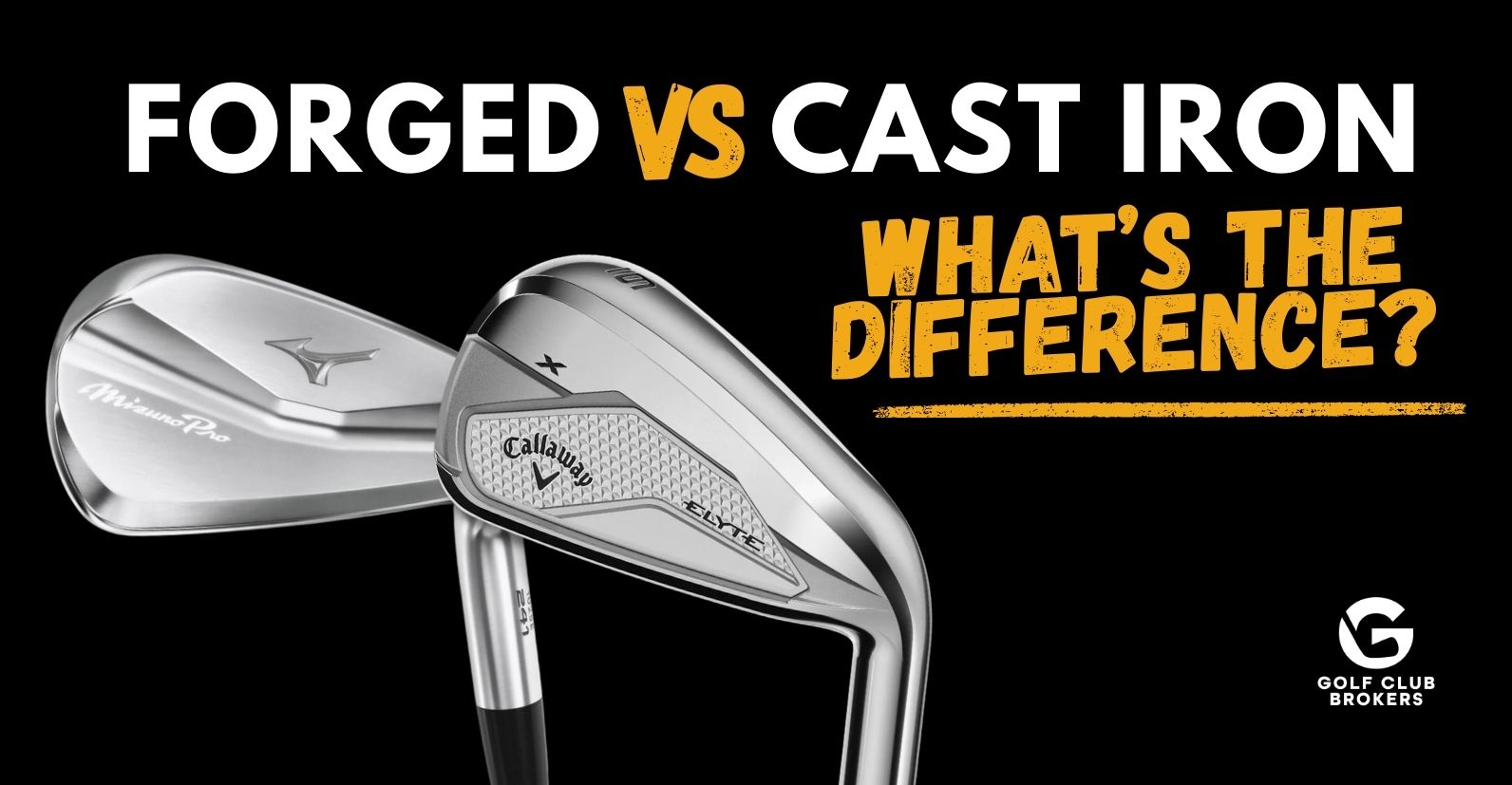
| 2026 Examples | Mizuno Pro 241, Titleist T100, Callaway Apex CB, TaylorMade P7MC, Ping Blueprint S | Callaway Elyte, TaylorMade Qi, Ping G440, Titleist T350, Cobra Air-X2 |
The Feel Question: Is Forged Really "Softer"?
This is the biggest claim in the forged-vs.-cast debate, and it's worth unpacking. Yes, forged irons generally feel softer at impact. The compressed, aligned grain structure of forged carbon steel transmits vibrations differently than cast stainless steel—you get a sensation that players describe as connected, responsive, or buttery. On a pure center-face strike, a well-made forged iron has a feel that's hard to replicate.
But here's the nuance: feel is partly about material, partly about design, and partly about perception. A forged iron with a hollow body and foam injection (like the TaylorMade P790) doesn't feel the same as a forged muscleback (like the Mizuno Pro 241). And a cast iron with vibration-damping technology (like the Ping G440's badge system) can feel remarkably smooth at impact.
The honest answer is that the best forged irons deliver a feel that cast irons haven't fully replicated—but the gap has narrowed significantly. If you're a golfer who's never hit a forged iron side-by-side with a cast iron, you might not notice the difference on a single shot. Over 18 holes, a sensitive player will feel it. A beginning player probably won't.
The Third Category: Multi-Material and Hybrid Construction
Here's where the modern iron market gets interesting—and where the forged-vs.-cast question gets less binary. A huge number of today's best-selling irons don't fall neatly into either camp. Instead, they combine both processes in a single clubhead:
- TaylorMade P790: Forged 4340M steel face welded to a forged hollow body, with SpeedFoam Air injected inside. The forging provides feel; the hollow construction provides distance and forgiveness you'd never get from a traditional forged blade.
- Callaway Apex Ai150 / Ai200 / Ai300: Forged body with a separate face plate, using AI to optimize face thickness patterns. The forging gives you the soft feel; the engineered face gives you ball speed across the face.
- Titleist T150 / T200: Forged body with a high-density tungsten weighting system. The forging process handles feel; the tungsten handles CG positioning and stability.
- Srixon ZXi 4 / ZXi 5: Forged body with face inserts designed for speed. Another example of combining forged feel with cast-style performance engineering.
- Ping i240: Investment cast 17-4 stainless steel, but with a precision forging technique (Ping's Pocket Forging) applied to the cavity in the long irons to save weight and reposition it. A cast iron that borrows from forging principles.
The point is this: the best modern irons from almost every major manufacturer use some combination of forged and cast elements. The "players distance" category—which is the fastest-growing segment in golf irons—is built almost entirely on multi-material, multi-process designs. If someone asks us whether they should play forged or cast, our first question is usually: "What category of iron are you looking at?" because within the players-distance segment, most options use both.
Loft and Lie Adjustability: A Practical Difference
Here's a practical distinction that doesn't get enough attention: forged irons are significantly easier to bend for loft and lie adjustments than cast irons.
The softer carbon steel used in forging—1025 and 8620 being the most common—bends smoothly and holds its new position without cracking or weakening the metal. A qualified club fitter can adjust a forged iron 2–4 degrees in loft or lie without any concern.
Cast stainless steel (17-4 in particular) is much harder and more brittle. It can be bent, but the range is narrower—typically 1–2 degrees maximum—and there's a higher risk of the metal cracking, especially on older clubs or heads that have already been adjusted. Some cast designs can't be safely bent at all.
This matters if you're buying used irons and plan to have them fitted to your specs. A used set of forged Mizuno Pro irons can be adjusted to your lie angle easily. A used set of cast Callaway Qi irons may not be adjustable at all, which means you'd need to find a set that already matches your measurements. We see this come up regularly with customers—it's worth knowing before you buy.
What We See on the Used Market
Here's what our experience with thousands of trade-ins and evaluations has taught us about forged and cast irons:
- Forged irons show wear differently. The softer carbon steel wears faster on the face—you'll see ball marks, minor face flattening, and groove wear sooner than on cast stainless steel. This is cosmetic in most cases and doesn't affect performance until the grooves are significantly worn. But it means a "used" forged iron often looks more worn than a cast iron with the same number of rounds played.
- Cast irons are more durable. The harder stainless steel resists scratching, face wear, and dings. A three-year-old cast iron often looks nearly new. This is one reason cast game-improvement irons are such strong values on the used market—they hold up cosmetically.
- Forged irons hold resale value better. Despite showing more wear, forged irons from premium brands (Mizuno, Titleist, Callaway Apex, TaylorMade P-series) command higher resale values relative to their original cost. The market values the construction quality and the brands that make them.
- Multi-material irons are the fastest-growing used segment. The P790 is one of the most-traded iron sets we see. Apex irons are right behind. The players-distance category is where the market is heading, and the used supply is growing quickly as golfers upgrade to each year's new release.
So Which Should You Play?
Here's our straightforward recommendation based on what we see every day:
- If you're a single-digit handicap who values feel and shot shaping: Forged. A Mizuno Pro 241, Titleist T100, Callaway Apex CB, TaylorMade P7MC, or Ping Blueprint S will give you the feedback and control you want. These are the irons where the forged advantage is most noticeable.
- If you're a mid-handicapper (8–18) who wants the best of both worlds: Multi-material/hybrid. The TaylorMade P790, Callaway Apex Ai150, Titleist T150, Srixon ZXi 5, or Ping i240 give you forged feel with significantly more forgiveness and distance than a pure forged blade. This is the sweet spot for most golfers who care about feel but also need some help.
- If you're a high handicapper or beginner: Cast. The Callaway Elyte, TaylorMade Qi, Ping G440, Titleist T350, or Cobra Air-X2 are designed to maximize forgiveness, launch, and distance. The design advantages that casting enables—wide soles, deep cavities, extreme perimeter weighting—are exactly what your game needs right now. Don't worry about "forged feel" until your ball striking is consistent enough to appreciate it.
- If you're buying used on a budget: Cast irons are the best value. They're more durable, show less wear, and the previous-generation game-improvement irons from major brands are outstanding performers at significant discounts. A one-year-old set of Callaway Elyte or Ping G440 irons will serve you beautifully for years.
The Bottom Line
The forged-vs.-cast question used to be simple: forged for good players, cast for everyone else. That's no longer true. The modern iron market is dominated by multi-material designs that borrow from both processes, and the players-distance category—where most mid-handicappers should be shopping—lives entirely in that hybrid space.
What hasn't changed is this: forged irons still deliver a feel that cast irons can't fully match, and cast irons still offer forgiveness that forged irons can't match without significant design compromises. Neither process is inherently better—they're tools for different jobs.
If you're not sure where you fall, come talk to us. We can help you find the right iron for your game, whether it's a forged blade, a cast game-improvement model, or something in between. And if you're looking to move your current set to make room for an upgrade, we're always buying.
Frequently Asked Questions
Are forged irons better than cast irons?
Neither is inherently better—they're designed for different purposes. Forged irons offer superior feel and shot-shaping control for skilled players. Cast irons provide more forgiveness, distance, and design flexibility for mid-to-high handicappers. Many modern irons combine both processes.
Can beginners play forged irons?
Technically yes, but it's usually not the best choice. Forged irons tend to be less forgiving and smaller, which makes consistent contact harder. Beginners benefit more from the forgiveness and larger sweet spots of cast or game-improvement irons.
Do forged irons really feel softer?
Generally, yes. The compressed grain structure of forged carbon steel transmits vibrations differently than cast stainless steel, creating what most golfers perceive as a softer, more connected feel at impact. The difference is most noticeable on center-face strikes.
Can cast irons be bent for loft and lie?
Some cast irons can be bent 1–2 degrees, but the harder stainless steel makes them more difficult and riskier to adjust than forged irons, which can typically be bent 2–4 degrees without issue. Always consult a qualified fitter before bending cast irons.
What is a "players distance" iron?
A players distance iron combines a compact, tour-inspired look with hidden technology (hollow bodies, foam fill, AI-designed faces) to deliver more forgiveness and distance than traditional forged irons. Examples include the TaylorMade P790, Callaway Apex Ai150, and Titleist T150. Most use a combination of forged and cast elements.
Do forged irons wear out faster?
Forged irons show cosmetic wear sooner because softer carbon steel scratches and marks more easily than hard stainless steel. However, performance typically isn't affected until grooves are significantly worn, which takes hundreds of rounds of regular play.