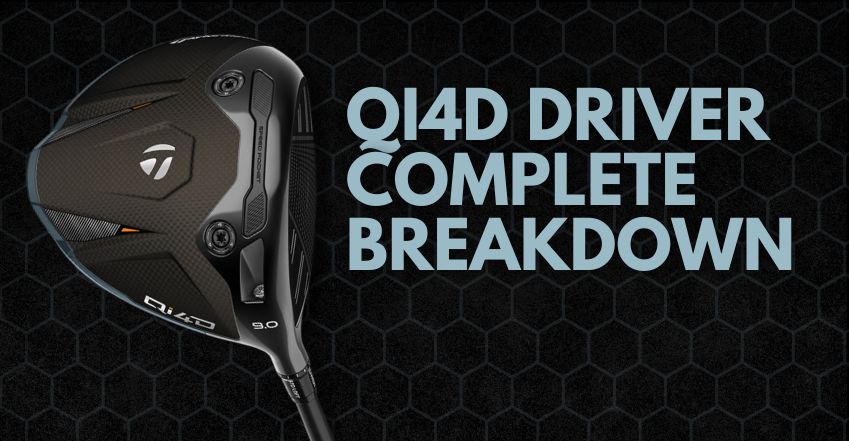
TaylorMade Qi4D Driver: Complete Breakdown (2026)
The Qi4D had a lot riding on it. TaylorMade’s 2025 Qi35 was a good driver that got dinged by inconsistency concerns — face-to-face manufacturing variance that made tour adoption slower than expected and left some buyers wondering if the driver they received matched the one they were fitted for. The Qi4D needed to fix that while also moving the performance needle forward.
Based on what we’ve seen so far at Golf Club Brokers — and what the early data shows — they’ve done both. Scottie Scheffler, Rory McIlroy, and Tommy Fleetwood all put the Qi4D in play before it officially launched. McIlroy called it the fastest driver switch he’s ever made, reportedly deciding after just three swings.
Let’s break down every model, every technology, and who each one is actually for.
The TaylorMade Qi4D is the third generation of TaylorMade’s Qi platform. Four models: Qi4D (core) with quad weighting and tour-influenced shape; Qi4D LS for low-spin, fast-swing players; Qi4D Max with first-ever adjustable weights in a Max head (7075 aluminum); Qi4D Max Lite for moderate swing speeds. All share the 5th-gen 60x Carbon Twist Face with improved roll radius (50% less spin variation top-to-bottom) and a 4° loft sleeve. The REAX shaft system — matching golfers by rotation rate instead of just swing speed — is the biggest fitting innovation in the lineup.
Qi4D Model Comparison: All Four Heads at a Glance
| Spec | Qi4D (Core) | Qi4D LS | Qi4D Max | Qi4D Max Lite |
|---|---|---|---|---|
| Target Player | Mid-low HCP, tour | Low HCP, 105+ mph | Mid-high HCP | Moderate speed |
| Weight System | Quad TAS (2x9g, 2x4g) | 2 TAS weights (F/B) | 2 TAS weights (13g/4g) | 1 TAS weight (4g) |
| Face | 60x Carbon Twist Face | 60x Carbon Twist Face | 60x Carbon Twist Face | 60x Carbon Twist Face |
| Head Material | Titanium + carbon | Titanium + carbon | 7075 aluminum + carbon | 7075 aluminum + carbon |
| Loft Sleeve | 4° adjustable | 4° adjustable | 4° adjustable | 4° adjustable |
| Available Lofts | 8°, 9°, 10.5°, 12° | 8°, 9°, 10.5° | 9°, 10.5°, 12° | 9°, 10.5°, 12°, HL |
| Spin Profile | Mid | Low | Mid-high | Mid-high |
| Profile | More compact than Qi35 | Most compact | Largest footprint | Same as Max, lighter |
| LME Option | Yes | Yes | Yes | No |
The 60x Carbon Twist Face: What’s New for 2026
TaylorMade has built their driver identity around carbon faces since the original Stealth in 2022. The Qi4D uses the fifth generation of this technology — 60 layers of carbon fiber fused together to create a face that’s lighter than titanium and engineered to maximize the USGA’s speed limit.
What’s actually new this year? Two things that matter.
Improved roll radius. The curvature of the face from top to bottom has been redesigned. On previous models, shots struck high on the face tended to produce lower spin than intended, and low-face shots produced higher spin. The Qi4D’s new roll radius tightens that variation by up to 50%. That’s a meaningful improvement in distance consistency on vertical mishits — the kind of miss most golfers make without realizing it.
New machine finishing process. This directly addresses the Qi35’s biggest criticism. TaylorMade introduced a machine finishing step that guarantees face-to-face consistency across production. No more hand-grinding variation. The face you’re fitted for should perform identically to the face you receive. That’s a big deal.
The Twist Face geometry itself remains: less loft in the heel, more loft in the toe. This corrects the gear effect on off-center horizontal strikes, keeping heel hits from hooking low and toe hits from slicing high. It’s been proven tech since 2018 and it stays.
Quad Weighting Returns: Why the Core Model Is the One to Watch
The Qi4D core head brings back quad weighting for the first time since the R7 era. Four movable weights — two 9g and two 4g — positioned in the sole give fitters (and golfers) enormous adjustability. You can configure for neutral, draw, fade, low spin, high spin, or maximum stability.
This is a shift from TaylorMade’s recent approach where the core model had less adjustability than the LS. Now the core is the most adjustable head in the lineup. That’s a deliberate move to make the core model the right fit for the widest range of golfers, not just a stepping stone to the LS or Max.
The Qi4D Max is also making history as TaylorMade’s first Max driver with adjustable weights. The inclusion of two TAS weights (13g and 4g) means high-handicappers who need maximum forgiveness no longer have to sacrifice adjustability. Previously, ultra-high-MOI Max drivers used fixed weighting because adding movable weights risked pushing MOI above legal limits. The Qi4D Max found the balance.
REAX Shafts: The Real Story of the Qi4D Launch
Here’s the part most reviews bury but that might matter more than the head. TaylorMade built an entirely new shaft fitting system around rotation rate.
Over 20 years, TaylorMade analyzed more than 11 million driver shots. They found that how fast a golfer rotates the clubface through impact — their “closure rate” — varies dramatically and doesn’t always correlate with swing speed. Two golfers who both swing at 95 mph can have completely different rotation profiles, and they need different shaft characteristics to deliver the face square.
The REAX system categorizes golfers into three groups:
- High Rotation (“Active”) — ~20% of golfers. The body releases faster than the club. REAX HR (Red) shafts have a softer tip to moderate rotation.
- Mid Rotation (“Balanced”) — ~60% of golfers. Body and club release in sync. REAX MR (Blue) shafts are the versatile middle ground.
- Low Rotation (“Hold”) — ~20% of golfers. The club releases faster than the body (like Collin Morikawa). REAX LR (White) shafts have a stiffer tip to prevent over-closing.
A fitter — or even a golfer with a face-on swing video — can identify rotation rate relatively quickly, making the fitting process more efficient. TaylorMade partnered with Mitsubishi Chemical to produce the REAX shafts, which are available across multiple weight and flex options.
That said, aftermarket shafts from Fujikura, Project X, and others are still fully compatible. Several reviewers and even some Tour players ended up in aftermarket shafts after testing REAX. The system is a strong stock option, not a mandate.
Model-by-Model: Who Each Qi4D Is Built For
Qi4D (Core)
The flagship. More compact than the Qi35 core — closer to the Qi10’s shape. Four-weight adjustability. Tour-influenced profile that better players will feel good looking down at. This is the head Scheffler and McIlroy play.
Best for: 0–15 handicap golfers who want maximum adjustability and a balanced performance between speed and forgiveness. The most versatile head in the lineup.
Qi4D LS (Low Spin)
The speed demon. Most compact head, two weights positioned forward for low spin and penetrating flight. This is for golfers with swing speeds north of 105 mph who generate too much spin with a standard head. If you don’t fight spin issues, you don’t need the LS — you’ll just hit it lower than necessary.
Best for: Low-handicap, high-speed players who need to keep spin under control. Not for most amateurs.
Qi4D Max
Maximum forgiveness. The first TaylorMade Max driver built from forged 7075 aluminum instead of titanium — lighter material that allows higher MOI without exceeding size limits. MOI is approximately 9,700, slightly lower than the Qi35 Max’s 10,000, but the trade-off is better aerodynamics and the addition of two adjustable weights.
Best for: 12–25+ handicap golfers who prioritize forgiveness and straight ball flight above all else. Also strong for mid-handicappers with inconsistent tee shots.
Qi4D Max Lite
Same design philosophy as the Max but with ultralight components throughout — lighter head, lighter shaft (Mitsubishi REAX 40 at 42–44g), lighter grip. Designed for golfers with moderate swing speeds (under 90 mph) who need every bit of help generating clubhead speed.
Best for: Seniors, slower-swinging golfers, and anyone who struggles to generate speed with standard-weight equipment.
Qi4D vs. Qi35: What Actually Changed?
- Face consistency: Machine finishing process eliminates the face-to-face variance that plagued the Qi35
- Roll radius: 50% tighter spin variation on vertical mishits
- Quad weighting: Core model now has 4 adjustable weights (Qi35 had 2)
- Max adjustability: First Max head with movable weights
- Aerodynamics: CFD-optimized head shapes deliver 1–2 mph more clubhead speed
- Aesthetics: Darker, sleeker finish replaces the Qi35’s lighter colorway
- Sound: Updated for a more traditional pitch — louder but more pleasing than Qi35
- REAX shafts: Entirely new stock shaft system based on rotation rate
What didn’t change? The 60x Carbon Twist Face concept, the loft sleeve, and the overall Qi platform philosophy of maximizing inertia. The Qi4D is an evolution, not a revolution — but the specific improvements (face consistency, adjustability, shaft fitting) directly address the Qi35’s weaknesses.
What This Means for Buying Used on the Qi Platform
The Qi4D’s launch means Qi35 and Qi10 drivers are entering the used market in volume. Golfers upgrading to the Qi4D are trading in their previous drivers, and that’s creating excellent buying opportunities.
The Qi10 remains a superb driver. It doesn’t have the Qi4D’s quad weighting or improved roll radius, but the 60x Carbon Twist Face platform is the same foundation. For golfers who aren’t chasing the absolute latest technology, a used Qi10 at a steep discount is a smart play.
The Qi35 is trickier. The face consistency concerns mean you should ideally try before you buy — or buy from a dealer who tests and authenticates every club. If you get a good Qi35, it’s a fantastic driver. The variance issue was real but not universal.
Frequently Asked Questions
Is the Qi4D worth upgrading from the Qi35?
If face consistency bothered you with the Qi35, the Qi4D directly solves that problem. The quad weighting on the core model also adds adjustability the Qi35 didn’t have. If your Qi35 performs well and you’re happy with it, the upgrade is incremental. If you’re due for a new driver and deciding between the two, the Qi4D is the better bet.
What does “Qi4D” stand for?
TaylorMade says the name references their four-dimensional approach to driver design: face, head, shaft, and the fitting process. The “Qi” continues from “Quest for Inertia,” their ongoing pursuit of maximum forgiveness through MOI optimization.
Do I need the REAX shafts or can I use aftermarket?
The REAX system is a strong stock option, but aftermarket shafts from Fujikura, Project X, Mitsubishi, and others are fully compatible via TaylorMade’s standard loft sleeve. Several Tour players and reviewers ended up preferring aftermarket options. Get fit and play whatever shaft delivers the best numbers.
Which Qi4D model should a 15-handicapper play?
Most 15-handicappers will perform best in the Qi4D Max. It offers the highest forgiveness in the lineup and now includes adjustable weights for the first time. If your swing speed is under 90 mph, consider the Max Lite. The core Qi4D is an option if you’re trending toward single digits and want more adjustability.
Is the 7075 aluminum in the Max as durable as titanium?
7075 aluminum is aircraft-grade material and extremely durable for golf application. It’s lighter than titanium, which is the whole point — the weight savings allow higher MOI. Durability should not be a concern for normal use.
Can I still buy the Qi4D without getting fit?
You can, but TaylorMade designed the Qi4D around fitting more than any previous driver. The REAX shaft system, quad weighting, and loft sleeve all work best when matched to your swing. Buying off the rack in a standard configuration will still perform well, but you’re leaving potential on the table.
Shop Used TaylorMade Drivers at Golf Club Brokers
We carry TaylorMade drivers across the entire Qi platform — Qi4D, Qi35, and Qi10 — in every loft and shaft configuration. Every driver is inspected, authenticated, and its adjustable hosel verified.
Get a Free Quote