Titleist T-Series Irons Explained: T100 vs T150 vs T250 vs T350 (2026)
Titleist’s T-Series is the most played iron family on the PGA Tour. It has been for nearly a decade. But the lineup now includes five models — and picking the right one isn’t straightforward unless you understand what each iron is actually designed to do.
We see every model come through Golf Club Brokers. T100s with worn grooves from three years of tournament play. Barely-hit T350s from golfers who bought forgiveness they didn’t end up needing. The pattern we see over and over? Golfers picking the model they want to play instead of the model that actually fits their game.
This guide breaks down every T-Series model — the 2025 generation that’s current as of 2026 — so you can make a decision based on specs and performance, not ego.
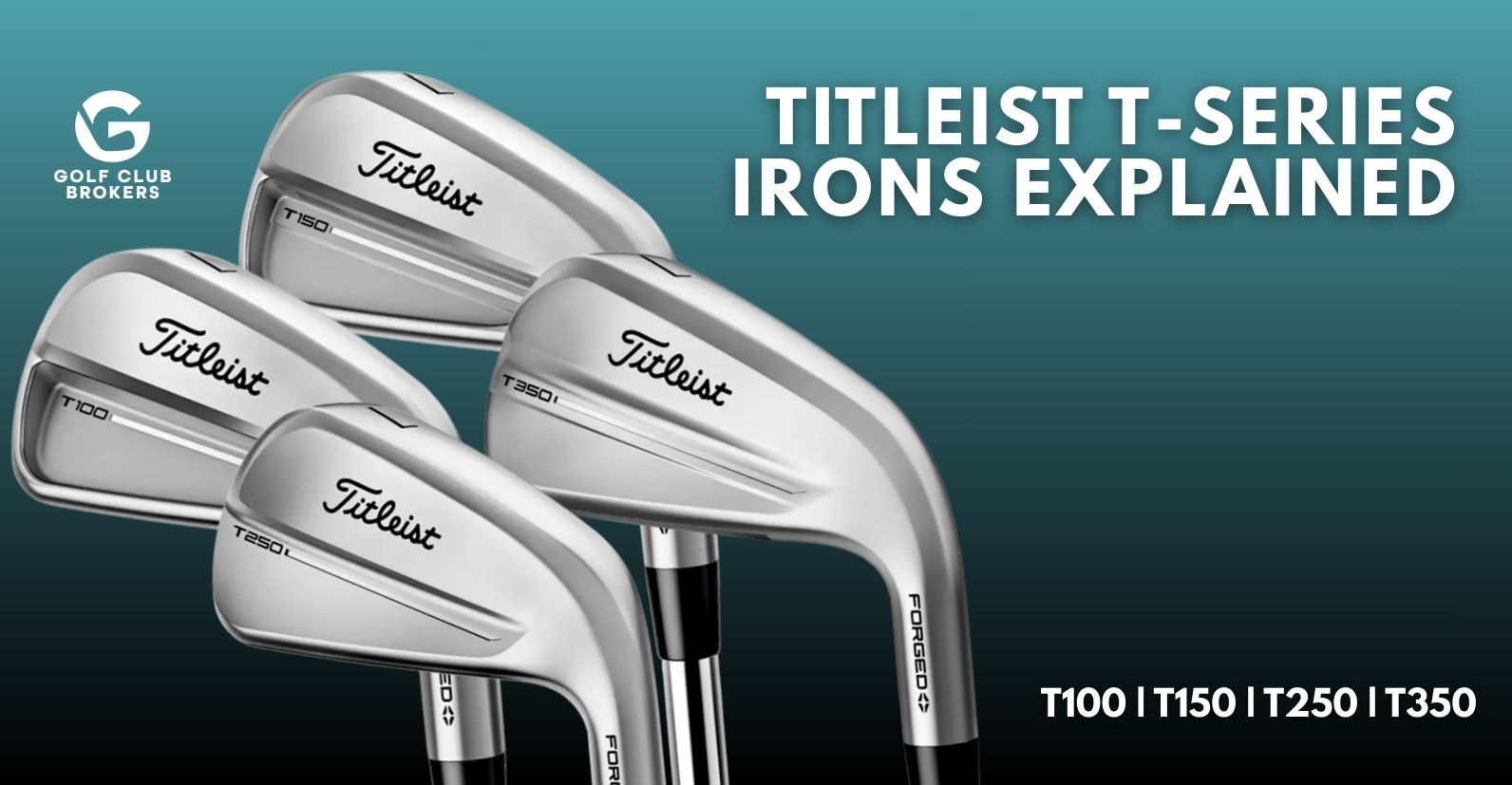
The Titleist T100 is the Tour iron — forged, compact, maximum control (handicap 0–5). The T150 adds a touch more size and speed for competitive players who want T100 feel with slightly more help (handicap 2–8). The T250 (replacing the T200) is the players’ distance iron — hollow-body, stronger lofts, impressive ball speed in a clean-looking package (handicap 5–18). The T350 (replacing the T300) is maximum forgiveness with a wider sole and bigger head (handicap 12–25+). All four share D18 tungsten weighting and blend seamlessly for combo sets.
T-Series at a Glance: Quick Comparison (2025/2026)
| Spec | T100 | T150 | T250 | T350 |
|---|---|---|---|---|
| Construction | Forged, dual cavity | Forged, muscle channel | Hollow-body, forged L-Face | Hollow-body, forged dual-taper face |
| 7-Iron Loft | 33° | 32° | 30.5° | 29° |
| Head Profile | Compact, thin topline, minimal offset | Slightly larger than T100 | Mid-size, clean all-steel look | Largest head, widest sole, most offset |
| Tungsten | D18 heel/toe | D18 split weighting | D18 heel/toe | D18 heel/toe |
| Face Tech | CNC milled, variable thickness | Variable thickness + muscle channel | Max Impact 2.0, forged L-Face | Max Impact, forged dual-taper face |
| Forgiveness | Low-moderate | Moderate | Moderate-high | High |
| Workability | Very high | High | Moderate | Low-moderate |
| Target Handicap | 0–5 | 2–8 | 5–18 | 12–25+ |
| Progressive Grooves | Yes (2025) | Yes (2025) | Yes (2025) | Yes (2025) |
T100: The Tour Iron
The T100 is Titleist’s flagship iron and the most played model on the PGA Tour. Period. It’s been the number-one iron on Tour since 2019, and the 2025 version refines what was already best-in-class.
This is a forged, dual-cavity iron. CNC-milled face. Variable face thickness for speed. D18 tungsten in the heel and toe for stability without bulk. The head is compact — thin topline, minimal offset, narrow sole. At address it looks like the kind of iron that demands good contact. Because it does.
The 2025 update brought progressive groove design that significantly improves spin consistency from the rough. In testing, spin retention from wet rough improved by over 1,000 RPM compared to the previous generation. That’s a meaningful change for competitive golfers who play from unpredictable lies.
The 7-iron loft is 33° — traditional by today’s standards, which means distance control and stopping power are excellent. You’re not going to hit this iron as far as a T250 or a P790. That’s the point.
Best for: Scratch to 5-handicap golfers who prioritize precision, shot-shaping, and feedback over distance. Tour players, elite amateurs, and low-handicappers who strike it well enough to be rewarded by a compact head.
T150: The Competitive Player’s Sweet Spot
The T150 sits between the T100 and the T250. Think of it as the T100 with a small insurance policy. The head is slightly larger, the topline is a touch thicker, and the lofts are one degree stronger (32° at the 7-iron vs. 33°). It’s still forged. Still feels like a player’s iron. Just a bit more room for error.
What makes the T150 special is the muscle channel behind the face in the mid-to-long irons. That channel adds speed and launch where you need it most — on 4- and 5-irons where even good players sometimes struggle to get the ball up. The short irons remain compact and precise.
On Tour, the T150 has become a popular blending option. Players like Aldrich Potgieter and Byeong-Hun An use T150s in the long irons (4–5) and switch to T100s from 6-iron down. That combo gets the best of both worlds: launch help where it matters, precision where you need it.
Best for: Handicaps roughly 2–8. Competitive golfers who want Tour-level feel with slightly more help in the long irons. Also the ideal blending partner with T100s in combo sets.
T250: The Players’ Distance Iron (New for 2025)
This is the big one for most golfers reading this. The T250 replaced the T200 in the 2025 lineup and it’s a significant upgrade.
The T200 was already one of the best players’ distance irons on the market. The T250 takes everything that worked and wraps it in a new all-steel construction that looks dramatically better than the old plastic-badged T200 back. It now visually blends with the T100 and T150, which matters for golfers who care about aesthetics but need forgiveness.
Inside, the T250 uses a hollow-body platform with a forged L-Face insert and Max Impact 2.0 technology. The L-Face wraps into the sole for more flex at impact, generating higher ball speeds. D18 tungsten in the heel and toe provides the stability that keeps mishits playable. The 7-iron loft is 30.5° — strong enough for impressive distance but not so juiced that gapping becomes a problem.
Justin Thomas added T250 long irons to his bag immediately. Wyndham Clark did the same. When Tour players who can hit anything choose a players’ distance iron for their 3- and 4-irons, that tells you something about the performance.
Best for: Handicaps roughly 5–18. Golfers who want distance and forgiveness in a clean, player-preferred look. The widest-appeal iron in the lineup. Also excellent as a long-iron option blended with T150 or T100 short irons.
T350: Maximum Forgiveness, Minimum Compromise
The T350 replaced the T300 and the transformation is dramatic. Where the T300 was a traditional cavity-back game-improvement iron, the T350 is a hollow-body design with a forged dual-taper face. It’s still the most forgiving iron in the T-Series — widest sole, most offset, biggest head — but it no longer looks like a beginner’s club.
That aesthetic upgrade matters. A lot of mid-handicappers avoided the T300 because it looked too “game improvement.” The T350’s all-steel construction and cleaner back profile put it much closer to the T250 visually. You could blend T350 long irons with T250 mid irons and nobody would notice the switch.
Performance-wise, the T350 is designed around launch and forgiveness. The wider sole and lower CG make it almost effortless to get the ball airborne, especially with long irons. Max Impact technology maintains ball speed across the face, so thin shots and toe shots still get reasonable distance.
The 7-iron loft is 29°. That’s strong. You will hit this iron farther than a T100 7-iron by a meaningful margin — but it’s geometry and construction doing the work, not magic.
Best for: Handicaps roughly 12–25+. Golfers who want maximum forgiveness and easy launch without looking like they’re playing beginner equipment. Also an excellent option for seniors or golfers with moderate swing speeds who need help getting long irons airborne.
What About the T250 Launch Spec?
The 2025 lineup also includes the T250 Launch Spec — a variant of the T250 with weaker lofts (35° at the 7-iron) designed for golfers with moderate swing speeds who need more height and stopping power. Think of it as the T250’s distance with the T100’s trajectory. It’s a niche model, but for the right golfer — typically a senior or someone with swing speeds under 80 mph — it fills a real gap.
The Combo Set: Why Titleist Designed These to Blend
Titleist deliberately engineered the 2025 T-Series with consistent aesthetics across the lineup. The all-steel construction on the T250 and T350 means they no longer look like different product families. Every model shares the same finish, branding placement, and design language.
This matters because combo sets are how a lot of the best players — amateur and professional — actually build their bags. Common combinations we see:
- T100 (7-PW) + T150 (5-6) + T250 (4) — the Tour blend
- T150 (6-PW) + T250 (4-5) — the competitive mid-handicapper
- T250 (6-PW) + T350 (4-5) — the golfer who wants help up top but precision down low
A fitting will tell you exactly where the transition should happen in your set. Don’t guess — the loft gaps between models need to be managed.
On the Used Market: What We See at Golf Club Brokers
Titleist T-Series irons hold value exceptionally well. The brand commands premium resale across the board, and the T-Series specifically benefits from Tour credibility and a reputation for longevity.
The previous-generation T200 is the current sweet spot on the used market. It’s the same players’ distance category as the new T250, plays beautifully, and can be found at a meaningful discount now that the T250 has taken its spot. Same logic applies to the previous T100 and T150 — both are outstanding used purchases.
What to watch for when buying used T-Series irons: groove wear (especially on heavily played T100s), shaft condition, and grip wear. Titleist irons tend to come in with more rounds on them than most brands because owners play them hard.
Frequently Asked Questions
What’s the difference between the T200 and the T250?
The T250 replaced the T200 in 2025. It’s a complete redesign with all-steel construction (no plastic badge), a forged L-Face insert, and Max Impact 2.0. The T250 is slightly larger, better looking, and performs at least as well. The T200 remains an excellent used purchase.
Can a 10-handicap play the T100?
Technically yes, but most 10-handicaps would score better with T150 or T250 irons. The T100’s compact head and weaker lofts reward centered strikes and punish mishits more than the other models. A fitting will tell you definitively.
Is the T350 just for beginners?
Not at all. The T350 is designed for golfers who prioritize forgiveness and launch. That includes mid-handicappers, seniors, and anyone who doesn’t consistently strike the center of the face. Its improved aesthetics in 2025 make it visually appropriate for any golfer.
How does Titleist’s T-Series compare to the TaylorMade P-Series?
The T100 competes with the P770 — both are compact, forged players’ irons. The T250 competes with the P790 — both are hollow-body players’ distance irons with strong lofts. The T350 competes with TaylorMade’s Qi irons. Both families are excellent; the choice often comes down to feel preference and fitting results.
Should I buy the 2025 T-Series or save money on the previous generation?
The 2025 generation brought meaningful improvements: progressive grooves for spin consistency from rough, the T250 redesign, and the T350’s hollow-body transformation. That said, the previous T100, T150, and T200 remain outstanding irons. If budget matters, the prior generation offers tremendous value on the used market.
What shafts come stock in the T-Series?
Steel options include True Temper AMT Black and the new Nippon N.S. 750GH NEO. Graphite options include the Mitsubishi MMT AMC Red. Titleist offers extensive custom shaft options through fitting. The stock shafts are well-chosen for each model’s target player.
Shop Used Titleist T-Series Irons
We carry every T-Series generation across all models and shaft configurations. Every set is inspected, authenticated, and graded. Titleist irons are some of the most requested clubs in our inventory — if you see the set you want, don’t wait.
Find Your Titleist T-Series Irons
Every set inspected, authenticated, and graded. T100 through T350, every generation in stock.