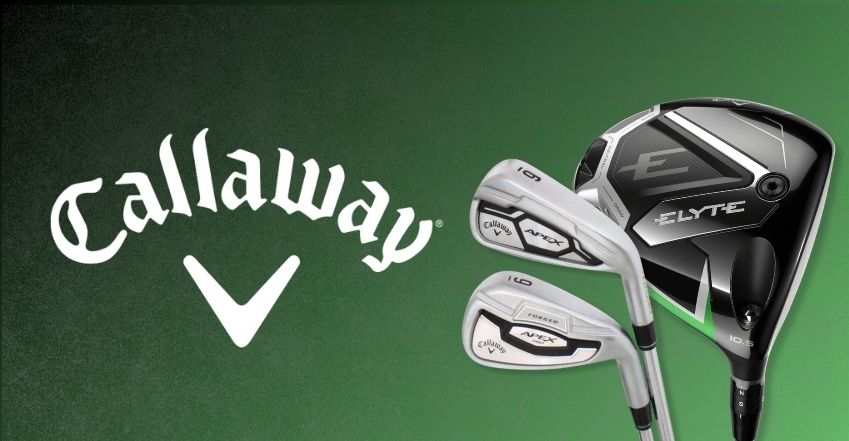
Callaway: Innovation Through the Ages
Callaway is the world's largest manufacturer of golf clubs, and they earned that position the same way they started: by making forgiveness the priority. From the first Big Bertha driver in 1991 to the AI-designed faces in the 2026 Quantum, Callaway has consistently bet that helping average golfers hit better shots is a bigger business than chasing the last 1 percent of tour-player performance.
We process a massive volume of Callaway equipment at Golf Club Brokers—drivers, irons, fairway woods, and especially Odyssey putters. The brand's reach is enormous: whether you're a 30-handicap who just started or a major championship winner, there's a Callaway club designed for your game. That breadth is part of what makes them the market leader.
In this guide, we'll walk through Callaway's history, explain the technology that defines their equipment, break down the entire current lineup from drivers to putters, and help you figure out which Callaway clubs make the most sense for you—whether you're buying new or shopping the used market.
From a Cadillac Trunk to the World's Biggest Golf Brand
Callaway's origin story is unlike anything else in golf. The company wasn't founded by a club designer or a touring professional—it was founded by a 63-year-old retired textile executive and winemaker who happened to love golf.
Ely Callaway Jr. had already run Burlington Industries (then the world's largest textile company) and built a successful California winery when he invested in a small club maker called Hickory Sticks USA in 1982. The company made clubs with hickory shafts and steel cores—a niche product. By 1983, Callaway had taken full control, moved the company to Carlsbad, California, and renamed it Callaway Golf. Legend has it he sold clubs out of the trunk of his Cadillac in those early days.
Callaway's first real innovation came in 1988 with the S2H2 (Short Straight Hollow Hosel) technology—a design that eliminated the traditional hosel neck and extended the shaft through the clubhead. It redistributed weight to the perimeter of the face, increasing forgiveness. Sales shot from $5 million to over $50 million in three years. But the real earthquake was still coming.
Big Bertha Changes Everything (1991)
In 1991, Callaway launched the Big Bertha driver—a 190cc stainless steel clubhead named after the massive German World War I howitzer. At the time, most golfers were still using wooden or small metal drivers. The Big Bertha was radically oversized by the standards of the day, and it used Callaway's S2H2 technology to put more weight around the perimeter of the face, creating a dramatically larger sweet spot.
The result was the most forgiving driver anyone had ever swung. Tour pros adopted it quickly, amateur golfers followed, and within two years Callaway had surpassed Wilson, Spalding, and MacGregor to become the revenue leader in golf equipment. By 1996, Callaway was the largest golf company in the world, with global sales of $683 million. Persimmon drivers were essentially extinct, and Big Bertha had killed them.
That success established the DNA that still defines Callaway: make the game easier for everyone, and do it by taking bigger risks on materials and engineering than anyone else is willing to take.
The Technology That Built Callaway
Here are the innovations that matter—the ones that actually changed how Callaway clubs perform and how the rest of the industry responded:
- 1988: S2H2 (Short Straight Hollow Hosel)—the first Callaway innovation. Redistributes weight from the hosel to the perimeter. Sales explode from $5 million to $54 million in three years.
- 1991: Big Bertha driver launches at 190cc—massive for its era. Stainless steel construction with perimeter weighting creates an unprecedented sweet spot. Callaway becomes the dominant force in golf equipment.
- 1995: Great Big Bertha introduces titanium to driver construction. The lighter, stronger material allows even larger heads (eventually reaching 290cc by 1997), setting the template that the entire industry follows for the next two decades.
- 1997: Odyssey Sports acquired—bringing the White Hot putter insert technology into Callaway's portfolio. The Odyssey White Hot line (launched 2000) becomes one of the most popular putter franchises ever made.
- 1998: Steelhead X-14 irons launch. The rounded profile and improved off-center performance make them a massive hit with mid-handicappers. Callaway claims roughly 70 percent of tour pros worldwide use their clubs.
- 2001: Ely Callaway passes away at 82. His legacy: a company that went from a garage startup to the world's largest golf manufacturer in under 20 years. The same year, Callaway launches the C4 driver—an all-carbon composite head that was ahead of its time. It commercially underperformed, but the carbon concept would return in a big way 16 years later.
- 2013: Apex irons debut at the Deutsche Bank Championship (branding covered so tour pros could test blind). The forged player's distance iron becomes Callaway's flagship iron line—a position it still holds in 2026.
- 2015: Chrome Soft golf ball launches, kicking off the low-compression premium ball trend. Callaway's tagline: "the ball that changed the ball."
- 2017: Great Big Bertha Epic introduces Jailbreak technology—two titanium bars connecting the crown and sole behind the face, stiffening the body to concentrate more energy in the face at impact. It's Callaway's most successful driver of the decade and the foundation for everything that follows.
- 2019: Epic Flash debuts the first AI-designed driver face. A supercomputer ran 15,000 face iterations over four weeks (a process that would have taken 34 years on a laptop) to optimize ball speed in ways no human engineer could have designed. AI-designed faces become the backbone of every Callaway club going forward.
- 2023: Paradym introduces the 360-degree carbon chassis—44 percent lighter than a titanium equivalent—freeing 20 grams of discretionary weight. Jailbreak evolves into a wishbone design. Paradym becomes the number-one driver in global sales and tour wins for 2023.
- 2024: Paradym Ai Smoke replaces Jailbreak entirely with the Ai Smart Face—micro-deflection points across the face that act as mini sweet spots, correcting direction on mishits. Built from 50,000+ face iterations using real player swing data from 250,000+ shots.
- 2026: Quantum launches with the Tri-Force Face—the industry's first three-material face combining ultra-thin titanium, carbon fiber, and military-grade Poly Mesh. Xander Schauffele, Sam Burns, and Rose Zhang put it in play immediately.
There's a clear through-line in this timeline: Callaway consistently pushes into new materials and manufacturing processes—carbon bodies, AI-designed faces, multi-material faces—before anyone else. Some bets (the 2001 C4) were too early. Most (Big Bertha, Jailbreak, AI faces) changed the industry.
The Bigger Picture: Callaway Beyond Clubs
It's worth noting that Callaway is more than a club company. Through a series of acquisitions, the Callaway family now includes Odyssey (putters, acquired 1997), OGIO (bags, 2017), TravisMathew (apparel, 2017), and Jack Wolfskin (outdoor apparel, 2019). In 2021, Callaway acquired Topgolf for $2 billion, rebranding as Topgolf Callaway Brands—though by late 2024, the company announced plans to separate the two businesses again after the combination didn't deliver expected returns. For golfers, the important thing is that the club and ball R&D operation in Carlsbad has continued at full speed through all of this corporate reshuffling.
The Current Lineup: What Callaway Makes in 2026
Callaway's product range is one of the broadest in golf. Here's what's available and who each product serves.
Drivers: The Quantum Family
The Quantum is Callaway's 2026 flagship driver platform, replacing the Elyte (2025) and Paradym Ai Smoke (2024). The headline technology is the Tri-Force Face—a first-of-its-kind three-layer construction combining ultra-thin titanium on the striking surface, carbon fiber behind it, and Poly Mesh (a military-grade polymer) bonding them together. Each material does what it does best: titanium compresses, carbon flexes and recovers, and Poly Mesh keeps them working as a system.
The Quantum's titanium is 14 percent thinner and 17 percent more responsive than previous Callaway faces, because the carbon backing provides structural support titanium alone can't. AI-optimized face mapping then tailors speed, spin, and launch across the entire face based on real player impact patterns.
| Max | Max D | Max Fast | Triple Diamond | TD Max | |
|---|---|---|---|---|---|
| Best For | Mid HCP, core model | Slicers, draw bias | Slow swing speed | Low HCP, low spin | Low spin + forgiveness |
| Head Size | 460cc | 460cc | 460cc | 450cc | 460cc |
| Weight System | 1 movable + 1 fixed | Heel-weighted | Ultralight build | Neutral/fade APW | Low-spin APW |
| Spin Profile | Mid | Mid-high | Mid-high | Low | Mid-low |
| Tour Players | — | — | — | Schauffele | Burns, Zhang |
Five models is more than most brands offer, and there's a reason: Callaway builds purpose-specific heads rather than asking one head to do everything. The Max is the bread-and-butter model for the widest range of golfers. The Max D adds built-in draw bias for slicers (Callaway says 85 percent of golfers miss right). The Max Fast is the lightest option for slower swing speeds. The Triple Diamond is the tour head for better players who need low spin. And the Triple Diamond Max—which Today's Golfer named Best Overall Driver of 2026—bridges low spin and forgiveness in a way that's hard to find from other brands.
If you're not sure which model to choose, start with the Max. It's the most versatile option in the lineup and the one we'd recommend for the majority of golfers.
Fairway Woods & Hybrids
The Quantum fairway woods carry the same Tri-Force face technology as the drivers, with AI-optimized face mapping tailored for turf interaction. The 360-degree carbon chassis from the Paradym era continues, keeping weight low for easy launch. Callaway also offers the Apex UW (Utility Wood)—a category-bridging club that sits between a fairway wood and a hybrid, with a 41-gram tungsten Speed Wave weight positioned low and forward for high launch from tight lies. Xander Schauffele has been instrumental in developing this club.
On the used market, Callaway fairway woods from the Paradym and Ai Smoke generations are excellent values right now. The Paradym Ai Smoke fairway wood was one of the highest-performing models on tour in 2024, and you can find them at a significant discount to original cost.
Irons: The Broadest Lineup in Golf
Callaway's iron lineup covers every skill level and playing style. Here's how it breaks down:
- Apex MB: Pure muscleback blade for elite ball strikers. Minimal offset, maximum feedback, compact profile. If you don't consistently find the center of the face, these will punish you.
- Apex CB: Cavity back with a forged 1025 body. Slightly more forgiveness than the MB while maintaining the compact, clean look that better players demand. One of our favorite irons for single-digit handicappers.
- Apex TCB (Tour Cavity Back): Xander Schauffele's iron—the one he used to win the 2024 PGA Championship and The Open. A tour-only offering that Callaway released to retail in a limited run of 1,000 sets. Features a raw finish that develops a rust patina over time and a 17-4 stainless steel face tuned for spin consistency. If you can find a set used, they're exceptional.
- Apex Ai150: Callaway's newest player's distance iron. Compact enough to appeal to low-handicappers, with AI-enhanced distance technology hidden inside. Think of it as Callaway's answer to the TaylorMade P790: a "best of both worlds" iron that gives you a clean look with hidden forgiveness.
- Apex Ti Fusion: The premium option—titanium and carbon construction that delivers game-improvement forgiveness in a players' iron size. Outstanding dispersion numbers. The build quality and materials command a premium, but for golfers who want forgiveness without a chunky profile, it's hard to beat.
- Elyte / Elyte X: The game-improvement line. AI-enhanced design with a reshaped sole for clean turf interaction and extreme perimeter weighting for stability on mishits. The Elyte X adds a touch more workability for mid-handicappers who want help but don't want to give up all shot shaping ability.
- Quantum Max / Max OS / Max Fast: The 2026 super game-improvement irons. Modern 360 Undercut cavity with extreme perimeter weighting for maximum ball speed and launch. The Max OS (Oversized) is the most forgiving iron Callaway makes. The Max Fast is ultralight for slower swings.
For most golfers walking into our shop, the Apex Ai150 or the Elyte are where we'd start the conversation. The Ai150 is the choice if you want a compact look with hidden tech; the Elyte is the pick if you prioritize maximum help on every shot without worrying about aesthetics.
Wedges: Opus and Jaws
Callaway's wedge lineup has grown into a genuine strength. The Opus SP is the tour wedge—forged from 8620 carbon steel with a raw face that delivers serious spin. Schauffele uses an Opus SP 52-degree as his gap wedge. The Jaws Raw and Jaws Full Toe round out the lineup for golfers who want maximum versatility around the greens. The Full Toe design, with grooves extending across the entire face, is particularly popular for open-faced flop shots and bunker play.
One thing we notice on used Callaway wedges: the raw finishes oxidize (rust) over time, which is by design—it actually helps maintain spin. But some buyers see the rust and assume the club is in poor condition. If you're buying a used Jaws Raw or Opus, surface oxidation is normal and expected.
Putters: Odyssey
The Odyssey brand—acquired by Callaway in 1997—is arguably the most successful putter brand in golf. The White Hot insert, introduced in 2000, remains the gold standard for insert-style putters, and Odyssey has consistently led the PGA Tour in putter usage for over two decades.
The current lineup includes several distinct families. The Ai-One series features AI-designed face inserts with micro-deflection points that maintain ball speed on off-center strikes—the same concept as the driver faces, applied to putting. The newer Ai-Dual putters add dual-material inserts for even more consistent roll. The Tri-Hot 5K line features a high-MOI steel and aluminum construction for golfers who want maximum stability. And the Toulon Design series represents Odyssey's premium, milled putter line—including the Las Vegas model that Schauffele uses on tour.
Odyssey putters are among the most durable clubs we see. A three-year-old White Hot insert performs virtually identically to a new one, which makes used Odyssey putters outstanding values. If you're on a budget, a previous-generation Ai-One or Tri-Hot 5K is one of the best deals in the used putter market.
Golf Balls: Chrome Tour
Callaway's Chrome Tour (formerly Chrome Soft) is a four-piece urethane ball that competes directly with the Titleist Pro V1. The Chrome Tour offers a softer feel with excellent short-game spin, while the Chrome Tour X is firmer with a higher flight and more driver distance. Schauffele plays the Chrome Tour, and Rose Zhang uses the Chrome Tour X. Both balls benefit from Callaway's seamless cover construction for more consistent flight than traditional two-hemisphere balls.
Who Is Callaway For?
Callaway's lineup is broad enough to cover virtually every golfer, but here's where the brand truly shines:
- Beginners and high handicappers: This is Callaway's sweet spot. The Quantum Max driver, Elyte irons, and an Odyssey Ai-One putter give you maximum forgiveness across the entire bag. No brand does more to help golfers who aren't hitting the center of the face.
- Mid-handicappers who want distance: The Apex Ai150 irons and Quantum Max driver are the combination. You get a clean, compact look with AI-enhanced performance that produces surprising distance and consistency.
- Low handicappers and tour players: Apex CB or TCB irons, Quantum Triple Diamond or TD Max driver, Opus wedges, and a Toulon Design putter. Schauffele won two majors in 2024 with this type of setup.
- Slicers: The Quantum Max D driver is one of the strongest draw-bias drivers on the market, and Callaway has built specific AI face patterns for each model to address how different golfers actually miss. If you're fighting a slice, Callaway takes this problem more seriously than most brands.
- Golfers who want simplicity: Callaway's philosophy of purpose-built heads means you pick the model designed for your game and it's already optimized. Unlike brands that rely heavily on adjustable weights, most Callaway models are engineered to work right out of the box.
- Used club shoppers: Callaway's annual release cycle creates a constant flow of previous-generation clubs onto the used market. A Paradym Ai Smoke driver or a set of Apex irons from 2024 will perform beautifully for years—at a fraction of what they cost new.
Buying Used Callaway: What We See at Golf Club Brokers
We move a lot of Callaway equipment, and here's what we've learned from handling thousands of their clubs:
- Paradym Ai Smoke drivers are the best value right now. With the Quantum just hitting shelves, the previous generation is available at significant discounts. The Ai Smoke Triple Diamond in particular was one of the best low-spin drivers of the last two years and performs nearly identically to the current model for most golfers.
- Apex irons hold their value. The Apex name carries premium positioning in the used market, similar to TaylorMade's P790. Demand stays strong across generations because the irons are genuinely well-made and golfers trust the line.
- Odyssey putters are the best used putter buy in golf. Durable construction, inserts that maintain performance, and a steady supply on the used market. A two-year-old Ai-One is practically identical to a new one in performance.
- Chrome Soft/Chrome Tour balls don't last on our shelves. Callaway golf balls are consistently popular with our buyers—strong demand and good value versus buying new boxes.
- Counterfeits exist but are less common than TaylorMade fakes. That said, we still see counterfeit Callaway drivers and irons come through. The Paradym line was particularly targeted by counterfeiters. As always, buy from a dealer who authenticates—not from random marketplace sellers.
The Bottom Line
Ely Callaway's famous standard for new products was that they had to be "pleasingly different and demonstrably superior." Over 40 years later, that philosophy still drives everything the company does. From the oversized Big Bertha to the AI-designed Quantum, Callaway has repeatedly been willing to look different if it means performing better—and more often than not, the rest of the industry eventually follows.
If we had to recommend a single Callaway club to try, it would be the Apex Ai150 irons. They represent the best of what Callaway does: tour-inspired looks backed by AI-enhanced technology that makes the clubs perform beyond what their compact size suggests. For drivers, the Quantum Max is the safest recommendation for the widest range of golfers, while the Triple Diamond Max is the sleeper pick—a driver that won Best Overall honors from Today's Golfer for its rare combination of low spin and forgiveness.
And don't sleep on Odyssey putters. They're one of the best values in golf, new or used. We always have a strong selection in stock, and they're consistently one of the first things our customers ask about.
Whether you're looking to buy Callaway equipment, sell what's already in your bag, or just want advice on which model fits your game—we're here to help.
Frequently Asked Questions
Is Callaway a good golf brand?
Callaway is the world's largest golf club manufacturer, known for industry-leading forgiveness, AI-designed faces, and a lineup that covers every skill level. They make clubs for beginners through tour professionals, and their Odyssey putter brand is the most-used on the PGA Tour.
What is the best Callaway iron for a mid-handicapper?
The Callaway Apex Ai150 is the top choice for mid-handicappers. It offers a compact, clean look with AI-enhanced distance and forgiveness hidden inside—similar to how TaylorMade's P790 bridges the gap between players and game-improvement irons.
What is the Tri-Force Face on the Callaway Quantum?
The Tri-Force Face is a three-layer construction combining ultra-thin titanium on the striking surface, carbon fiber behind it, and a military-grade polymer (Poly Mesh) binding them together. It's the first time these three materials have been used together in a driver face.
Are used Callaway drivers worth buying?
Absolutely. The Paradym Ai Smoke drivers from 2024 are outstanding values on the used market right now, and the Ai Smart Face technology delivers performance very close to the current Quantum for most golfers.
What driver does Xander Schauffele use?
As of early 2026, Xander Schauffele is gaming the Callaway Quantum Triple Diamond driver with the new Tri-Force Face technology.
Does Callaway own Odyssey?
Yes. Callaway acquired Odyssey Sports in 1997. Odyssey putters are designed and manufactured under the Callaway umbrella, and the brand consistently leads the PGA Tour in putter usage.