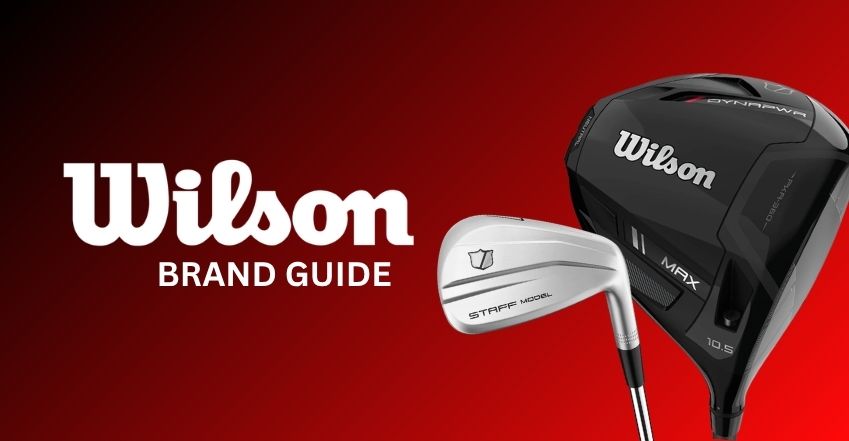
Wilson Golf Brand Spotlight: 110 Years, 62 Majors, and One of the Best Used-Market Plays in the Game
Quick test. Name the club brand with the most major championship wins in golf history. Most people guess Titleist. A few say TaylorMade. Real history nerds might say Spalding.
The answer is Wilson. By a wide margin.
Wilson clubs have been used to win 62+ major championships — more than any other brand on earth. Gene Sarazen, Sam Snead, Arnold Palmer, Walter Hagen, Patty Berg, Ben Crenshaw, Payne Stewart, Nick Faldo, John Daly, Vijay Singh, Hale Irwin — all gamed Wilsons during their best years. The "Shot Heard Round the World" — Sarazen's double-eagle on the 15th at the 1935 Masters — was struck with a Wilson 4-wood. The modern sand wedge, the one with bounce on the sole that every short-game club still copies? Sarazen invented it in 1932 with a piece of steel welded to a Wilson wedge.
So why does almost nobody buy Wilson new in 2026? That's actually the most interesting part of the story — and it's what makes Wilson one of the smartest used-market plays in the entire game right now.
TL;DR: Yes — and especially on the used market. Wilson Golf is one of the oldest and most decorated brands in the sport, with 62+ major championship wins (more than any other manufacturer) and a current 2026 Staff Model lineup (Blade, CB, XB) that competes head-to-head with the best forged irons being made. Because Wilson sells fewer units than Titleist, TaylorMade, Callaway, or Ping, their used clubs depreciate faster — meaning you can pick up genuinely tour-quality forged Wilson irons at significantly lower prices than equivalent Mizuno, Titleist, or Callaway gear. The performance gap? Effectively zero.
The Full Wilson Golf Story: 110 Years of Major Championships
Wilson started in 1914 as the Thomas E. Wilson Sporting Co., spun out of a Chicago meatpacking operation. Yes, really. The original company was using animal intestines from slaughterhouses to make tennis strings, then realized the broader sporting goods market was more profitable than the byproducts business. Walter Hagen had just won the U.S. Open and American golf was exploding. Wilson saw the opening.
By 1922, Wilson signed Gene Sarazen as their first golf advisor. That contract ran for 75 years — the longest-running endorsement deal in the history of professional sports. During that time, Sarazen would become one of the most influential figures in golf equipment history, not just as a player but as an inventor.
1932 — Sarazen Invents the Sand Wedge
This is the one that genuinely changed golf. Sarazen, frustrated with how golf clubs of the era plowed into sand traps and stuck, looked at the wing of an airplane and thought about why it didn't dive. He took a Wilson wedge, welded a piece of steel onto the sole, and ground it down so the back edge sat lower than the leading edge — creating what we now call "bounce."
That single innovation made bunker shots playable. Wilson started producing it commercially as the R-90 sand wedge, which became the most successful short-game club of the 20th century. Every modern wedge — Vokey, Cleveland, TaylorMade MG, Mizuno T22, all of them — is a descendant of Sarazen's R-90.
1933 — The Ogg-mented Irons Move Mass Toward the Center
That same era, Wilson advisor Willie Ogg redesigned irons to move weight away from the heel toward the center of the face. Sounds obvious now. Wasn't obvious then. Most early irons had mass concentrated where the head met the shaft, which meant any strike outside the heel produced wildly inconsistent results. The "Ogg-mented" approach was an early version of what we'd now call perimeter weighting and center-of-gravity optimization.
Sarazen won seven majors gaming Ogg-mented irons. The principle is now built into every iron made.
1935 — The "Shot Heard Round the World"
Augusta National, the par-5 15th hole, final round of the second Masters Tournament. Gene Sarazen, three shots behind leader Craig Wood, hits a 4-wood from 235 yards. The ball lands short of the green, releases, and rolls into the cup for a double eagle (albatross). Sarazen ties Wood, wins the playoff the next day, and that single shot becomes one of the most famous in golf history.
The club was a Wilson Turfrider 4-wood. That moment is part of why Wilson's logo and history still carries the weight it does in golf circles — even decades later, when the brand's market share has shrunk dramatically.
1947–1980s — The Golden Era
Sam Snead joined the Wilson advisory staff in 1947 and stayed for the rest of his career. So did Patty Berg (one of the founders of the LPGA), Hall of Fame clubmaker Bob Mendralla, and Arnold Palmer (during his early career). Through the 1970s, Wilson dominated the equipment side of professional golf. The Staff Dyna-Power irons, the Fluid Feel hosel, the FG Series blades — all became tour standards.
By 1983, Wilson clubs were the #1 club on the PGA Tour. The 1985 Staff Tour Blade and the persimmon Staff woods with aluminum face inserts pushed that dominance through the rest of the decade.
1990s–2000s — The Decline
Then came the rough patch. Wilson missed the metalwood revolution that Callaway and TaylorMade led in the early '90s. They missed the cavity-back distance iron arms race. They got rebranded — fairly or not — as "the clubs your grandfather used." Market share collapsed. The brand survived, but barely.
In 2006, Wilson made a deliberate move back to the premium player's iron space, and the Staff Model brand started to slowly rebuild. Slowly being the key word. Wilson today still doesn't have anywhere close to the marketing budget of TaylorMade or Callaway — and that affects everything from tour presence to retail visibility.
2014 — The Centennial
Wilson celebrated 100 years of golf manufacturing in 2014 with retro Staff bags on tour, vintage logos, and a serious reinvestment in the Staff Model line. The FG Tour V2 cavity-back irons released in this era became one of the highest-rated player's irons MyGolfSpy ever tested. Wilson's quiet renaissance had begun.
Where Wilson Sits in 2026: The Staff Model Family
Fast forward to 2026. Wilson's current lineup is arguably the strongest set of forged irons the brand has produced in the modern era. Three models:
| Model | Player Type | Construction | Key Tech |
|---|---|---|---|
| Staff Model Blade | Tour-level / scratch player | Forged 8620 carbon steel, muscle-back blade | Variable hosel length, brushed satin finish |
| Staff Model CB | 0–10 handicap player's iron | Forged 8620, cavity back | Fluid Feel hosel, precision-milled face |
| Staff Model XB | 5–15 handicap player's distance | Forged 8620, hollow body with urethane fill | First Wilson hollow-body, topology-optimized internals |
Staff Model Blade — The Pure Tradition Play
The 2026 Blade is the kind of muscle-back iron tour-level players have been gaming since the 1960s. Thin top line, compact heel-to-toe profile, less than a tenth of an inch of offset in the 4-iron. Forged from 8620 carbon steel — one of the softest materials still being used in iron production — these things give you instant feedback on every strike. Center contact feels surgical. Mishits punish you accordingly.
The big aesthetic update for 2026 is a brushed satin finish replacing the traditional chrome — less glare at address, more contemporary. Variable hosel length lets each iron in the set have its center of gravity dialed in slightly differently than the next.
Best for: scratch and low-single-digit players who want pure feedback and full workability. If your strike pattern isn't there yet, look at the CB or XB instead.
Staff Model CB — The Mid-Handicap Player's Iron
If we had to pick one iron in the Wilson lineup that punches the most weight per dollar, it's the CB. It's a forged cavity back with most of the visual qualities of the Blade — short blade length, minimal offset, classic shaping — but with enough cavity-back forgiveness that mid-handicap players can actually game it. Golf Monthly called the 2026 CB a "triumph of aesthetics and performance" and one of the best low-handicap irons of 2026.
Best for: 0–10 handicap players who want forged feel without giving up all forgiveness. Strong combo-set candidate paired with the Blade in the short irons.
Staff Model XB — The Sleeper Hit of 2026
This is the one industry reviewers have been most excited about. The XB is Wilson's first hollow-body forged iron — two pieces of 8620 forged steel, urethane-filled internal cavity, topology-optimized internal geometry. The result is a player's distance iron that delivers more ball speed and forgiveness than the CB, but in a profile most player's irons compromise to achieve.
Wilson reportedly tested 5,000 different design variations to land on the final XB shape. The testing paid off. MyGolfSpy and Plugged In Golf both flagged it as the most interesting Wilson iron in years.
Best for: 5–15 handicap players who want forged feel, real distance, and forgiveness without the visual bulk of a super game-improvement iron.
Pricing for 2026: $1,399.99 for a seven-club set, $199.99 per single iron. That's competitive with Mizuno JPX and Callaway Apex Pro — and below current Titleist T-Series and TaylorMade P770 pricing.
Beyond Irons: The Rest of the Wilson Lineup
Wilson doesn't have the breadth that the big four offer, but the corners they compete in are genuinely strong.
Wedges — The Staff Model ZM Series
Wilson's wedge history is the deepest of any brand in the game (Sarazen invented the category in 1932). The current ZM series sits in conversation with Vokey, Cleveland RTZ, and TaylorMade MG5 for tour-level wedge performance, with prices that tend to run 10–15% lower than the bigger brands. Tour staffer feedback on the ZMs has been consistently strong.
For deeper wedge comparisons, see Vokey vs RTZ vs Opus: The Honest Wedge Comparison.
Putters — The 8802 Legacy
The Wilson 8802 is one of the most influential blade putter shapes in golf. Arnold Palmer used one. So did Ben Crenshaw, who named his "Little Ben" and rode it to two Masters wins. The pure 8802 silhouette — small head, slightly hooked neck, classic look — is a shape that gets copied by every premium putter brand. Wilson still produces 8802-style putters in their current lineup.
Golf Balls — Staff Model and DUO
Wilson's golf ball game is genuinely competitive. The 2026 Staff Model golf ball won MyGolfSpy's 2025 robot test, beating premium offerings from Titleist and Callaway in their independent testing. The DUO is one of the softest, most popular value-tier balls in retail. At $50 a dozen, Staff Model is priced just below Pro V1 territory but performs nearly identically in head-to-head testing.
Drivers and Woods — Where Wilson Is Weakest
Honest take: Wilson's metalwood lineup is the weakest part of their current portfolio. The Dynapower drivers and woods are perfectly good clubs, but they don't move the conversation the way TaylorMade Qi35, Callaway Elyte, Ping G440, or Titleist GT do. If you're shopping Wilson, focus on the irons, wedges, and putters where the brand genuinely competes at the top tier.
The Wilson Used-Market Play: Why It's One of the Best Values in Golf
This is where Wilson genuinely shines as a brand worth buying — and where the GCB shop floor sees the value play unfold every week.
Here's the dynamic: Wilson sells fewer new units than the big four manufacturers. Smaller new-retail volume means smaller used-market volume. Smaller used-market volume means weaker price discovery. And weaker price discovery means Wilson clubs depreciate faster than equivalent Titleist, Callaway, TaylorMade, or Ping clubs — even when the actual performance is identical.
A 2024 Wilson Staff Model Blade in good condition sells used for roughly 35–50% of its original retail. A 2024 Titleist T100 in identical condition sells for 55–70%. The performance difference between those two irons in real-world play? Genuinely negligible. The price difference? Significant.
Where the Used-Market Wilson Value Is Best
- Wilson Staff Model V6 / FG Tour V6 (2017–2021): Some of the highest-rated player's irons of their era. Available used at major discounts to comparable Mizuno, Titleist, or Callaway products.
- Wilson Staff Model Blade (2022–2024 generations): True tour-level forged blades. Pre-2026-redesign blades especially are excellent buys.
- Wilson FG Tour V2 (2010–2014): The MyGolfSpy darling of its era. Genuine cult following. Cheap on the used market and still elite-level forged feel.
- Wilson 8802 putters: Vintage examples have legitimate collector value. Modern 8802-style Wilsons are priced reasonably and play beautifully.
- Older Wilson DUO and Staff Model golf balls: Not used-market relevant per se, but worth knowing — Wilson balls are consistently underpriced relative to performance.
What we tell customers at the shop: if you're cross-shopping a Mizuno JPX 923 against a Wilson Staff Model V6 in the used market, you can typically save $150–$250 on the Wilson and end up with essentially the same performance. The Mizuno carries more brand cachet. The Wilson plays just as well. That's the whole pitch.
For the comparison, see Mizuno Brand Spotlight and Forged vs Cast Irons.
Who Plays Wilson Today? The Tour Story
Modern Wilson tour presence is small but legitimate. Pádraig Harrington — three-time major champion (two Open Championships and a PGA Championship) — has been a Wilson Staff player for years and continues to game Wilson irons and wedges. Brendan Steele, Ricky Barnes, and Kevin Streelman have all carried Wilson bags during their careers. Streelman won the 2013 Tampa Bay Championship gaming Wilson FG Tour V2 irons and FG Tour TC wedges.
The bigger story isn't current tour count — it's the historical depth. When you walk into a tour van and check old WITB lists, the Wilson names dominate the back catalog. Hagen, Sarazen, Snead, Berg, Palmer, Faldo, Stewart, Crenshaw, Daly, Singh, Irwin. That's seven World Golf Hall of Famers and dozens of major champions all gaming Wilsons during peak years.
Key Takeaways: Why Wilson Deserves a Look
- Most decorated iron brand in history. 62+ major championships — more than any other manufacturer.
- Founder of the modern wedge category. Sarazen's 1932 R-90 sand wedge is the ancestor of every modern wedge being made.
- 2026 Staff Model lineup is genuinely competitive. The new XB is one of the most interesting forged player's distance irons of 2026.
- Used-market value play is one of the best in golf. Wilson clubs depreciate faster than the big four for marketing reasons, not performance reasons.
- Strongest in irons, wedges, and putters. Drivers and woods are the weak spot of the current lineup.
- Tour history is the deepest of any brand. Hagen, Sarazen, Snead, Palmer, Crenshaw, Faldo, Stewart, Daly, Harrington.
- Wilson Staff Model golf ball won MyGolfSpy's 2025 robot test against premium tier competitors.
Frequently Asked Questions
Are Wilson golf clubs any good?
Yes, particularly in irons, wedges, and putters. The 2026 Staff Model lineup (Blade, CB, XB) competes directly with top forged irons from Mizuno, Titleist, Callaway Apex, and TaylorMade P790. Wilson wedges have a 90+ year heritage that started with Gene Sarazen inventing the modern sand wedge. Where Wilson is weakest is drivers and fairway woods, where the bigger brands have a meaningful R&D edge.
How many majors have Wilson clubs won?
Wilson clubs have been used to win 62+ major championships — more than any other golf club manufacturer in history. Notable wins include Gene Sarazen's career Grand Slam (which he completed first), Sam Snead's seven majors, Arnold Palmer's early career titles, Walter Hagen's 11 majors, Pádraig Harrington's three majors (2007/2008 Opens and 2008 PGA), and dozens of others across over a century of professional golf.
Why don't more pros play Wilson now?
Two main reasons. First, marketing budgets — Wilson's tour budget is a fraction of TaylorMade's, Callaway's, or Titleist's, which limits how many endorsement deals they can sign. Second, brand momentum — once a brand falls out of tour visibility, it's hard to recover even if the equipment is excellent. Wilson's current Staff Model irons are genuinely tour-quality, but with limited tour staff, they fly under the radar.
Is the Wilson Staff Model XB worth buying?
For the right player, absolutely. The XB is Wilson's first hollow-body forged iron — designed for 5–15 handicap players who want forged feel with extra forgiveness. It's been one of the most positively reviewed new irons of 2026, with Plugged In Golf, MyGolfSpy, and Golf Monthly all calling it a sleeper hit. At $1,399.99 for a seven-piece set, it's also competitively priced against Mizuno JPX 925 and Callaway Apex Pro.
Are used Wilson golf clubs a good buy?
Honestly, yes — and arguably better value than equivalent used clubs from the bigger brands. Because Wilson sells less volume new, used Wilson clubs depreciate faster and trade at lower prices than identical-performance clubs from Titleist, Callaway, or TaylorMade. The Staff Model V6, FG Tour V2, and 8802 putters are particularly strong used-market values.
Did Wilson really invent the sand wedge?
Yes. In 1932, Wilson advisor Gene Sarazen welded a piece of steel onto the sole of a Wilson wedge and ground it down to create what's now called "bounce" — the angle that lets the club glide through sand instead of digging in. Wilson commercialized the design as the R-90 sand wedge, which became the most successful short-game club of the 20th century. Every modern wedge (Vokey, Cleveland, TaylorMade MG, Mizuno T22) is descended from Sarazen's design.
What is the Wilson 8802 putter?
The Wilson 8802 is one of the most iconic blade putter shapes in golf history — a small, slightly hooked-neck blade with classic minimal styling. Arnold Palmer played an 8802. Ben Crenshaw famously named his 'Little Ben' and used it to win two Masters championships. The 8802 silhouette is so foundational that it shows up as the design inspiration for putters from many other brands, including some Scotty Cameron and Bettinardi models.
How does Wilson compare to Mizuno?
Both brands focus heavily on forged irons and have devoted enthusiast followings. Mizuno has stronger current tour presence and brand cachet, which translates to higher new-retail prices and stronger used-market resale. Wilson's current Staff Model irons play essentially identically to Mizuno JPX equivalents but typically cost less both new and used. If you want the heritage forged-iron feel without paying the Mizuno premium, Wilson is your play.
Ready to Trade In or Buy a Wilson?
If you're ready to give Wilson a serious look, the used market is where the value lives. We keep used Wilson Staff Model irons, FG Tour V2 sets, ZM wedges, 8802-style putters, and other Wilson gear in rotation regularly — every club authenticated, hand-inspected, and graded honestly. If you're trading in current Wilsons or any other brand, we pay fair market values and don't lowball you on equipment that deserves better.