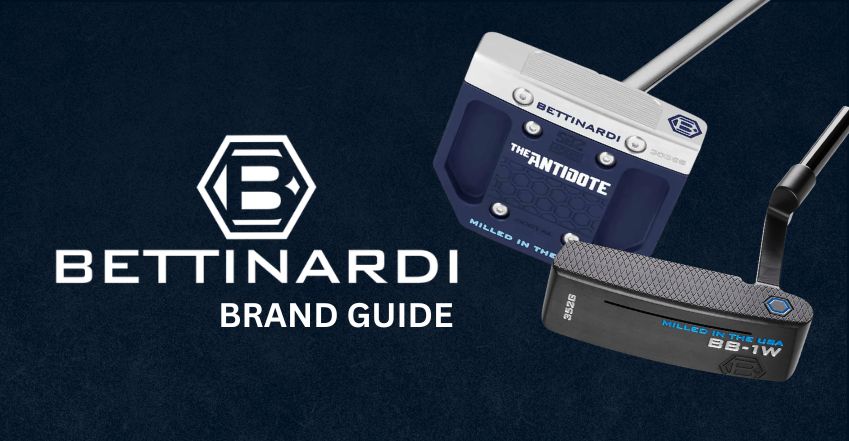
Bettinardi Brand Spotlight: The Premium Milled Putter Maker You Should Know About
Most golfers can name three or four putter brands. Scotty Cameron. Odyssey. TaylorMade Spider. Maybe Ping. After that? Crickets.
If your shortlist stops there, you're missing one of the most carefully made putters on earth.
Bettinardi is the brand that invented the one-piece milled putter. The brand that contracted with most of the major OEMs in the 1990s to mill the putters that won 49 PGA Tour events and four majors before Robert Bettinardi even put his own name on a head. The brand whose Honeycomb face milling pattern is so precise that other manufacturers spent years trying to replicate it. The brand made entirely in Tinley Park, Illinois — every single putter, every single component, every single step — by a company that's still family-run by Robert and his son Sam.
If Scotty Cameron is the Lexus of putters, Bettinardi is the small-batch, hand-built sports car. Smaller production. More exotic feel. A tighter, more obsessive enthusiast following. And on the used market — where premium milled putters tend to retain serious value — Bettinardi is genuinely one of the most interesting plays going.
TL;DR: Bettinardi Golf is a premium American putter manufacturer based in Tinley Park, Illinois, founded by Robert J. Bettinardi — the inventor of the one-piece milled putter and the Honeycomb face milling pattern. The current lineup includes the BB Series (classic blades and mallets), Studio Stock (premium 303 stainless steel models), Queen B (decorative finish series, named after Robert's mother), and Inovai (high-MOI mallets). Putters are priced in the premium tier alongside Scotty Cameron, are 100% American-made, and have a devoted enthusiast and tour following. Yes — they're worth it, and they hold resale value extraordinarily well, making used Bettinardis one of the better premium putter values on the market.
How Bettinardi Started: The One-Piece Milled Putter Revolution
The Bettinardi origin story is one of the better entrepreneurial tales in golf. In the early 1990s, Robert Bettinardi owned a CNC manufacturing facility doing precision machining work for the hydraulics and communications industries. Not golf. Robert was a fabricator with a serious skill set in tight-tolerance metalwork — and a casual interest in golf.
He saw an advertisement in a golf shop showing putters being made on a Bridgeport milling machine. The lightbulb went off. If he could mill golf putters with the precision his factory used for industrial parts, he could build something fundamentally different from what was being mass-produced at the time.
Robert started by milling putters under contract for other golf brands. Over five years from 1993 to 1998, every major OEM that wanted a true milled putter — the kind tour pros were starting to demand over cast or forged options — was sourcing them from Bettinardi's facility. By 1998, those Bettinardi-milled putters had captured 49 PGA Tour wins and four major championships.
Tour data point: between 1993 and 1998, the number of PGA Tour players using a milled putter jumped from 10 to over 75. Bettinardi's milling capacity was the reason that shift was even possible.
In 1998, Robert decided he was done milling putters for other brands and started Bettinardi Golf. The first six models — BB1, BB1MS, BB2, BB8, BB10, BB12 — debuted at the Greater Greensboro Open in 1999. That same week, Jesper Parnevik picked up an MC-10 prototype, took just 99 putts over 72 holes, and set a tournament scoring record at -23. Word traveled fast.
What Made Bettinardi's Milling Different
Two innovations set Bettinardi apart from the start:
- One-piece milled construction. Most putters before this era were either cast (poured molten metal) or had components (face inserts, weight slots) added after the fact. Bettinardi milled the entire putter — body, face, hosel, sole — from a single block of soft carbon steel or stainless steel. No inserts, no welds, no dissimilar materials. Better feel, more consistent weight distribution, no risk of insert separation.
- Honeycomb face milling. Robert developed a method where a special jeweler-grade machine cutter milled the face vertically rather than sweeping across it. Result: a 200% flatter face than competitors, with the small honeycomb pattern providing the perfect amount of soft, responsive feel at impact. No competitor has fully replicated the precision of Bettinardi Honeycomb milling, even three decades later.
These weren't marketing claims. The performance differences were measurable, and tour players noticed.
2003 US Open: Jim Furyk's Baby Ben Wins a Major
Bettinardi's signature tour moment came at Olympia Fields in 2003. Jim Furyk, gaming a Bettinardi Baby Ben center-shafted mallet, putted his way to the US Open title — Bettinardi's first major win as a stand-alone brand.
Furyk's putter became one of the most influential mallet designs of its era. The Bettinardi Inovai line was eventually inspired by that exact shape, with the modern Inovai 7.0 explicitly described by Sam Bettinardi as a tribute to the 2003 US Open winner — though with 30% higher MOI than the original.
Since 1998, Bettinardi-branded putters have notched over 100 professional tour wins worldwide. Not Cameron numbers, but for a small Illinois operation building everything by hand, it's a serious record.
The Bettinardi Lineup Today: Four Major Series
Bettinardi refreshes its full lineup roughly every 2–3 years. The current era includes four distinct families — each targeting different price points, stroke types, and aesthetic preferences.
| Series | Material | Feel Profile | Best For |
|---|---|---|---|
| BB Series | Soft carbon steel, milled | Soft, traditional | Traditional blade and mallet players |
| Studio Stock | 303 stainless steel, milled | Firmer, more responsive | Premium tour-style players |
| Queen B | Soft carbon steel, decorative finish | Soft with firmer Micro Honeycomb face | Players who want art with their performance |
| Inovai | 303 SS + 6061 aluminum bi-metal | Softest (F.I.T. milling) | Mallet players, MOI seekers |
BB Series — The Classics
The BB line is the heart of Bettinardi. Originally launched in 1999 with six models, today's BB lineup includes blades, mid-mallets, and traditional shapes that have evolved across multiple generations. The BB1 is the iconic flat-back blade. The BB28 is a modern Spud-neck that delivers blade looks with extra forgiveness. The BB49 (released for 2026) is a compact mallet with the new Variable Depth Flymill (VDF) face — nine individually tuned milling zones that maintain consistent ball speeds on off-center strikes. Golf Monthly called the BB49 "an excellent example of modern craftsmanship blended with traditional design."
Each BB Series putter is precision-milled from a single block of soft carbon steel and finished in either Glacier Black, Diamond Blast, or limited specialty finishes. Standard weight runs around 350g.
Best for: traditionalists. Players who want a classic blade or compact mallet without the visual bulk of a full mallet.
Studio Stock — The Premium Tour Line
Studio Stock launched in 2011 as Bettinardi's premium tier — milled from 303 stainless steel rather than carbon steel, finished with the brand's Diamond Blast topline treatment, and built around tour-validated head shapes. The current SS7, SS17, SS18, and SS28 cover blades, mid-mallets, and high-MOI mallet options.
The signature Studio Stock tech is the Roll Control Face — an asymmetrical groove pattern engineered to get the ball into a true forward roll faster, while still maintaining Bettinardi's signature soft feel. Released in 2021, it remains the face milling on every Studio Stock model today.
Best for: players who want premium milled-putter performance with classic visual cues and a slightly firmer feel than the soft carbon steel BB Series.
Queen B — Performance With Aesthetic Charm
Named after Robert's mother, the Queen B series is Bettinardi's decorative finish line. Same precision-milling and tight tolerances as the BB Series, but completed in a stunning rose gold PVD or aged copper finish that the brand calls "unmatched work of art." Queen B uses Micro Honeycomb Face Milling — slightly firmer feel than the standard Honeycomb pattern, designed for golfers who prefer a more responsive impact sound.
Available in QB6 (wide-body blade), QB11 (compact crescent-neck mallet), and QB12 (traditional blade), all milled from soft carbon steel to 362 grams.
Best for: players who treat their putter as both performance tool and visual statement. Strong on the secondary market with collectors.
Inovai — The MOI Mallet Family
Inovai is Bettinardi's high-MOI mallet line, distinguished from competitors by curved organic shapes (rather than the typical fang-style geometry) and bi-metal construction. The body is 6061 aluminum (light), the face is 303 stainless steel (heavier and more durable), and the design pushes mass to the perimeter for maximum stability on off-center strikes.
The current Inovai lineup includes the 6.0 (compact wingback), 6.5, 9.0, and 10.0 (largest, highest MOI), each available in multiple neck options including Spud Neck, Crescent Neck, Center Shaft, and Counterbalance configurations. F.I.T. (Feel Impact Technology) Face milling on the Inovai gives the softest feel of any current Bettinardi face.
Best for: mallet players who want premium American manufacturing without the typical mallet aesthetic. The Inovai is genuinely Bettinardi's most distinctive design — you'll either love it or hate it.
The Hive: Bettinardi's Premium Limited-Run Program
Sam Bettinardi joined the family business in 2013 and one of his early initiatives was developing The Hive — a separate Bettinardi platform dedicated to ultra-premium and tour-only putter releases. Through The Hive, Bettinardi releases limited-edition collaborations (Weller x Bettinardi, themed Tiki Limited Runs, sports-team commemoratives like the Super Bowl LX Champions putter), DASS (Double Aged Spring Steel) pieces, and tour-issue prototypes that don't make the standard production lineup.
Hive releases happen at scheduled times — Black Friday, Masters Week, US Open Week, etc. — and most sell out within minutes. The Hive is also where the rarest collector Bettinardis live: tour-issue putters with custom stamping, prototype heads that never went production, and one-of-a-kind pieces.
On the secondary market, Hive releases are where Bettinardi value goes vertical. Standard production putters trade hands at predictable used prices. Limited Hive releases in mint condition can sell for several times their original retail, sometimes more for tour-only pieces. If you're shopping used Bettinardis, knowing what was a Hive release versus standard production is genuinely important.
Bettinardi vs. Scotty Cameron: The Honest Comparison
This comparison comes up constantly at the shop. Both brands occupy the premium milled-putter space. Both have devoted followings. Both retail in the same general price range. So how do they actually differ?
| Factor | Bettinardi | Scotty Cameron |
|---|---|---|
| Manufacturing | Tinley Park, IL — 100% in-house | California / Carlsbad — Titleist subsidiary |
| Production volume | Smaller, more boutique | Significantly larger |
| Face milling | Honeycomb / Roll Control / F.I.T. | Studio Carbon Steel / various |
| Tour presence | ~5-10 tour staffers, niche | Dominant tour presence |
| Counterfeit problem | Less common (smaller market) | Most-counterfeited putter brand on earth |
| Used market depth | Smaller inventory pool, faster turnover | Massive inventory, broad price range |
| Limited-edition culture | The Hive program — extreme exclusivity | Circle T tour issues, Champions Choice |
| Visual identity | Distinct color schemes, family signatures | Clean classic, deeply iconic shapes |
The simplest way to think about it: Cameron is the established luxury brand with a broader product range and deeper tour penetration. Bettinardi is the boutique craftsman brand with tighter quality control, more distinctive designs, and a smaller-but-fanatical enthusiast following. Both make excellent putters. The right one depends on which culture appeals to you more.
For the full deep dive on Cameron, check our Scotty Cameron Brand Spotlight and the Scotty Cameron Model Guide.
Bettinardi on the Used Market: What to Look For
Bettinardis hold value extraordinarily well — better than most premium putters except Scotty Cameron, and arguably better than Cameron in some specific generations. A few things to know if you're shopping used.
What Drives Bettinardi Used Value
- Generation matters. Bettinardi refreshes the lineup every 2-3 years. Current-generation putters hold 70-85% of retail used. One generation back drops to 50-65%. Two generations back drops further to 35-50%. The drop-off is steeper than Cameron's because the production numbers are smaller and the visual updates can be significant.
- Hive releases vs. production. A Hive limited release in similar condition can sell for 2-5x what an equivalent production model trades at. Always verify whether a putter was production or Hive — it dramatically affects pricing.
- Finish condition. Bettinardi's distinctive finishes (Rose Gold, Aged Copper, Glacier Black, custom Hive PVDs) are visually stunning when fresh and visibly tired when worn. Finish wear can chop 20-30% off resale value even if the playing surface is fine.
- Hosel and neck wear. Inspect the hosel-to-shaft junction carefully on used Bettinardis. The crescent and spud necks especially can develop wear at the connection point.
- Headcover match. Bettinardi headcovers are model-specific and seasonally produced. A correct, matching headcover with original putter adds real resale value. A wrong cover or a generic replacement subtracts from it.
Where the Best Bettinardi Used Values Are
- Studio Stock 17/18 (2017-2021 generations): Same Roll Control Face technology as current models, often available at 50-65% of current retail.
- BB1 Flow and BB8 Wide (2018-2022): Classic shapes with strong cult followings. Rarely overpriced.
- Older Inovai 6.0 / 7.0 generations: Bi-metal construction is essentially unchanged in newer Inovai models. Older versions perform identically at significant discount.
- Queen B 6 (older generations): The wide-body Queen B shape has been refined but not fundamentally redesigned. Older copper-finish QB6 putters are stunning and underpriced.
What we tell customers at the shop: a 3-year-old Bettinardi in clean condition with the correct headcover is one of the genuinely smartest premium putter buys on the used market. Performance is essentially current-gen. Price is 40-60% off current retail. The brand still has a long enthusiast tail that protects future resale value if you ever want to move on.
For more on premium mallet evolution, see our TaylorMade Spider Putter Evolution.
Key Takeaways: Why Bettinardi Belongs on Your Radar
- Robert Bettinardi invented the one-piece milled putter in the early 1990s, transforming how premium putters were manufactured.
- Honeycomb face milling remains one of the most precise face manufacturing methods in the game — 200% flatter than the era's standard, milled vertically rather than swept.
- 100% American-made in Tinley Park, IL. Robert and son Sam still run the company. Every putter is hand-finished and assembled in-house.
- Four core production lines: BB Series (classic blades), Studio Stock (premium tour), Queen B (decorative finish), Inovai (high-MOI mallets).
- The Hive program drops limited releases multiple times per year. Hive pieces can hold or appreciate in value, while production models depreciate normally.
- Jim Furyk won the 2003 US Open with a Bettinardi Baby Ben — the brand's signature major moment.
- 100+ professional tour wins since Bettinardi launched as its own brand in 1998.
- Used Bettinardis hold value extraordinarily well — especially Studio Stock and BB Series in 2-3 year-old generations.
Frequently Asked Questions
Are Bettinardi putters worth the money?
For the right player, absolutely. Bettinardi putters are 100% American-made in small batches with milling tolerances tighter than mass-produced competitors. The materials are premium (soft carbon steel, 303 stainless, 6061 aluminum), the face milling is among the best in the industry, and the resale value holds up extraordinarily well. New retail prices sit in the same premium tier as Scotty Cameron. If you value craftsmanship and want a putter that feels different from cast or forged options, Bettinardi delivers.
Where are Bettinardi putters made?
Every Bettinardi putter is made in Tinley Park, Illinois — just outside Chicago. Robert Bettinardi opened the manufacturing facility decades before starting his own golf brand, and to this day, every putter is precision-milled, hand-finished, and assembled in that single facility. Bettinardi is one of the very few major golf manufacturers whose products are 100% American-made.
What's the best Bettinardi putter for a beginner?
The Inovai 6.0 or 9.0 — both are forgiving high-MOI mallets that suit straight-back-straight-through stroke patterns and tolerate off-center strikes well. For beginners drawn to blade aesthetics, the BB28 Spud delivers blade looks with above-average forgiveness for the category. Bettinardi sits firmly in the premium price tier on new retail, so beginners on tighter budgets should consider used Bettinardis from one or two generations back at significantly lower prices.
What is the Bettinardi Hive?
The Hive is Bettinardi's limited-edition release platform, launched by Sam Bettinardi to house ultra-premium putters, tour-only pieces, themed collaborations, and one-of-a-kind designs. Hive releases happen at scheduled times throughout the year (Black Friday, Masters Week, etc.) and typically sell out in minutes. Limited-run Hive pieces hold or appreciate in value on the secondary market — sometimes selling for multiples of their original retail price.
How does Bettinardi compare to Scotty Cameron?
Both are premium milled-putter brands at similar price points, but they target different cultures. Cameron is Titleist-owned, has dominant tour presence, and produces at higher volume. Bettinardi is family-owned, has a smaller-but-fanatical enthusiast following, and produces in tighter batches with arguably more visual distinctiveness. Performance is genuinely comparable at the top end of each lineup. Choice often comes down to feel preference and brand culture rather than measurable performance differences.
What is Honeycomb face milling?
Honeycomb is Bettinardi's signature face milling pattern, developed by Robert Bettinardi. Unlike traditional face milling that sweeps a cutter across the face, Honeycomb is milled vertically using a jeweler-grade machine cutter that produces a 200% flatter face than competitor methods of its era. The hexagonal milling pattern creates a distinct soft-but-responsive feel at impact, without requiring a separate face insert. Bettinardi has refined the pattern over decades — variants include Super-Fly, Micro Honeycomb (firmer), F.I.T. (softest), and Variable Depth Flymill (newest).
Do Bettinardi putters hold their value?
Yes — among the best in the premium putter market. Current-generation production Bettinardis hold roughly 70-85% of retail used in good condition. Limited Hive releases can hold or appreciate in value. The combination of small production runs, devoted enthusiast following, and strong brand identity creates favorable secondary-market dynamics. Older-generation production putters depreciate steadily but stabilize once they're 3-5 years old.
Who plays Bettinardi on the PGA Tour?
Bettinardi maintains a smaller tour staff than Cameron or TaylorMade but has had genuinely strong representation. Jim Furyk won the 2003 US Open with a Bettinardi Baby Ben. Matt Kuchar gamed Bettinardi for years (Kuchar Signature line still exists). Tour wins under the Bettinardi brand have totaled over 100 professional victories since the brand's 1998 launch. Current tour staffers vary year to year — Bettinardi prefers fewer, more-engaged ambassadors over high-volume sponsorship deals.
Get a Quote on Your Bettinardi
Bettinardis are the kind of putter where buying used is genuinely smart — current-generation performance at a fraction of the new retail price, paired with a brand whose used-market value tends to be more resilient than most premium options. We keep used Bettinardi BB Series, Studio Stock, Queen B, and Inovai putters in rotation regularly, all authenticated and graded honestly by our team. If you've got a Bettinardi to trade in or sell outright, we know what they're actually worth — including the difference between standard production and Hive releases.