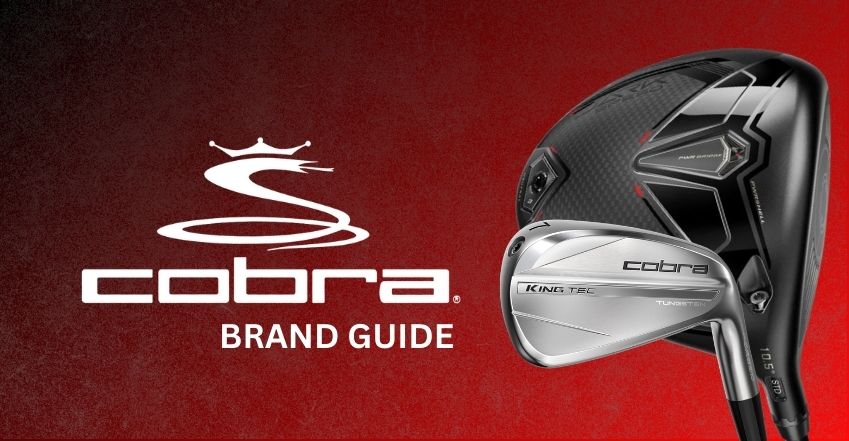
Cobra Golf: The Complete Brand Guide for Golfers (2026)
Cobra has always been the brand that punches above its weight. They don't have Titleist's Tour presence or Callaway's marketing budget. What they have is a willingness to try things nobody else will — 3D-printed irons, single-length sets, embedded GPS sensors, a 33-setting adjustable hosel — and a price point that consistently undercuts the Big Four.
That combination makes Cobra one of the most interesting stories in golf equipment right now. And for used club buyers? It makes them one of the best values on the market.
We see a steady flow of Cobra equipment at Golf Club Brokers, and the brand has quietly built a following that's as loyal as anything in golf. Here's the full picture.
TL;DR — Quick Answer
Cobra Golf is a Puma-owned manufacturer based in Carlsbad, California, known for aggressive innovation and competitive pricing. Their 2026 lineup includes the OPTM drivers (featuring POI design and the FutureFit33 adjustable hosel), 3DP Tour irons built with 3D-printed lattice technology, King and King Max game-improvement irons, and two putter families (3DP Tour and MIM). Cobra clubs deliver excellent performance per dollar and hold decent resale value, especially drivers. They're an outstanding choice for golfers who want premium technology without the premium price tag.
The Cobra Story: From the Baffler to 3D Printing
Cobra was founded in 1973 by Thomas Crow, an Australian who'd won the 1961 Australian Amateur Championship. Crow moved to San Diego with an idea: make golf clubs that helped average golfers — especially seniors and women — hit the ball farther and more consistently.
His first real breakthrough came in 1975 with the Baffler, a utility club with rails on the sole inspired by catamaran hulls. It was basically a hybrid before hybrids existed — decades before TaylorMade's Rescue made the category mainstream. The Baffler became Cobra's identity and the foundation for everything that followed.
The brand exploded in the late '80s and early '90s. Greg Norman bought 12% of the company for $2 million in 1991, helped develop Cobra's first forged irons, and lent his star power to the brand. John Daly won the 1991 PGA Championship using a Cobra Ultramid driver — built with the same plastic used in bulletproof vests. By 1994, King Cobra Oversize irons were the best-selling irons in golf.
Then came the ownership changes. Acushnet (Titleist's parent) bought Cobra in 1996. Puma acquired Cobra from Acushnet in 2010, forming Cobra Puma Golf. The Puma era brought a younger, edgier vibe — bright colors, lifestyle partnerships, and athletes like Rickie Fowler, Lexi Thompson, and Bryson DeChambeau.
Who Owns Cobra Golf?
Cobra is a division of Puma SE, the German sportswear company. Design and engineering happen at Cobra's headquarters in Carlsbad, California. Manufacturing is handled by Takumi Co., Ltd., a precision golf club factory in Himeji, Japan, that's been Cobra's exclusive production partner since 1998.
Cobra Timeline
| Year | Milestone |
|---|---|
| 1973 | Thomas Crow founds Cobra Golf in San Diego |
| 1975 | The Baffler launches — proto-hybrid, decades ahead of its time |
| 1985 | First US manufacturer to offer graphite shafts as stock in irons and woods |
| 1991 | Greg Norman buys in; John Daly wins PGA Championship with Cobra driver |
| 1994 | King Cobra Oversize irons become #1 selling irons in golf |
| 1996 | Acushnet (Titleist parent) acquires Cobra |
| 2010 | Puma acquires Cobra from Acushnet; Cobra Puma Golf is born |
| 2016 | First "smart" clubs with embedded Arccos GPS sensors |
| 2017 | First major brand to offer single-length irons to consumers |
| 2020 | Partners with HP — launches first 3D-printed putter in golf |
| 2025 | 3DP Tour irons launch — first 3D-printed iron heads; DS-Adapt drivers |
| 2026 | OPTM drivers (POI design), King Tec-MD mini driver, MIM and 3DP Tour putters |
The Puma connection gives Cobra something unique: a built-in apparel and footwear ecosystem. No other equipment manufacturer has that kind of integration with a global fashion-sport brand. It's part of why Cobra tends to attract younger golfers — the brand doesn't feel like your dad's golf company.
OPTM Drivers: Cobra's 2026 Lineup
The 2026 OPTM drivers are built around a concept Cobra calls POI — Product of Inertia. While MOI measures how resistant a clubhead is to twisting on the vertical and horizontal axes independently, POI measures diagonal, three-dimensional twisting across all axes simultaneously. It's a more complete picture of what happens when you don't hit the center of the face.
The practical result? Cobra says the OPTM drivers reduce shot dispersion by up to 23% compared to previous models. All four models also feature the FutureFit33 adjustable hosel — 33 unique loft and lie combinations that can be adjusted independently — and the H.O.T. (Highly Optimized Topology) AI-designed face.
| Model | Key Feature | Best For | Price |
|---|---|---|---|
| OPTM X | Balanced speed + forgiveness; adjustable 11g/3g weights (front or back) | Most golfers — the all-rounder | $599 |
| OPTM LS | Low spin; aerodynamic shape; 3-weight system (11g/7g/3g) | Fast swingers needing spin reduction | $599 |
| OPTM Max-K | Highest forgiveness; fixed 11g rear weight for max stability | Max MOI seekers — all skill levels | $599 |
| OPTM Max-D | Draw bias with max forgiveness; heel-weighted CG | Players fighting a slice | $599 |
Also worth noting: the King Tec-MD mini driver ($479) fills the gap between driver and 3-wood. At 303cc with a 43.75-inch shaft, it's designed for golfers who want more control off the tee without giving up too much distance. The FutureFit33 hosel and moveable sole weights give it more adjustability than any mini driver on the market.
Cobra Irons: 3D Printing Changes the Game
This is where Cobra's story gets really interesting. The 3DP Tour irons — built by fusing 2,600 layers of 316 stainless steel powder with lasers — represent a genuine manufacturing breakthrough. The 3D-printed lattice structure inside the head is lighter than anything you can achieve with casting or forging, which lets Cobra redistribute weight to the perimeter for higher MOI in a players-size package.
It's not gimmicky. It's real engineering that produces real results. The forgiveness-to-head-size ratio is unlike anything else on the market. At $330 per iron, they're not cheap — but they're competitive with Titleist and TaylorMade's top-tier offerings.
| Iron | Category | Construction | Best For |
|---|---|---|---|
| 3DP Tour | Players / Players Distance | 3D-printed 316 stainless steel lattice; H.O.T. Face | Low-mid handicaps wanting max forgiveness in a compact head |
| King Forged Tec | Players Distance | Hollow-body forged with polymer insert | Mid handicaps wanting distance + feel |
| King | Game Improvement | Cavity-back with 3D-printed CG cartridge | Mid-high handicaps; stronger lofts with high launch |
| King Max | Super Game Improvement | Larger cavity-back with 3D-printed CG cartridge | High handicaps; max forgiveness + distance |
The 2026 King and King Max irons ($999 for a 5-GW steel set) deserve attention too. Cobra used 3D-printed CG cartridges inside a traditional cavity-back design to optimize launch — solving the classic problem where stronger lofts give you distance but kill your launch angle. It's a clever application of the 3D printing tech at a much more accessible price point.
Putters: Two Families, Two Philosophies
Cobra made putters an afterthought for years. Not anymore. The 2026 lineup splits into two families that couldn't be more different in approach.
3DP Tour putters ($379): Multi-material construction using a 3D-printed nylon cartridge, carbon fiber crown, MIM stainless steel body, and tungsten sole weighting. The 3D printing decouples MOI from CG placement — you get super-high stability with a forward CG that's easier to square. Milled 304 stainless steel face. For golfers who want maximum forgiveness and don't mind non-traditional shapes.
MIM putters ($279): Metal Injection Molded stainless steel bodies with a refined Pebax insert for soft, responsive feel. Traditional shapes — blades and mid-mallets — with classic aesthetics and gentle forgiveness. For golfers who want clean looks and a soft touch. The MIM process delivers forging-like precision at a lower cost.
Both families feature LA Golf's Descending Loft Technology — the face is divided into four sections with loft decreasing from top to bottom, ensuring consistent roll regardless of your shaft lean at impact.
Fairway Woods, Hybrids, and the Mini Driver
The OPTM fairway wood and hybrid lineup mirrors the driver family's POI philosophy and FutureFit33 hosel system. The fairway woods come in three models: LS ($469 in titanium), X ($369), and Max ($329). The OPTM hybrid is $329 and features a slightly larger profile than previous Cobra hybrids with a shallower face for easier launch.
The real story here is the King Tec-MD mini driver. Mini drivers have been one of the hottest categories in golf over the past two years, and Cobra's entry is arguably the most adjustable one available. Lexi Thompson was spotted gaming one in late 2025 before the official launch. At $479, it's competitive with TaylorMade's Original One and the other mini drivers on the market.
What We See on the Used Market
Cobra clubs depreciate faster than Titleist or Ping — that's just reality. But here's the flip side: that depreciation makes them some of the best values on the used market.
DS-Adapt drivers (2025): Already discounted meaningfully with the OPTM launch. These were excellent drivers — the DS-Adapt X in particular — and they're available for 35-45% off original retail. Terrific value.
Aerojet and LTDx drivers: Two and three generations back, respectively, but still competitive performers. The Aerojet LS was one of the fastest drivers of its generation. Available for under $200 used.
3DP Tour irons: Very limited used supply since they only launched in late 2025. When they do appear, they hold value well because there's nothing else like them on the market.
King Forged Tec / Forged Tec X irons: Great used picks. Solid construction, good feel, and prices have come down as the 3DP line takes over Cobra's premium iron slot.
F9 Speedback driver: This one has cult status. Released in 2019 and still shows up in GCB trade-ins regularly. It was one of those designs that just worked. Available for well under $100 used.
Counterfeiting isn't as much of a concern with Cobra as it is with Scotty Cameron or Titleist Vokey, but we still recommend buying from a dealer who inspects inventory. The FutureFit33 hosel on newer models is easy to verify — it's a distinctive feature that's hard to fake.
Who Plays Cobra on Tour?
Cobra's Tour roster is smaller than the Big Four, but it includes some recognizable names. Rickie Fowler is the marquee signing and has been with Cobra for over a decade. Max Homa joined in 2023. Lexi Thompson remains the brand's biggest presence in women's golf. On the LIV side, Bryson DeChambeau was Cobra's most prominent ambassador before parting ways, though his use of single-length Cobra irons brought the brand enormous visibility.
The honest assessment: Cobra doesn't have a top-10 player in the world right now, and that affects perception more than performance. Their equipment holds up against anything in independent testing — it's the Tour validation gap that keeps some golfers from considering the brand.
Is Cobra Right for You?
Best for: Golfers who want cutting-edge technology at competitive prices. Cobra's innovation-per-dollar ratio is the best in golf. The 3DP irons are genuinely unique, the FutureFit33 hosel offers more fitting flexibility than any competitor, and the OPTM drivers perform with the best in the category at $599 — roughly the same price or less than Titleist, TaylorMade, and Callaway.
Consider alternatives if: Tour pedigree matters to you, or you want the widest possible selection of player's irons and forged options. Cobra's iron lineup is strong but narrower than Titleist's or Ping's, and their forged offerings are limited compared to what Mizuno or Titleist provide.
Our take: Cobra is the most underrated brand in golf. Full stop. If you're a mid-handicapper who's been buying TaylorMade or Callaway on autopilot, you owe it to yourself to at least try Cobra's current lineup. You might be surprised — and you'll almost certainly save money.
Frequently Asked Questions
Is Cobra a good golf brand?
Yes. Cobra consistently ranks near the top in independent equipment testing, especially for drivers and game-improvement irons. Their 3D-printed technology is genuinely innovative, not just marketing. The brand's price point is also lower than Titleist, TaylorMade, and Callaway for comparable performance, making them an outstanding value.
Who owns Cobra Golf?
Cobra Golf is owned by Puma SE, the German sportswear company. Puma acquired Cobra from Acushnet (Titleist's parent company) in 2010. Design and engineering happen at Cobra's headquarters in Carlsbad, California, with manufacturing handled by Takumi Co., Ltd. in Japan.
What is the FutureFit33 hosel?
FutureFit33 is Cobra's adjustable hosel system that offers 33 unique loft and lie combinations — more than any competitor. Loft and lie can be adjusted independently, giving fitters and golfers enormous flexibility to optimize ball flight. It's available on all OPTM drivers, fairway woods, and the King Tec-MD mini driver.
Are Cobra's 3D-printed irons worth the price?
At $330 per iron, the 3DP Tour irons are priced competitively with premium offerings from Titleist, TaylorMade, and Ping. The 3D-printed lattice structure enables higher MOI in a smaller head than traditional manufacturing allows. If you want players-iron aesthetics with game-improvement forgiveness, they're worth serious consideration.
How do Cobra drivers compare to TaylorMade and Callaway?
In independent testing, Cobra OPTM drivers perform comparably to TaylorMade Qi4D and Callaway Quantum drivers across ball speed, distance, and forgiveness metrics. The main differences are price ($599 vs. $599-$600), adjustability (Cobra's FutureFit33 offers more loft/lie options), and Tour visibility (TaylorMade and Callaway have more top-ranked staffers).
Do Cobra clubs hold their resale value?
Cobra clubs depreciate faster than Titleist or Ping but comparably to most other brands. That depreciation actually benefits used buyers — previous-generation Cobra drivers and irons offer exceptional performance at steep discounts. Drivers from one generation back typically sell for 35-45% of original retail.