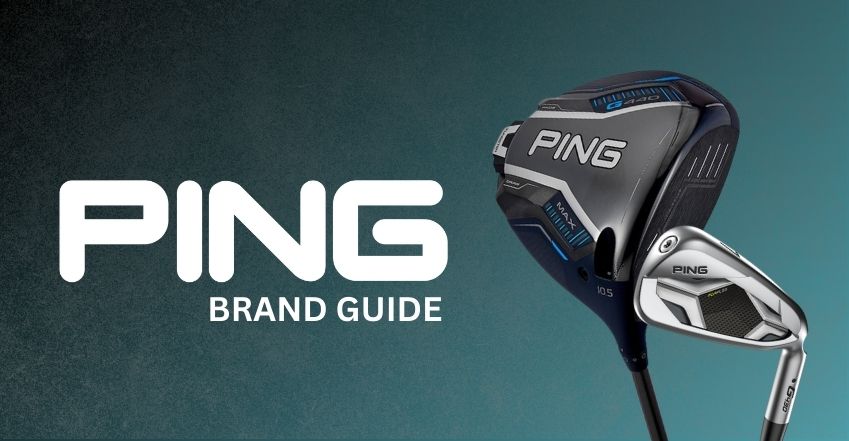
Ping: The Complete Brand Guide for Golfers (2026)
There's an argument to be made that Ping has shaped modern golf equipment more than any other single company. Not TaylorMade. Not Callaway. Ping.
Think about it. Perimeter weighting? Ping invented it. The cavity-back iron? Ping. Investment casting as a manufacturing standard? Ping. Factory custom fitting based on your physical characteristics? Also Ping. The things we take for granted in every golf shop today started in Karsten Solheim's garage in 1959.
We process a huge volume of Ping clubs at Golf Club Brokers — from vintage Eye2 irons that people refuse to give up, to brand-new G440 trade-ins from golfers chasing the latest thing. Ping equipment is built to last, holds its resale value well, and has one of the most loyal followings in golf. Here's everything you need to know.
TL;DR — Quick Answer
Ping is a family-owned, Phoenix-based manufacturer that pioneered perimeter weighting, cavity-back irons, and custom fitting. Their current lineup spans the G440 drivers and irons (forgiveness-focused), the i230/i530 player's irons, the forged Blueprint S and T, the new s259 wedges, and a deep putter line anchored by the iconic Anser. Ping clubs are engineered for consistency and durability, hold resale value well, and the brand's color-coded fitting system remains an industry benchmark.
How Ping Became Ping: The Karsten Solheim Story
Karsten Solheim was a mechanical engineer at General Electric. Born in Bergen, Norway in 1911, his family emigrated to Seattle when he was two. He didn't touch a golf club until 1954 — at age 42 — when coworkers dragged him out to make a foursome.
He was terrible at putting. Predictably, the engineer in him couldn't leave that alone.
Solheim started designing putters in his garage using sugar cubes and popsicle sticks to prototype weight distribution. His breakthrough was simple but revolutionary: instead of concentrating weight in the center of the blade, he moved it to the heel and toe. Perimeter weighting. The putter that resulted made a distinctive high-pitched sound when it struck the ball — a "ping." The name stuck.
He shipped his first putter, the 1A, on January 15, 1959. By 1966, he'd sketched the design for the Anser putter on the dust cover of a 78 RPM record because he couldn't find a piece of paper. His wife Louise suggested naming it "Answer" — because it solved the putting problem — but the word was too long to stamp on the toe. Drop the W, and you've got Anser. The most copied putter design in golf history.
Julius Boros won the 1967 Phoenix Open with an Anser. Solheim quit GE that same year and moved the operation from his garage to a factory in Phoenix. George Archer won the 1969 Masters with a Ping putter. The company never looked back.
Ping Timeline
| Year | Milestone |
|---|---|
| 1959 | Karsten Solheim ships first putter (1A) from his garage |
| 1966 | Anser putter designed — becomes most copied putter in golf history |
| 1967 | Solheim leaves GE; establishes Karsten Manufacturing in Phoenix |
| 1969 | Perimeter-weighted irons introduced; first Masters win with a Ping putter |
| 1982 | Ping Eye2 irons launch — capture 40% iron market share in the '80s |
| 1990 | Solheim Cup inaugurated — women's equivalent of the Ryder Cup |
| 1995 | John A. Solheim takes over as CEO from Karsten |
| 2000 | Karsten Solheim passes away; inducted into World Golf Hall of Fame (posthumous 2001) |
| 2017 | Third-generation John K. Solheim becomes CEO |
| 2025 | G440 driver family launches; i530 and G440 irons released |
| 2026 | G440 K driver (10K+ MOI), s259 wedges, expanded fitting ecosystem |
Who Owns Ping?
Ping is still family-owned. That's unusual in an industry dominated by public corporations and private equity. The company operates as Karsten Manufacturing Corporation, headquartered in Phoenix, Arizona, with roughly 1,000 employees. John K. Solheim — Karsten's grandson — serves as President and CEO. His father John A. Solheim is Executive Chairman.
Being privately held means Ping doesn't chase quarterly earnings or answer to Wall Street. They operate on longer product cycles (typically two years for drivers, longer for irons), invest heavily in engineering and fitting infrastructure, and don't discount aggressively. That philosophy frustrates bargain hunters but builds incredible brand loyalty.
Ping also founded and sponsors the Solheim Cup, the premier international team event in women's professional golf — modeled after the Ryder Cup and first played in 1990.
The G440 Driver Family: Ping's Current Lineup
Ping runs on a two-year driver cycle. The G440 family launched in early 2025, and for 2026 they've added the G440 K — their most forgiving driver ever — to the existing lineup.
All G440 drivers share the Carbonfly Wrap crown technology and Ping's deepest center of gravity yet, thanks to the Free Hosel design that freed up five grams of weight from the high-heel section. The result: more ball speed, higher launch, and tight dispersion even on off-center hits.
| Model | Key Feature | Best For | Price |
|---|---|---|---|
| G440 Max | Highest MOI in standard line; adjustable back weight | Most golfers — forgiveness without sacrifice | ~$600 |
| G440 LST | Low spin; deeper face for a penetrating flight | High-speed players who need spin reduction | ~$600 |
| G440 SFT | Draw bias to counter a fade/slice | Players fighting a persistent slice | ~$600 |
| G440 K (2026) | 10,000+ MOI; adjustable 32g back weight (draw/fade/neutral); Dual Carbonfly Wrap | Max forgiveness with adjustability — all skill levels | $650 |
The G440 K deserves special attention. It combines 10,000+ MOI with adjustable draw/fade/neutral weighting — something Ping couldn't offer in the previous G430 10K without exceeding USGA conformance limits. Early Tour adoption has been strong, with Lauren Coughlin winning with a prototype and multiple players across the PGA and DP World Tours putting it in play before its January 2026 retail launch.
Ping Irons: Which Line Is Right for Your Game?
Ping's iron lineup is wider than most brands, and they organize it clearly by skill level. Here's the breakdown:
| Iron | Category | Construction | Best For |
|---|---|---|---|
| Blueprint T | Tour Blade | Single-piece forged 8620 carbon steel | Scratch/plus players wanting max control |
| Blueprint S | Players Iron | Forged cavity-back with elastomer pocket (3-5i) | Low single-digit; Tour-proven workability + some forgiveness |
| i230 | Players Iron | 431 stainless steel with elastomer insert | Single-digit to low teens; feel and feedback |
| i530 | Players Distance | Hollow-body with maraging steel face | Mid-handicaps wanting distance in a compact shape |
| G440 | Game Improvement | Cast with PurFlex cavity badge; thinner face | Mid to high handicaps; max forgiveness |
| G730 | Super Game Improvement | Hollow-body; ultra-thin face for max speed | High handicaps; seniors; max launch and distance |
The Blueprint S has been a Tour sensation since debuting in mid-2023. Matt Fitzpatrick, Tyrrell Hatton, and Viktor Hovland have all gamed it, and it quickly became one of Ping's most-played irons on worldwide tours. The patented precision pocket in the long irons (3-5) frees up 10 grams of weight for better forgiveness — a meaningful advantage in a forged players iron.
For most golfers we see at GCB? The i530 or G440 are where you should be looking. The i530 gives you distance in a compact, good-looking package. The G440 does everything the G430 did but with a 9% thinner face, lower CG, and better cosmetics. Either one is excellent.
s259 Wedges: Ping's 2026 Scoring Clubs
Ping released the s259 wedges for 2026 — an evolution of the well-received s159 line from 2024. Cast from 8620 carbon steel with wheel-cut grooves and an enhanced face blast for maximum spin, the s259 lineup offers 25 loft and grind combinations across six different grinds.
That's an enormous amount of variety. Ping refined the T and E grinds for 2026 and gave fitters even more options to dial in bounce, sole width, and leading edge for each golfer's turf interaction. It's very much a "go get fit" wedge line — the right combination is out there, but you need someone who understands your swing to find it.
Putters: Where It All Started
You can't talk about Ping without talking about putters. The Anser is the most influential putter design ever made — virtually every heel-toe weighted blade on the market today descends from Solheim's 1966 sketch. Over 2,300 gold Ping putters sit in the company's vault, each representing a Tour victory.
The current putter lineup is deep. The Anser and Anser 2 remain in the line as timeless blades. The DS72 and Kushin C deliver mid-mallet stability. The PLD (Putter Locker Design) line offers custom shop-level options at a premium price point. And the Tomcat and Harwood mallets provide high-MOI alternatives for players who want maximum stability.
One thing that sets Ping apart: their adjustable-length putter shaft technology and the sheer range of models available in left-hand configurations. Ping has always prioritized inclusivity in their fitting — they offer more custom lie, length, and loft options than most competitors.
The Color Code System: Why Fitting Matters with Ping
Ping pioneered custom fitting and they're still the gold standard. Their color-coded dot system — 12 lie angles from the most upright (maroon) to the flattest (orange) — has been simplifying the fitting process since the early 1980s. Every iron and wedge comes stamped with a colored dot on the hosel that indicates its lie angle specification.
Here's why this matters: a club that's even two degrees off on lie angle can send your ball five to ten yards offline. Ping makes it easy for fitters — and for used club buyers — to identify exactly what spec a club is built to. When you're shopping for used Ping irons, that dot tells you immediately whether the club matches your build.
The Ping nFlight fitting app and Co-Pilot system that their certified fitters use is among the most sophisticated in the industry. If you've never been fit for Ping clubs, it's worth the trip to an authorized fitter just to see the process.
What We See on the Used Market
Ping clubs hold their value. Period. The build quality is exceptional — we regularly see G400-era irons (2017-2018) come through our shop looking like they've barely been played. The finish doesn't chip or flake the way some competitors' clubs do, and the structural integrity holds up over years of play.
Here's the used market landscape for Ping in early 2026:
G440 drivers and irons: Still selling close to retail on the used market because they're only a year into their cycle. Limited supply of used inventory. Wait six months if you want a deal.
G430 drivers and irons: The sweet spot right now. Great technology, proven performance, and prices have dropped 30-40% since the G440 launch. We'd point most golfers here for value.
i230 and Blueprint S irons: Hold value extremely well due to Tour credibility and the fact that Ping hasn't released direct replacements yet. If you find a set in your specs, buy it.
i525 irons: Replaced by the i530 but still excellent. Available at significant discounts and perform beautifully.
Older G-series (G425, G410): Solid clubs at great prices. The G425 irons were arguably the best game-improvement iron of their generation. Still very playable.
Vintage Eye2 irons: A collector's item that some golfers genuinely still play. The wedge from this set is legendary. Value depends heavily on condition and which groove pattern (pre- or post-1990).
One note on counterfeits: Ping clubs are less commonly faked than Scotty Cameron or Titleist, but fake Ping drivers do exist. The color dot system on irons actually helps with authentication — it's a detail counterfeiters often get wrong.
Who Plays Ping on Tour in 2026?
Ping's Tour staff includes some of the biggest names in golf. Viktor Hovland, Tyrrell Hatton, Tony Finau, Bubba Watson, Sahith Theegala, Corey Conners, and Harris English all carry Ping bags. On the LPGA side, Ping has been a dominant presence for decades, and the Solheim Cup connection reinforces that relationship.
What's notable is how many non-contracted players choose Ping equipment voluntarily. The Blueprint S irons and G440 K driver have been spotted in bags across all major tours — players are gravitating toward the equipment regardless of endorsement deals. That's the ultimate credibility signal.
Is Ping Right for You?
Best for: Golfers who value engineering, consistency, durability, and custom fitting. Ping's strength is making clubs that perform reliably across a wide range of skill levels. Their game-improvement line (G440/G730) is among the most forgiving equipment available, and their players irons (Blueprint S, i230) compete with the best on Tour.
Consider alternatives if: You prioritize boutique aesthetics or ultra-premium feel above all else. Ping's forged iron line (Blueprint S and T) is excellent, but brands like Mizuno and Titleist have traditionally owned the "pure forged feel" conversation. Ping's strength is performance engineering, not artisan cachet.
Our take: If you're a 10-handicap who wants to buy one set of irons and play them for five years, Ping is probably the best choice in golf. The build quality outlasts the competition, the fitting system ensures you get the right specs, and the resale value means you'll get fair money back when it's time to move on.
Frequently Asked Questions
Is Ping a good golf brand?
Ping is one of the most respected brands in golf equipment. They pioneered perimeter weighting, cavity-back irons, and custom fitting — innovations that every major manufacturer now uses. Their clubs consistently rank among the best in independent testing, and the company's engineering-first approach has earned them a loyal following from beginners to Tour professionals.
What does the colored dot on Ping irons mean?
The dot indicates the iron's lie angle specification. Ping offers up to 12 different lie angles, color-coded from maroon (most upright) through black (standard) to orange (most flat). This system makes it easy for fitters and buyers to identify a club's exact specification — especially useful when shopping used.
Are Ping clubs worth the money?
Ping clubs carry a premium price, but the durability, engineering, and resale value justify the investment for most golfers. Ping equipment routinely outlasts competitors' products and holds its value better on the secondary market. A well-maintained set of Ping irons can easily last five to seven years of regular play.
What's the difference between Ping G440 and i530 irons?
The G440 is a game-improvement iron with a larger head, more forgiveness, and stronger lofts for maximum distance. The i530 is a players distance iron with a more compact, blade-like profile aimed at lower-handicap golfers who want distance without sacrificing aesthetics or workability. The G440 suits mid to high handicaps; the i530 suits mid to low.
Does Ping make the most forgiving driver?
The G440 K, launched in January 2026, delivers over 10,000 MOI — making it one of the most forgiving drivers available from any manufacturer. Its adjustable 32-gram back weight allows draw, fade, or neutral bias tuning. For golfers who prioritize keeping the ball in the fairway over raw distance, it's an outstanding option.
Where are Ping clubs manufactured?
Ping clubs are assembled at the company's headquarters in Phoenix, Arizona. Ping is one of the few major golf equipment brands that still does its manufacturing and assembly in the United States, and the company employs roughly 1,000 people at their Phoenix campus.