Scotty Cameron Studio Style vs. Phantom: Which Putter Family Is Right for You? (2026)
Choosing a Scotty Cameron putter used to be straightforward. You either wanted a blade or you didn't. Now? The lineup has expanded into two distinct families — Studio Style and Phantom — with enough models, neck options, and configurations between them to make your head spin. In a good way.
We handle hundreds of Scotty Cameron putters a year at Golf Club Brokers. We authenticate them, price them, and talk to the people buying and selling them. And the question we hear more than anything else is this: Studio Style or Phantom?
Short answer: it depends on your stroke. Longer answer: that's what this article is for.
TL;DR — Quick Answer
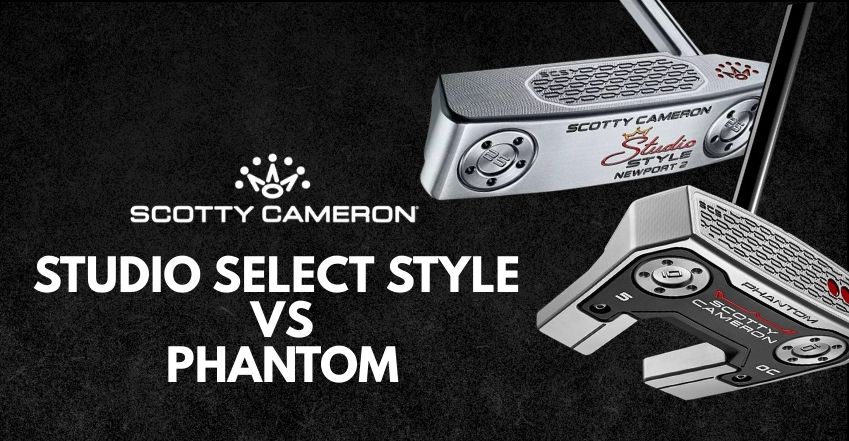
Studio Style putters are Scotty Cameron's blade and compact mid-mallet family — built for players who want maximum feel, feedback, and workability. Phantom putters are the full mallet line — higher MOI, more alignment features, and better forgiveness on off-center strikes. Both families now share the same Studio Carbon Steel face insert and chain-link milling technology, so the feel gap has narrowed significantly. The choice comes down to stroke type, visual preference, and how much stability you need.
What Are the Two Scotty Cameron Putter Families?
Scotty Cameron's current putter lineup splits cleanly into two camps. The naming changed in 2025 — the old Super Select blades became "Studio Style" and the Phantom mallets got a major overhaul for 2026. Both families are built at Cameron's Putter Studio in Southern California, and both now use his signature Studio Carbon Steel (SCS) face insert with chain-link milling.
Here's the quick breakdown:
Studio Style (2025, expanded 2026) — Blades and compact mid-mallets. Think Newport, Newport 2, Fastback, Squareback, the new Santa Fe, and the Catalina. These are the player's putters. Classic shapes, clean sightlines, and the kind of face feedback that tells you exactly where you struck it.
Phantom (2026) — Full-size mallets with wingback designs. The Phantom 5, 7, and 9R. Higher MOI for forgiveness, stronger alignment cues, and the same SCS insert that debuted in Studio Style. These are stability-first putters for players who want consistency on every stroke.
Studio Style vs. Phantom: Side-by-Side Comparison
| Feature | Studio Style | Phantom |
|---|---|---|
| Head Types | Blades (Newport, Santa Fe) + compact mid-mallets (Fastback, Squareback) | Full-size mallets (Phantom 5, 7, 9R) |
| Face Insert | Studio Carbon Steel (SCS) with chain-link milling | Studio Carbon Steel (SCS) with chain-link milling |
| MOI / Forgiveness | Lower — rewards consistent strikers with feel and feedback | Higher — more stable on off-center hits, reduces distance loss on mishits |
| Alignment Aids | Minimal — clean toplines, subtle sight dots, two-tone contrast on mid-mallets | Strong — sightlines, wingback rails, high-contrast visual cues |
| Toe Flow Options | Full range — high toe flow (flow neck) to near face-balanced (single bend) | Moderate to low — mid-bend, plumbing, jet neck, double-bend, OC low-torque |
| Stroke Type | Best for arcing strokes with natural face rotation | Best for straighter, less-arc strokes; OC models suit straight-back-straight-through |
| Feel | Maximum feedback — you feel every strike precisely | Soft and muted — SCS insert dampens vibration through the larger head |
| Price (2026) | $499 standard / $549 Long Design & OC models | $499 standard / $549 Phantom 5 OC |
| Models (2026 count) | 15+ configurations across blades and mid-mallets | 3 head shapes (5, 7, 9R) with multiple neck/shaft configs |
The Face Technology That Changed Everything
Here's something that would've surprised anyone two years ago: the feel gap between a Cameron blade and a Cameron mallet is basically gone.
That's because of the Studio Carbon Steel insert. Cameron's team tested dozens of metals before landing on carbon steel — which has a greater damping capacity than Teryllium, stainless steel, or aluminum. Pair that with the chain-link milling pattern (which reduces contact points with the ball at impact), and you get a putter face that's remarkably soft without deadening the feedback.
Studio Style got this tech first in March 2025. The Phantom line just received it for the 2026 models. So if you tried a Phantom two or three years ago and thought it felt harsh or clicky compared to a blade — try again. Different putter now.
One thing we've noticed handling both families: the Studio Style blades do give you slightly more granular feedback on exactly where you struck it. The Phantom mallets smooth things out a bit — by design. Neither is better. It's a preference.
Who Should Play Studio Style?
Studio Style putters are for golfers who want to feel the putt. Every putt. The good ones and the bad ones.
If you've got an arcing stroke — where the putter head naturally opens on the backswing and closes through impact — most Studio Style models will suit you. The Newport with its plumbing neck gives you solid toe flow. The Santa Fe's flow neck takes that even further. And if you prefer less rotation, the Catalina's single-bend shaft delivers near face-balanced performance in a blade shape.
The mid-mallet options (Fastback and Squareback) are the crossover picks. They're compact enough to look like a blade from above, but the perimeter weighting and aluminum inlays bump up the MOI. We recommend these for players who like the idea of a blade but want a little insurance on off-center hits.
The 2026 additions — Santa Fe, Fastback 2, and Fastback 2 Long Design — round out the family nicely. The Fastback OC (Onset Center) model is also worth a look if you're curious about the low-torque, zero-rotation trend that's been picking up steam on Tour.
Key Studio Style Models to Know
| Model | Type | Neck/Shaft | Best For |
|---|---|---|---|
| Newport | Classic blade | Plumbing neck | Traditional arcing stroke |
| Newport 2 | Angular blade | I-beam plumbing neck | Players wanting squared-off look |
| Santa Fe (new) | Rounded blade | Flow neck — max toe flow | Strong arc, wants face rotation feel |
| Catalina | Wide-body blade | Single-bend — near face-balanced | Straight stroke in a blade shape |
| Fastback / Fastback 2 | Compact mid-mallet | Mid-bend / Plumbing | Blade look, mallet forgiveness |
| Fastback OC | Mid-mallet, low-torque | Onset Center — minimal rotation | Zero-torque, straight-back stroke |
Who Should Play Phantom?
If you want to take some of the guesswork out of putting, that's what Phantom is built for.
The higher MOI means mishits don't punish you as severely. The alignment features — sightlines, wing rails, contrasting colors — make it easier to set up square without overthinking. And the new SCS insert means you're not sacrificing feel for forgiveness anymore.
The 2026 Phantom lineup has three head shapes. The Phantom 5 is the compact one — a wingback mallet that Cameron fans often describe as the "gateway mallet" because it doesn't look or feel like a traditional chunky mallet. Justin Thomas and Russell Henley both won on Tour with Phantom 5 prototypes in 2025.
The Phantom 7 is larger with sharper angles and longer wings. More alignment, more stability. Patrick Cantlay's been gaming a 7.2 prototype. And the new Phantom 9R is a rounded mallet with softer contours — think of it as the Phantom for people who don't love angular shapes.
The big additions for 2026: deeper face heights that reduce issues from excessive upward strikes, a rounded topline for better ball framing at address, and that SCS insert migration from Studio Style. Also new — a double-bend shaft option on the Phantom 7 and the Onset Center (OC) low-torque build on the Phantom 5.
Phantom Models at a Glance
| Model | Shape | Neck/Shaft Options | Best For |
|---|---|---|---|
| Phantom 5 | Compact wingback mallet | Mid-bend, plumbing, jet neck, OC low-torque | Mallet feel without bulk |
| Phantom 7 | Angular wingback, larger footprint | Double-bend (new), plumbing, jet neck | Max alignment and stability |
| Phantom 9R | Rounded mallet, softer look | Mid-bend, plumbing | Mallet stability, softer aesthetics |
What We See on the Used Market
Scotty Cameron putters are the single most counterfeited product in golf. Full stop. We authenticate every one that comes through our shop, and we still catch fakes regularly. So rule number one: buy from a dealer you trust.
That out of the way — here's what the secondary market looks like right now:
The 2025 Studio Style models hold value extremely well. A used Newport 2 in good condition still trades close to retail. Demand is consistently high. The previous-gen Super Select and Select models have dropped in price since Studio Style launched, which makes them interesting value picks if you don't need the SCS insert.
Phantom mallets move a bit faster in terms of depreciation — mostly because mallet designs evolve quicker than blade shapes, and buyers tend to want the latest version. Previous-gen Phantoms (the 2024 models with deep-milled faces instead of SCS inserts) are available at solid discounts and still perform beautifully.
One thing worth knowing: Cameron's Tour Prototype models and Custom Shop finishes hold their value like nothing else in golf equipment. A Circle T or Gallery model can actually appreciate over time. We've seen it firsthand.
The Bottom Line: Which Family Should You Pick?
Pick Studio Style if: you have an arcing putting stroke, you want maximum feel and feedback, you prefer a clean look at address without heavy alignment aids, or you've always been a blade player. The Fastback and Squareback mid-mallets are great stepping stones if you're blade-curious but not ready to give up stability.
Pick Phantom if: you have a straighter putting stroke, you want forgiveness on off-center strikes, you benefit from strong alignment cues at address, or you've been struggling with distance control. The Phantom 5 is where most people should start — it's the least "mallet-looking" mallet in the lineup.
Pick either if: feel is your top priority. The SCS insert has made this an honest-to-goodness toss-up on the feel front. Both families sound and feel excellent. This wasn't true two years ago.
Our recommendation for most mid-handicappers? Start with the Phantom 5 in a plumbing neck configuration. It gives you mallet stability with a compact look, moderate toe flow for a slight arc, and that SCS softness. If you roll it and it feels like too much putter, move to a Studio Style Fastback. If it doesn't feel like enough, try the Phantom 7.
Frequently Asked Questions
Is the Scotty Cameron Phantom replacing the Studio Style?
No — they're two separate families that will continue side by side. Studio Style covers blades and compact mid-mallets. Phantom covers full-size mallets. Cameron expanded both lines for 2026, adding new models to each. There's no indication either family is going away.
Do Studio Style and Phantom putters use the same face insert?
Yes, as of 2026 both families feature the Studio Carbon Steel (SCS) insert with chain-link face milling. Studio Style got it first in 2025, and Phantom added it for the 2026 generation. The insert material and milling pattern are identical across both families.
Which Scotty Cameron putter is most forgiving?
The Phantom 7 offers the highest MOI in the lineup thanks to its larger head shape and extended wingback design. If forgiveness is your top priority, start there. Among Studio Style models, the Squareback 2 and Fastback provide the most stability due to their perimeter-weighted, multi-material construction.
How do I know if a used Scotty Cameron is authentic?
Key authentication checks include verifying the head weight against the stamped specification, inspecting milling quality and consistency, checking font spacing on all stampings, and confirming correct sole weight markings. Counterfeits are common — we authenticate every Cameron that passes through Golf Club Brokers and recommend buying only from reputable dealers.
What's the difference between the Phantom 5 OC and the regular Phantom 5?
The OC (Onset Center) version shifts the shaft position back from the leading edge and in line with the putter's center of gravity, which minimizes torque and promotes a square-to-the-path stroke. It also has a heavier head weight (10 grams more), a stiffer shaft, and a Matador Mid grip. It's built for players who want zero face rotation.
Are previous-generation Scotty Cameron putters still worth buying?
Absolutely. The 2024 Super Select and earlier Select models are excellent putters that have simply been superseded cosmetically and in face technology. They still roll the ball beautifully. On the used market, they represent strong value — especially if you don't prioritize having the latest SCS insert.