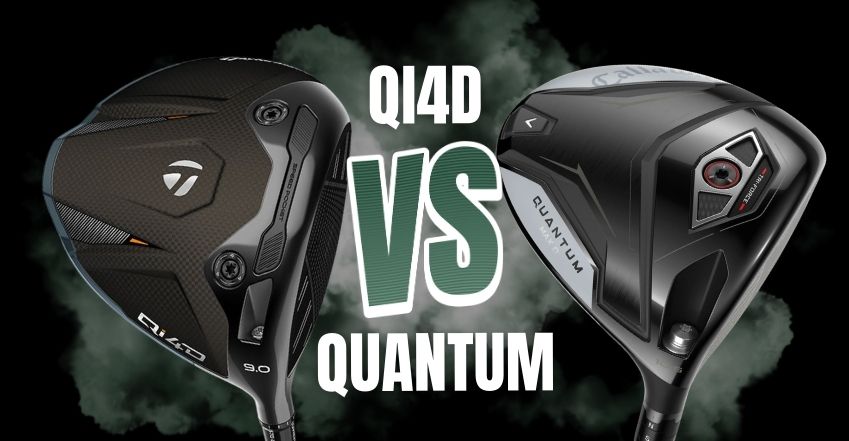
TaylorMade Qi4D vs. Callaway Quantum Driver: The 2026 Showdown
Every year, TaylorMade and Callaway go head to head for driver supremacy. And every year, we get asked the same question: which one should I buy? For 2026, both brands have delivered genuinely impressive flagship drivers—the TaylorMade Qi4D and the Callaway Quantum—and the answer isn't as simple as picking a winner.
We've been handling both models since they hit the market, and we've been following early tour adoption, independent testing, and real-world feedback closely. What we can tell you is this: both drivers represent meaningful improvements over their predecessors, but they're taking fundamentally different approaches to the same goal—more speed, more forgiveness, more consistency off the tee.
In this head-to-head, we'll break down the technology, compare the lineups model by model, and give you our honest take on which driver makes sense for different types of golfers. Let's get into it.
The Big Picture: Two Different Philosophies
Before we compare specs and performance, it's worth understanding what each brand is actually trying to do—because TaylorMade and Callaway are solving the same problem from opposite directions.
TaylorMade's Qi4D is a reset. After the Qi35 drew criticism for manufacturing inconsistencies in the carbon face (some tour players, including Scheffler and McIlroy, famously refused to put it in play), TaylorMade went back to the drawing board. The Qi4D introduces a machine-finished carbon face with a tighter roll radius, improved aerodynamics, and—critically—a new quad weighting system that makes it the most adjustable TaylorMade driver since the R7 era. The message: speed plus fittability, with the consistency problems solved.
Callaway's Quantum is a material breakthrough. Instead of refining a single face material, Callaway layered three materials together—ultra-thin titanium on the outside, carbon fiber on the inside, bonded by a military-grade polymer called Poly Mesh. They call it the Tri-Force Face, and it's the first time these three materials have been combined in a driver face. Paired with Callaway's AI-optimized face mapping, the pitch: each material does what it does best, and the combination produces more speed and more consistency than any single material can deliver alone.
At a Glance: Core Model Comparison
We're comparing the core models—the TaylorMade Qi4D and the Callaway Quantum Max—since these fit the widest range of golfers.
| TaylorMade Qi4D | Callaway Quantum Max | |
|---|---|---|
| Face Technology | 60x Carbon Twist Face with improved roll radius | Tri-Force Face: titanium + Poly Mesh + carbon fiber |
| Face Material | Carbon fiber (machine-finished) | Multi-material: titanium exterior, carbon interior |
| AI/Optimization | FEA-optimized Speed Pocket and roll radius | AI-optimized face mapping for speed, spin, launch |
| Body Construction | Carbon crown + titanium body | 360° carbon chassis |
| Adjustable Weights | 4 TAS weights (9g x2, 4g x2) | 1 movable weight (neutral/draw) |
| Loft Sleeve | 4° adjustable (loft, lie, face angle) | OptiFit 4 hosel (loft, lie, face angle) |
| Available Lofts | 8°, 9°, 10.5°, 12° | 9°, 10.5°, 12° |
| Head Size | 460cc | 460cc |
| Stock Shaft | REAX (by rotation rate: HR, MR, LR) | Project X Cypher 2.0 (by swing speed) |
| Spin Profile | Mid (adjustable via weights) | Mid-to-low |
| Key Tour Players | Scheffler, McIlroy, Fleetwood, Korda, Hull | Schauffele, Burns, Zhang, Bhatia |
| Models in Family | 4: Qi4D, LS, Max, Max Lite | 5: Max, Max D, Max Fast, TD, TD Max |
Face Technology: Carbon Fiber vs. Tri-Force
This is the headline battle of 2026, and it comes down to a fundamental question: is a lighter, all-carbon face better than a multi-material composite? TaylorMade and Callaway have placed very different bets.
TaylorMade: 60x Carbon Twist Face
TaylorMade has been building carbon driver faces since the Stealth in 2022, and the Qi4D represents the fifth generation of that technology. The core argument: carbon is lighter than titanium, and that weight savings translates to faster swing speeds and better mass distribution for higher MOI.
What's genuinely new for 2026 is the manufacturing process. The Qi35's biggest issue wasn't the material itself—it was the hand-grinding process used to shape each face, which introduced variability from head to head. TaylorMade has moved to a machine-finishing process for the Qi4D that produces much tighter tolerances. They've also redesigned the roll radius (the vertical curvature of the face), reducing spin variation by over 30 percent across different impact points—and up to 50 percent in some areas, particularly high on the face. That means less ballooning on high strikes and less drop-off on low ones.
Callaway: Tri-Force Face
Callaway's approach is to stop asking which single material makes the best face and instead combine them. The Tri-Force Face puts ultra-thin titanium on the striking surface (where its compressive strength excels), carbon fiber behind it (where its tensile strength provides flex and recovery), and bonds them with Poly Mesh, a high-strength polymer that holds the system together while allowing each layer to work independently.
The titanium in the Quantum is 14 percent thinner and 17 percent more responsive than previous Callaway faces, because the carbon backing provides structural support that titanium alone can't. Callaway's AI then maps the entire face to optimize speed, spin, and launch based on real player impact patterns. The result, according to early testing, is exceptional ball speed consistency across the face—particularly on off-center strikes, where the Tri-Force construction maintains energy transfer better than a single-material design.
Face Technology: Draw — Both produce elite ball speed and consistency. The Qi4D's carbon face is lighter for better weight distribution. The Quantum's Tri-Force may hold a slight edge on off-center speed retention. You'd need a launch monitor to tell the difference.
Adjustability: Where TaylorMade Pulls Away
This is the clearest separation between the two drivers, and it's not close.
The Qi4D core model features four movable Trajectory Adjustment System (TAS) weights—two at 9 grams and two at 4 grams—in four ports around the head. Move both heavy weights forward for a penetrating, low-spin flight. Push them back for maximum forgiveness. Heel-weight for draw bias, toe-weight for fade. Combined with the 4-degree adjustable loft sleeve, this is the most tunable TaylorMade driver since the R7 SuperQuad.
The Callaway Quantum Max has a single movable rear weight that toggles between neutral and draw positions, plus a forward port for swingweight adjustment. The OptiFit 4 hosel provides loft, lie, and face angle adjustability—solid, but noticeably less flexible than the Qi4D's quad setup.
For golfers who love to tinker or plan to get professionally fitted, the Qi4D's adjustability is a significant advantage. For set-it-and-forget-it players, the Quantum's simpler system works fine—you just have fewer options if your swing changes.
Adjustability: TaylorMade Qi4D — Four movable weights plus a 4° loft sleeve give the Qi4D dramatically more tunability. If you're getting fitted, this matters.
Forgiveness and Consistency
Both drivers deliver outstanding forgiveness for 2026, but they go about it differently.
The Qi4D's improved roll radius tightens spin rates across vertical impact locations, reducing the distance penalty for hitting it high or low on the face. Early testing found remarkably consistent spin numbers—which translates to more predictable carry distances on mishits. The carbon face's lighter weight also pushes mass to the perimeter, boosting MOI.
The Quantum's 360-degree carbon chassis serves a similar purpose, freeing mass for strategic placement. The Tri-Force construction maintains ball speed on off-center strikes exceptionally well—multiple testers noted that toe and low-face misses didn't lose appreciable speed or height. Today's Golfer named the Quantum Triple Diamond Max their Best Overall Driver of 2026, citing exactly this: near-elite distance with genuine forgiveness in one package.
One practical edge for Callaway: the five-model lineup covers more ground than TaylorMade's four. The dedicated Max D (draw bias), Max Fast (ultralight), and Triple Diamond Max (low-spin with forgiveness) give fitters more targeted options out of the box. TaylorMade counters by arguing one highly adjustable Qi4D head can cover what Callaway does with multiple heads. Both approaches work—it depends on whether you'd rather dial in one head or pick the purpose-built one.
Forgiveness: Slight Edge Callaway — Five models gives fitters more targeted options. But the Qi4D's quad weights can replicate many configurations from a single head. Nearly a draw.
Shaft Systems: A New Approach vs. the Standard
TaylorMade is making a bigger bet here, and it's worth understanding.
The Qi4D introduces the REAX shaft system, developed with Mitsubishi Chemical, which categorizes golfers by rotation rate through impact rather than swing speed alone. After analyzing over 11 million driver shots, TaylorMade found that how quickly you rotate the club through the hitting zone is a better predictor of optimal shaft selection than speed. Three REAX profiles (high, mid, low rotation) match your natural release pattern for more center-face contact.
This is genuinely innovative, but requires a fitting—ideally with the Launch Monitor Enabled (LME) head featuring built-in reflective face markers—to identify your rotation profile. If you're buying off the rack, you might not get the full benefit.
Callaway uses the Project X Cypher 2.0 stock shaft, with fitting based on traditional swing speed and launch metrics. Proven and effective, even if less revolutionary. Both brands offer aftermarket options from Fujikura, True Temper, and others.
Shaft Innovation: TaylorMade Qi4D — The REAX rotation-based concept is a genuine step forward. But you need a proper fitting to unlock it.
Looks and Sound
Looks are subjective, but here's what we're hearing consistently.
The Qi4D has drawn near-universal praise. The darker carbon crown with satin finish gives it a sleek, tour-quality look—a significant upgrade from the Qi35's lighter grey. The head shape reverts closer to the popular Qi10 profile: more compact and tour-inspired without sacrificing the footprint needed for forgiveness. Multiple reviewers have called it TaylorMade's best-looking driver in years.
The Quantum takes a more triangular, angular approach, particularly in the sole design. Opinion is more divided—some love the modern, aggressive look, while others find it less confidence-inspiring at address. The woven carbon sole pattern is visually striking, though the lighter grey accents haven't been as universally praised as the Qi4D's darker aesthetic.
Sound-wise, the Qi4D is louder and more traditional in pitch—a positive change over the muted Qi35. The Quantum produces a more dampened impact sound. Neither is objectively better. But if you liked the crack of older titanium drivers, the Qi4D is closer.
Looks: TaylorMade Qi4D — Near-consensus among reviewers. The Qi4D is one of the best-looking drivers of the year. The Quantum's shaping is more polarizing.
Tour Validation
Tour adoption doesn't mean a driver is right for you, but it tells you something about confidence in the product.
The Qi4D's story is remarkable. Scottie Scheffler (world No. 1), Rory McIlroy (No. 2), and Tommy Fleetwood (No. 3) all put the Qi4D in play before official launch, after none of them used the Qi35. Nelly Korda, Charley Hull, and Brooke Henderson followed on the LPGA side. On the DP World Tour, Jayden Schaper collected the first two victories with a Qi4D LS in consecutive weeks. That kind of instant adoption from players who actively rejected the previous model speaks volumes.
The Quantum has strong representation too: Xander Schauffele, Sam Burns, Akshay Bhatia, Si Woo Kim, and Rose Zhang. Schauffele—the reigning Open and PGA Championship winner—is the headline name. Callaway saw 12 players gaming Quantum drivers at the Dubai Invitational shortly after launch.
Tour Validation: TaylorMade Qi4D — The world's top three ranked players—especially after skipping the Qi35—is the strongest driver endorsement of 2026.
Full Lineup: Model-by-Model Matchup
| Player Profile | TaylorMade | Callaway | Key Difference |
|---|---|---|---|
| Low HCP / Low Spin | Qi4D LS — compact, forward CG, 15g + 4g weights | Quantum Triple Diamond — 450cc, neutral/fade APW | LS has 2 movable weights; TD has 1 |
| Low-Mid HCP | Qi4D — quad weights, maximum adjustability | Quantum TD Max — 460cc, low spin + forgiveness | Qi4D has 4 weights; TD Max is a fixed-bias blend |
| Mid HCP / Core | Qi4D (same head, different weight config) | Quantum Max — neutral, 1 movable weight | One adjustable head vs. dedicated head |
| Draw Bias | Qi4D Max — aluminum, 13g + 4g weights | Quantum Max D — heel-weighted, built-in draw | Qi4D Max has adjustable weights; Max D is fixed draw |
| Slow Swing Speed | Qi4D Max Lite — ultralight, single 4g weight | Quantum Max Fast — lightest in lineup | Test both; shaft and weight systems differ |
The philosophical difference is clear: TaylorMade uses the Qi4D core as a Swiss Army knife—one head configurable for multiple profiles through weight changes. Callaway builds purpose-specific heads for each profile. The TaylorMade model rewards fitting and experimentation. The Callaway model gives you a head already optimized for your profile out of the box.
So Which One Should You Get?
Our honest recommendation, based on what we see and what the data shows:
Choose the TaylorMade Qi4D if you...
- Want maximum adjustability and plan to get fitted (or enjoy tinkering)
- Value a compact, tour-inspired shape with a classic pear profile
- Like the idea of rotation-based shaft fitting
- Want the same driver the world's top three players chose
- Prefer a louder, more traditional impact sound
- Tried the Qi35 and were disappointed—the Qi4D addresses those issues directly
Choose the Callaway Quantum if you...
- Want a driver that performs well out of the box without extensive weight adjustments
- Prioritize off-center ball speed retention
- Need a specific configuration like a dedicated draw bias (Max D) or ultralight build (Max Fast)
- Need higher lofts—the Quantum handles high-loft setups cleanly without face manipulation
- Prefer a quieter, more muted impact sound
- Love Callaway's AI face technology lineage from the Paradym Ai Smoke era forward
Can't Decide?
Get fitted. Multiple independent testers have called these two "too close to separate" on launch monitor data alone. The one that's right for you depends on your swing, your miss pattern, and which one looks better to your eye at address. A 30-minute fitting with both heads will tell you more than any review can.
What This Means for Used Club Shoppers
Here's the angle nobody else is talking about: the launch of the Qi4D and Quantum means the previous generation of both brands' drivers just got significantly more affordable on the used market—and those drivers are still excellent.
- TaylorMade Qi35 and Qi10 drivers are hitting the used market as golfers upgrade. The Qi10 is still an outstanding performer, and the Qi35, despite its tour-level consistency issues, works beautifully for the vast majority of amateurs. Both are excellent value right now.
- Callaway Elyte and Paradym Ai Smoke drivers are similarly dropping. The Paradym Ai Smoke Triple Diamond remains one of the best low-spin drivers of the last two years at a fraction of what it cost new.
- Timing tip: Waiting 2–3 months after a new driver launch is the sweet spot for used pricing on the previous generation. Supply increases as trade-ins come in, and the initial demand surge settles.
We authenticate every driver that comes through our shop, which matters more than ever with both TaylorMade and Callaway being among the most counterfeited brands in golf. Buy from a dealer who checks authenticity—not just condition.
The Bottom Line
If we had to pick one, the TaylorMade Qi4D gets a slight edge for most golfers: the quad weighting gives it more versatility from a single head, the tour adoption is unprecedented, and the aesthetics are best-in-class. It's the driver we'd point most golfers toward in a fitting.
But the Callaway Quantum—particularly the Triple Diamond Max—is a legitimate contender that earned Today's Golfer's Best Overall Driver award for good reason. If the Quantum produces better numbers for your swing, don't let anyone talk you out of it. The Tri-Force face is the real deal.
Either way, 2026 is a great year to be shopping for a driver—both new and used.
Frequently Asked Questions
Is the TaylorMade Qi4D or Callaway Quantum better?
Both are outstanding 2026 drivers. The Qi4D offers more adjustability with four movable weights and is used by the world's top three players. The Quantum introduces an innovative Tri-Force face and comes in five models. The best choice depends on your swing—get fitted with both.
What is the Tri-Force face on the Callaway Quantum?
A three-layer face combining ultra-thin titanium, carbon fiber, and a military-grade polymer (Poly Mesh). It's the first time these three materials have been used together in a driver face, designed for maximum speed, flex, and consistency.
What drivers did the Qi4D and Quantum replace?
The Qi4D replaces the Qi35 (2025). The Quantum replaces the Elyte (2025). Both previous-generation models are now excellent values on the used market.
What driver does Scottie Scheffler use in 2026?
Scottie Scheffler games the TaylorMade Qi4D, after declining to use the Qi35.
What driver does Xander Schauffele use in 2026?
Xander Schauffele uses the Callaway Quantum Triple Diamond.