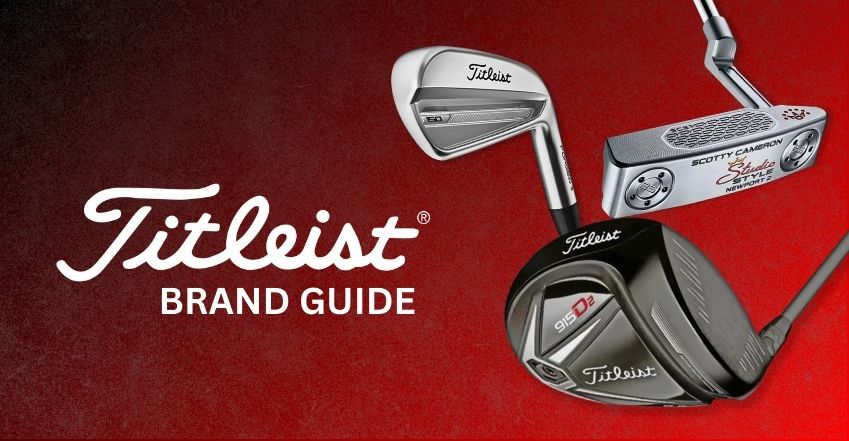
Titleist: The Complete Brand Guide for Golfers (2026)
There's a reason Titleist shows up in more bags on the PGA Tour than any other brand. It's not sponsorship deals or flashy marketing—it's the golf ball. And the irons. And the wedges. And yes, those putters. Titleist has built a reputation across 90+ years that most companies in any industry would kill for: quiet dominance backed by relentless performance.
We handle thousands of Titleist clubs every year at Golf Club Brokers, and we've seen the full spectrum—mint-condition GT drivers still in the wrapper, beaten-up Vokey wedges with the grooves worn smooth, vintage Scotty Cameron Newports that collectors fight over. We know this brand inside and out.
This guide covers everything: Titleist's history, their current lineup across every category, what we see in the used market, and who each product is actually built for. Whether you're considering your first set of Titleist irons or wondering if that used Pro V1 is legit, start here.
TL;DR — Quick Answer
Titleist is the most played iron, wedge, and putter brand on the PGA Tour, owned by Acushnet Company and headquartered in Massachusetts. Their current club lineup includes GT drivers (GT1, GT2, GT3, GT4), T-Series irons (T100 through T350), Vokey SM11 wedges, and Scotty Cameron putters—plus the legendary Pro V1 golf ball family. Titleist equipment holds its value exceptionally well on the used market, and the current generation represents the strongest club lineup in the brand's history. If you want tour-proven performance from tee to green from a single manufacturer, Titleist is the standard.
How Titleist Became Golf's Most Trusted Name
The origin story is almost too good. In 1932, Phil "Skipper" Young—an MIT grad who ran a rubber company called Acushnet Process—missed a putt he should've made. Convinced the ball was the problem, he took it to a friend at the local hospital and X-rayed it. The core was off-center.
That one X-ray changed golf equipment forever.
Young spent three years developing a golf ball with a perfectly centered core. He called it "Titleist"—a play on "titlist," meaning title holder. By 1935, the first Titleist ball was in production. By 1949, it was the most played ball at the U.S. Open. The brand never looked back.
Here's a quick timeline of the milestones that matter:
| Year | Milestone |
|---|---|
| 1910 | Acushnet Process Company founded by Phil Young in Massachusetts |
| 1932 | Young X-rays a golf ball, discovers off-center core — Titleist brand born |
| 1935 | First Titleist golf ball enters production |
| 1949 | Titleist becomes most played ball at the U.S. Open |
| 1962 | Acushnet enters the club business — acquires Bulls Eye putter maker |
| 1976 | American Brands (later Fortune Brands) purchases Acushnet |
| 1985 | FootJoy acquired — joins the Acushnet family |
| 1994 | Scotty Cameron signs partnership with Titleist |
| 2000 | Pro V1 debuts on PGA Tour at Las Vegas — Billy Andrade wins with it the same week |
| 2011 | Fila Korea / Mirae Asset Private Equity acquires Acushnet for $1.23 billion |
| 2016 | Acushnet goes public on NYSE under ticker "GOLF" |
| 2024 | GT driver line launches — Titleist's first polymer-crown driver |
The thing that stands out about Titleist's history isn't any single product. It's the consistency. They've been the most played ball on the PGA Tour for over 70 years. Not 70 months—70 years. That kind of sustained dominance doesn't happen by accident.
Who Owns Titleist? The Acushnet Family of Brands
Titleist isn't a standalone company. It's the flagship brand under Acushnet Holdings (NYSE: GOLF), which also owns FootJoy, Scotty Cameron, Vokey Design, Pinnacle, and KJUS. Together, these brands cover practically everything a golfer wears, swings, or rolls.
Acushnet operates three golf ball manufacturing plants that produce over a million balls a day. Their R&D team includes chemists, physicists, and engineers, plus they hold more than 1,600 golf ball patents. It's a serious operation—and that R&D depth filters down into every product category.
The company's strategy is deliberately focused on what they call the top of the "golf engagement pyramid"—the one to two million most dedicated golfers who prioritize performance and invest in premium equipment. That's who Titleist builds for. If you want the cheapest driver on the rack, they're happy to point you elsewhere.
Yes, the Pro V1 Is Legendary — But Let's Talk Clubs
We can't write a Titleist brand guide without mentioning the Pro V1. It's been the most played golf ball on the PGA Tour for over 70 years, with roughly 75% of touring professionals choosing a Titleist ball. The Pro V1, Pro V1x, and the newer Pro V1x Left Dash remain the gold standard. But Titleist's golf ball dominance is well-documented territory.
What doesn't get enough attention is just how strong Titleist's club lineup has become—and that's what we're going to dig into. Because at Golf Club Brokers, clubs are what we buy, sell, and authenticate every single day. And Titleist's current equipment roster, from drivers through putters, is the deepest and most competitive it's ever been.
Titleist Drivers in 2026: The GT Family
Titleist's driver history is shorter than their ball history—they didn't seriously enter the metalwood business until the late '90s. But they've made up ground fast. As of 2024, Titleist has been the most played driver brand on the PGA Tour for five consecutive years.
The current GT line launched in August 2024 and represented a major shift. For the first time, Titleist moved away from an all-titanium crown, using a new Proprietary Matrix Polymer—essentially a lightweight composite that's three times lighter than titanium. Six years of development went into that material. The result is what Titleist calls Seamless Thermoform Crown construction, paired with Split Mass weighting that pushes discretionary mass to the optimal spots in each head.
There's also the GT1, added in early 2025 for players who want maximum launch and forgiveness with a lightweight build, and the GT280 Mini Driver for golfers looking for something between a driver and a 3-wood.
GT Driver Lineup at a Glance
| Model | Head Size | Best For | Key Feature | Lofts Available |
|---|---|---|---|---|
| GT1 | 460cc | Max forgiveness, lightweight feel | Adjustable lightweight/standard settings | 9°, 10°, 12° |
| GT2 | 460cc | Speed + forgiveness across the face | High MOI, rear weight, pear shape | 8°, 9°, 10°, 11° |
| GT3 | 460cc | Adjustable distance and control | 5-position CG track near face | 8°, 9°, 10°, 11° |
| GT4 | 430cc | Low spin, penetrating flight | Dual weight ports for spin control | 8°, 9°, 10° |
| GT280 Mini | 280cc | Tee or fairway versatility | Flat sole, bridges driver/3-wood gap | 13° |
On Tour, the GT2 accounts for about 60% of Titleist driver usage and the GT3 about 40%. Players like Justin Thomas, Cameron Young, and Will Zalatoris gamed the GT2, while Tom Kim and J.T. Poston preferred the GT3's adjustability. By the time the Genesis Scottish Open rolled around in July 2024, over 100 PGA Tour players had already put a GT in play.
One thing we always tell customers: if you're coming from a TSR2 or TSR3, the GT is a genuine upgrade—not just a cosmetic refresh. The polymer crown changed the game in terms of weight distribution. And the SureFit hosel is backward-compatible with TSR, TSi, and TS models, so your old shaft adapter still works.
T-Series Irons: From Tour Blades to Game Improvement
Titleist has been the most played iron on the PGA Tour for 11 seasons running. The T100 alone has held the "most played iron model" title since 2019. That's a staggering run.
The 2025/2026 T-Series lineup got a significant refresh. The old T200 is gone—replaced by the all-new T250, which looks completely different. And the T350 has been rebuilt from scratch as a hollow-body design. Here's how the current family breaks down:
T-Series Iron Comparison
| Model | Player Profile | Construction | 7-Iron Loft | Key Selling Point |
|---|---|---|---|---|
| T100 | Elite ball-strikers | Fully forged | 33° | Pure Tour precision |
| T150 | Better players wanting more speed | Fully forged, slightly larger | 32° | T100 feel with extra distance |
| T250 | Mid-handicaps wanting distance + looks | Hollow-body, all-steel | 30.5° | Clean look hiding serious tech |
| T250 Launch Spec | Moderate swing speeds needing launch | Hollow-body, lighter heads | 35° | Same T250 tech, weaker lofts for easier launch |
| T350 | Higher handicaps wanting max help | Hollow-body, forged L-face | 29° | Most forgiving Titleist iron, period |
The big news is how good the T250 looks. Previous player's distance irons from Titleist (the T200) had a visible tech badge on the back that turned off better players. The T250 ditches that entirely—all-steel construction that looks almost like a muscle-back blade from behind, while hiding Max Impact technology and a forged L-face inside. It's the iron in the lineup that's going to move the most units, and for good reason.
Blended sets are the norm now—about 80% of Titleist's Tour staff play blended iron configurations. So don't feel locked into one model. A T150 in your long irons and T100 from 6-iron down? That's what the pros are doing.
Titleist also offers the 620 Forged line (MB and CB) for purists who want a traditional muscle-back blade, though these cater to a very small slice of the market.
Vokey SM11 Wedges: Still the Tour Standard in 2026
Bob Vokey's wedges have been the most played on the PGA Tour since 2004. Let that sink in. Twenty-plus years of dominance in a single equipment category—including 26 PGA Tour wins and two major championships in 2025 alone.
The SM11, which hit retail in February 2026, represents the 11th generation of the Spin Milled design. The big improvement this time? Progressive CG positioning. In previous generations, center of gravity shifted between grinds within the same loft. That meant a 56° D-grind and a 56° S-grind actually flew differently. Vokey's engineers fixed this by adjusting hosel lengths across grinds so every wedge in a given loft now launches the same way—regardless of which grind you pick.
Other upgrades include 5% more groove volume for better spin in wet conditions, a directional face texture for increased friction, and a high-frequency heat treatment that doubles groove-edge durability. Three finishes are available: Tour Chrome, a new Jet Black, and Nickel (plus raw through custom order).
We see more Vokey wedges come through our shop than any other brand. They're workhorses—most players replace them every 60–75 rounds once the grooves start losing bite. If you're buying used Vokeys, check the grooves carefully. A fingernail test works: run your nail across the grooves, and if they feel smooth instead of grabbing, the wedge is past its prime.
Scotty Cameron Putters: Where Craftsmanship Meets Obsession
Scotty Cameron has been making putters under the Titleist umbrella since 1994, and the brand has earned an almost cult-like following. Tiger Woods used the same Cameron Newport 2 GSS for 14 of his 15 major championships. That single putter might be the most famous club in golf history.
The 2026 lineup splits into two main families:
Studio Style—blade and mid-mallet designs built around a carbon-steel face insert for soft feel and muted sound. The lineup now includes the Newport, Fastback, Newport 2 Plus, the new Santa Fe, and the Fastback 2 (with a Long Design option). These are the player's putters—clean lines, classic shapes.
Phantom—mallet designs with full-face carbon-steel inserts and chain-link milling for distance control. The 2026 Phantoms come in three head shapes (Phantom 5, 7, and 9R) with a wider range of neck and shaft options than ever before. New additions include the Onset Center low-torque build and a double-bend shaft option.
Cameron putters hold their value better than almost any golf equipment on the secondary market. We handle hundreds of them annually, and the demand never slows down—especially for tour-prototype models, Custom Shop finishes, and limited releases. A mint-condition Super Select Newport can fetch close to retail on the used market years after purchase. Worth noting.
Buying Used Titleist: What We See at Golf Club Brokers
Here's what we tell every customer considering used Titleist equipment:
Resale value is strong across the board. Titleist holds value better than most competitors. GT drivers that are 12–18 months old still trade close to their original prices. T-Series irons from even two generations back maintain respectable value because the designs are so well-regarded.
Previous-generation T-Series irons are phenomenal value. The T200 and T300 (now replaced by T250 and T350) are outstanding irons that dropped in price the moment their successors launched. If you don't need the absolute latest, previous-gen Titleist irons are one of the best deals in golf.
Scotty Cameron putters are the most counterfeited product in golf. We authenticate every putter that comes through our shop. Common tells include wrong weight, incorrect font spacing on stampings, and poor sole milling. Buy from a reputable dealer—not a random marketplace listing.
Vokey wedge condition matters more than age. A one-year-old Vokey with heavy practice use might have less groove life than a three-year-old model that was only played once a week. Always check the grooves before buying used wedges.
Based on what we see in trade-ins, the sweet spot for value right now is previous-gen TSR drivers and T200/T300 irons—Tour-level technology at a fraction of the original price.
Who Plays Titleist on Tour in 2026?
Titleist's Tour presence is massive. Key brand ambassadors include Jordan Spieth, Justin Thomas, Cameron Young, Will Zalatoris, Tom Kim, J.T. Poston, Ludwig Åberg, Adam Scott, and Collin Morikawa (Titleist ball). On the LPGA, players like Jin Hee Im, Emily K. Pedersen, and Albane Valenzuela game Titleist equipment.
But here's what makes Titleist's Tour numbers unique: a huge portion of their Tour usage comes from non-contracted players. Golfers who aren't paid to play Titleist but choose to anyway—especially the golf ball. Roughly 75% of professionals worldwide play a Pro V1 or Pro V1x. That includes players who are sponsored by competing club brands but still choose Titleist's ball because nothing else matches the performance.
The Bottom Line: Is Titleist Right for You?
Best for: Dedicated golfers who want tour-proven performance, premium feel, and equipment that holds its value. Titleist builds for players who care about every detail in their bag—from the dimple pattern on their ball to the grind on their lob wedge.
Maybe not for: Budget-conscious golfers looking for the lowest possible entry price. Titleist is premium equipment at premium prices. That said, previous-generation Titleist on the used market often delivers better performance per dollar than new equipment from lesser brands.
If you're shopping for your first set of serious irons, the T250 is where we'd point most mid-handicappers. Pair it with a GT2 driver, a set of SM11 wedges, and a Scotty Cameron Studio Style putter, and you've got a bag that can take you from a 15 handicap to scratch without changing a thing.
Frequently Asked Questions
Is Titleist the best golf brand?
Titleist dominates the PGA Tour across more equipment categories than any other single manufacturer—balls, irons, wedges, and putters. Whether that makes them "the best" depends on your game and preferences, but the Tour validation is hard to argue with. We see more Titleist clubs come through our shop than any other brand, and customer satisfaction is consistently high.
Are Titleist clubs worth the price?
Titleist equipment sits at the premium end of the market, and the technology and build quality justify it. They also hold resale value better than most competitors. A set of T-Series irons purchased new will still be worth a meaningful percentage of its original price two or three years later, which isn't true for a lot of brands.
What's the difference between Pro V1 and Pro V1x?
The Pro V1 flies on a slightly lower, more penetrating trajectory with a softer feel. The Pro V1x launches higher with a firmer compression. The Pro V1x Left Dash takes that further with dramatically lower full-swing spin. Most mid-handicappers will prefer the Pro V1. Faster swingers who want a higher ball flight tend to gravitate toward the Pro V1x.
How do I know if a Scotty Cameron putter is real?
Counterfeits are common with Scotty Cameron. Key things to check: the weight should match the stamped specification exactly, the milling pattern should be crisp and uniform, and the font on face stampings should be perfectly spaced. If you're not confident, buy from a reputable dealer like Golf Club Brokers—we authenticate every Cameron that passes through our hands.
Which Titleist iron is best for mid-handicappers?
The T250 is purpose-built for mid-handicap players. It combines a clean, player-preferred look with hollow-body distance technology and a forgiving sweet spot. If you have a slower swing speed, the T250 Launch Spec offers the same tech with weaker lofts and lighter head weights for easier launch.
Does Titleist make game-improvement clubs?
Yes. The T350 iron is Titleist's game-improvement offering—it's their most forgiving iron with the highest launch and most distance across the face. The GT1 driver serves a similar role for players who need maximum forgiveness with a lightweight feel. Titleist has historically focused on better players, but the current lineup genuinely caters to all skill levels.