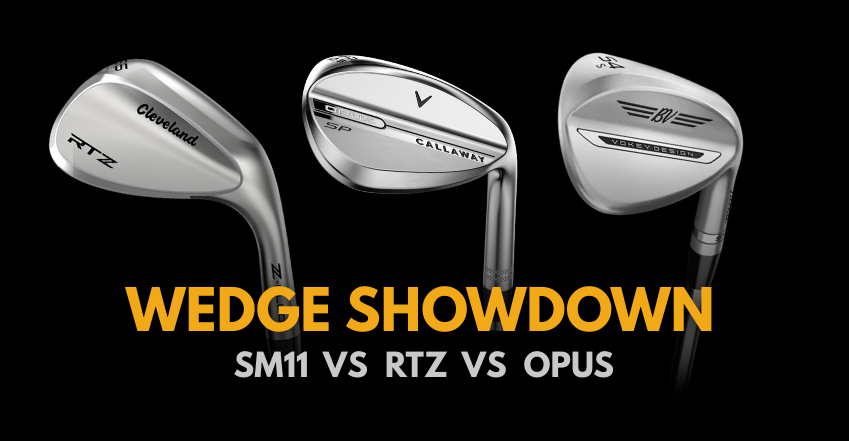
Vokey SM11 vs Cleveland RTZ vs Callaway Opus SP+: 2026 Wedge Showdown
Three wedges. Three philosophies. All claiming to be the best scoring club in your bag. The Titleist Vokey SM11, Cleveland RTZ, and Callaway Opus SP+ represent the state of the art in wedge design — and choosing between them is harder than it's been in years.
That's good news. It means there's no wrong answer. But there is a best answer for your game, and it depends on what you value most: Tour-proven reliability, innovative materials, or spin-focused engineering. We handle all three brands constantly at Golf Club Brokers, and that perspective shapes everything in this comparison.
TL;DR — Quick Answer
The Vokey SM11 is the safest choice — the most played wedge on both major Tours, the widest grind selection, and a new Precise CG system that makes grind swaps seamless. The Cleveland RTZ brings Z-Alloy steel for better feel and rust resistance, plus Roger Cleveland's design influence. The Callaway Opus SP+ is the spin specialist — 3-piece construction with tungsten and a Spin Pocket that produces the lowest, most controlled launch of the three. All three produce comparable spin numbers on clean strikes. Previous-generation models are widely available on the used market and deliver outstanding performance at significant discounts.
The Head-to-Head Comparison Table
| Spec | Vokey SM11 | Cleveland RTZ | Callaway Opus SP+ |
|---|---|---|---|
| Material | 8620 carbon steel, heat-treated | Proprietary Z-Alloy steel | 3-piece: 8620 body, MIM face, tungsten |
| CG Story | Precise CG: identical CG in all grinds per loft | ZipCore: low-density core raises CG, centers it | Spin Pocket + tungsten raises CG highest of the three |
| Grinds | 6 grinds (F, S, M, D, K, T) | Multiple sole options incl. Adaptive Sole | 5 grinds (limited to 54–60° in SP+) |
| Finishes | Tour Chrome, Nickel, Jet Black, Raw | Tour Rack (raw), Tour Satin, others | Chrome, Shadow Black |
| Groove Tech | Angled face texture + heat-treated grooves (2x durability) | Wheel-cut grooves with HydraZip face | Spin Gen 2.0: 17° groove angle, tighter pitch, cross-hatch laser |
| Feel | Classic soft carbon steel; Tour standard | Softer and more muted thanks to Z-Alloy | Firmer, snappier; MIM face is solid and responsive |
| Rust Resistance | Raw finish rusts (by design); chrome/nickel don't | Z-Alloy is rust-resistant across all finishes | Standard durability; chrome and shadow finishes |
| Tour Usage | Most played wedge on PGA + DP World Tours | Growing; Koepka, Lowry, Matsuyama, Spaun | Schauffele, Rahm; fastest Tour conversion in Callaway history |
| Best For | Widest selection; golfers who want proven reliability | Value + innovation; best feel for the money | Spin-obsessed players; low-launch wedge play |
Titleist Vokey SM11: The Benchmark
The SM11 doesn't try to reinvent wedge design. It refines it. The headline innovation — Precise CG — sounds subtle, but it solves a real problem. In previous Vokey generations, switching between grinds at the same loft could subtly change your trajectory because the CG shifted with the sole geometry. SM11 eliminates that by referencing CG to the leading edge instead of the ground plane. Every grind at a given loft now produces the same ball flight.
Practically, that means you can pick your grind purely for turf interaction and feel, without worrying about trajectory changes. That's a meaningful improvement for golfers who play different grinds in different conditions.
The groove system has been updated with angled face texture and heat-treated grooves that Titleist claims double the durability. Available in four finishes and six grinds across a wide loft range. The SM11 was the most-played wedge model on both the PGA Tour and DP World Tour in its very first week.
Best for: Golfers who want the widest grind selection, proven Tour performance, and the confidence that comes from playing what most of the world's best play.
Cleveland RTZ: The Materials Innovator
The RTZ is Cleveland's statement that they're all-in on wedges. With the brand exiting irons and woods in 2026 to focus exclusively on wedges and putters, the RTZ gets their full R&D attention.
The headline is Z-Alloy — a proprietary steel developed by Cleveland's in-house metallurgy team. It's softer and less dense than traditional 8620 carbon steel, which does two things: it feels better at impact (softer, more muted), and it's naturally rust-resistant. That second part matters. If you play raw-finish wedges because you like the look and feel, Z-Alloy gives you that without the actual rusting.
ZipCore technology — a low-density core material cast into the hosel area — moves weight away from the neck and raises the CG for better spin and feel. The RTZ is also the most affordable of the three, which combined with the Z-Alloy durability makes it arguably the best value proposition in the wedge market.
Roger Cleveland returning to the company adds credibility. He's consulting on grind design, and the man knows scoring clubs better than almost anyone alive.
Best for: Golfers who want premium feel, rust resistance, and the best value of the three. Particularly strong for players who prefer a raw-style finish without the maintenance.
Callaway Opus SP+: The Spin Engineer
The Opus SP+ is the most technically ambitious wedge of the three. Its 3-piece construction — cast 8620 body, MIM (metal injection molded) face, and tungsten weighting in the topline — is designed to push the CG as high as possible for the lowest launch and highest spin.
The Spin Pocket, a hollowed-out section behind the face, is 25% larger in the SP+ versus the standard Opus SP. Combined with 23% more tungsten than the Opus Platinum, the SP+ produces the most penetrating flight of any wedge in Callaway's history.
The feel is different from both the Vokey and RTZ — firmer, snappier, with a distinctive click at impact. Some golfers love it. Others prefer the softer response of carbon steel. This is genuinely a preference thing, not a quality issue.
One limitation: the SP+ is only available from 54–60 degrees. For gap wedges (46–52°), you'd pair it with the standard Opus SP, which uses a 2-piece construction without the tungsten. That's by design — Callaway says the Spin Pocket isn't needed at lower lofts where CG is naturally in the right position.
Best for: Low-handicap players obsessed with spin control and penetrating flight. Golfers who want the most technologically advanced scoring club available.
Smart Wedge Shopping on the Used Market
Here's where things get exciting for golfers who know what they want.
The Vokey SM10 (previous gen) is widely available used and represents outstanding value. Same steel, similar grooves, and the CG difference is only noticeable if you're switching grinds frequently. If you play one grind and one loft, a used SM10 is 95% of the SM11 at a significant discount. We see these come through Golf Club Brokers constantly, and the demand stays strong because golfers recognize how much wedge you're getting for the money.
Cleveland RTX ZipCore (previous gen) is also excellent used value — same ZipCore technology, just the older steel composition rather than Z-Alloy. Feel difference is subtle. And because Cleveland wedges depreciate faster than Vokeys, the savings are even steeper.
Callaway Opus (original) and Opus SP are starting to appear on the used market as players upgrade to SP+. The original Opus with its single-piece 8620 construction is a steal at current used pricing — same Shape 6 Tour-validated profile, same angled grooves.
When shopping used wedges, groove condition is the thing to check. Run your fingernail across the groove edges. If they feel sharp and catch your nail, you're good. If they feel smooth or rounded, the wedge has seen heavy play and the spin performance has degraded. A used wedge with sharp grooves — and there are plenty out there — performs identically to a new one. That's the beauty of buying smart.
One more thing worth knowing: the SM11's heat-treated grooves and the RTZ's Z-Alloy both claim improved groove durability over previous generations. That means as these models start appearing on the used market, they should hold their performance characteristics longer than older models did — making them even better used buys down the road.
The Verdict: Which Wedge Should You Buy?
If you want the safest choice: Vokey SM11. It's the benchmark for a reason — the widest selection, the most Tour validation, and now the most consistent CG system in the category.
If you want the best value: Cleveland RTZ. Z-Alloy is a genuine material innovation, the feel is outstanding, and Roger Cleveland's involvement is more than symbolic.
If you want maximum spin control: Callaway Opus SP+. The 3-piece construction, tungsten weighting, and Spin Pocket produce the lowest launch and most penetrating flight. It's the most specialized of the three — and that's its strength.
If you're shopping smart: Previous-generation models from all three brands — SM10, RTX ZipCore, original Opus — are available on the used market at significant discounts. With sharp grooves and the right grind for your game, a used wedge from any of these families is a legitimate scoring weapon.
The differences between these three current models are real but narrow. Any of them will serve you well. And any of their predecessors, in good condition, will too.
Frequently Asked Questions
Which wedge has the most spin?
On clean, center-face strikes with a premium ball, all three produce comparable spin — roughly 7,000–7,500 RPM on a 50-yard pitch. The Opus SP+ tends to produce slightly lower launch with similar spin, which can feel like more bite on landing. The RTZ and SM11 are nearly identical in raw spin numbers.
Can I mix wedge brands in my bag?
Absolutely. Many Tour players do. There's no rule that says your wedges need to match. Pick the best wedge for each loft and grind slot based on what performs for you. A Vokey gap wedge with a Cleveland sand wedge and a Callaway lob wedge is perfectly fine.
How do I know if a used wedge still has good grooves?
Run your fingernail across the groove edges. Sharp grooves will catch your nail; worn grooves feel smooth or rounded. You can also look at the face under good light — groove edges should appear crisp and defined, not soft or blurry. A reputable dealer will grade groove condition honestly.
Which has the best grind selection?
The Vokey SM11 wins here with six grinds across the widest loft range. Cleveland offers strong grind variety including the Adaptive Sole. Callaway's Opus SP+ has five grind options but is limited to 54–60 degrees, with the standard Opus SP covering gap wedge lofts.
Are previous-generation wedges from these brands still worth playing?
Yes. The SM10, RTX ZipCore, and original Opus are all excellent wedges. The performance gap between generations is small — mainly CG refinements and groove durability improvements. A previous-gen wedge with good groove condition will perform nearly identically to the current model for most golfers.
Which wedge holds its value best on the used market?
Vokey wedges hold resale value better than Cleveland or Callaway, primarily due to Tour prestige and brand demand. Cleveland and Callaway wedges depreciate faster, which makes them outstanding value buys for used shoppers.