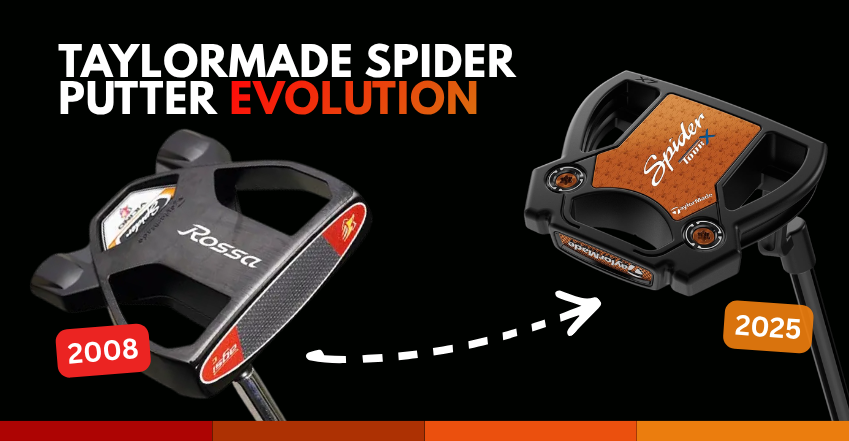
TaylorMade Spider Putter Evolution: From Monza Spider to Spider Tour X
When the original TaylorMade Spider launched in 2008, plenty of people called it "beyond ugly." Seventeen years later, a Spider putter walked Rory McIlroy down the 18th fairway at Augusta National to complete his career Grand Slam. Not bad for a putter nobody wanted to look at.
The Spider franchise is one of the most successful putter lineages in golf history — more than 1.5 million units sold, reportedly north of $250 million in lifetime retail, and a collection of majors, FedEx Cups, and World Number Ones who've rolled it through their best seasons. We see Spiders in our shop every week at Golf Club Brokers, across every generation, and the shape has become so iconic that each era has its own collector's following.
This guide walks you through the full 17-year arc of the Spider putter — from the original Monza Spider to today's Spider Tour Series. We'll cover every major generation, the tour stories behind each one, which version might be right for your stroke, and — most importantly for GCB shoppers — how to find the best Spider value on the used market.
Why the Spider Changed Putter Design Forever
Before 2008, PGA Tour bags were dominated by blade putters. Scotty Cameron Newports, Ping Ansers, classic shapes that had ruled greens for decades. The Spider flipped that. Today, more than 60 percent of PGA Tour players use a mallet-style putter — and the Spider is a huge reason why.
TaylorMade's original pitch was simple: more stability means more putts made, especially on off-center strikes. A high-MOI (moment of inertia — basically resistance to twisting on mishits) mallet holds its line better than a blade when you don't catch the ball perfectly in the middle of the face. Tour pros noticed that their lag putts from 30 feet were tracking closer to the hole, and their 6-footers were breaking less off the toe.
Rory McIlroy, one of the best ball-strikers in the world but a streaky putter his whole career, reportedly gained 1.25 strokes per round with his Spider X compared to the blade he used before. Over a four-day tournament, that's five shots. Five shots is the difference between winning the Open Championship and finishing T-15.
The Complete TaylorMade Spider Putter Timeline
Here's the full family tree, generation by generation.
| Year | Model | Key Innovation | Notable Moment |
|---|---|---|---|
| 2008 | Monza Spider | Steel frame + aluminum core + rear weights | JB Holmes wins FBR Open over Mickelson |
| 2009 | Itsy Bitsy Spider | 20% smaller head, refined core shape | Became the template for all future Spiders |
| 2011 | Ghost Spider | White-bodied alignment revolution | Justin Rose wins at The Memorial |
| 2013 | Spider Blade | Spider tech in a blade profile | Justin Rose wins 2013 US Open at Merion |
| 2017 | Spider Tour Red | Milled aluminum body, compact shape | Jason Day's requested red signature |
| 2019 | Spider X | True Path alignment, new Pure Roll insert | Rory McIlroy's prototype goes retail |
| 2021 | Spider EX | Refined CG, enhanced stability features | McIlroy's best putting year (2022) |
| 2022 | Spider GT / MySpider GT | Full customization platform launch | Dustin Johnson, Collin Morikawa adoption |
| 2024 | Spider Tour Series (S/V/X/Z) | 5-model family, HYBRAR Echo Damper | Scottie Scheffler wins 2024 Masters |
| 2025 | Spider Tour X (Rory's gamer) | Career Grand Slam at Augusta | Scheffler PGA Championship + Olympic gold |
2008 — The Original Monza Spider
The one that started everything. TaylorMade had forecast maybe 30,000 units for the launch year. They sold over 200,000. The golf world was not prepared.
The Monza Spider's engineering was genuinely new: a steel wireframe, an aluminum core, and "legs" that held additional weights out at the perimeter. That construction pushed the moment of inertia to levels no traditional mallet could match. The shape was so unlike anything else at the time that tour pros were slow to adopt it — exactly four went into play the first week.
Then JB Holmes won the 2008 FBR Open (now the Waste Management Phoenix Open) in a playoff over Phil Mickelson, and the conversation changed. Holmes was known at the time as one of the worst putters on tour, which made the win even more of a proof point. By Torrey Pines a few weeks later, 12 Spiders were in play. Six months after launch, Spider was a phenomenon.
Used-market status: collector's item. Original Monza Spiders are relatively rare in good condition and carry a premium among putter enthusiasts.
2009 — The Itsy Bitsy Spider
Tour pros loved the performance of the Monza Spider but asked for a 20 percent smaller package — something less overwhelming at address. TaylorMade delivered the Itsy Bitsy Spider, playfully named but seriously engineered. The shape that came out of this redesign became the foundation for every Spider that followed. If you see a modern Spider and think "that shape looks familiar," it's because the Itsy Bitsy's DNA is in every one of them.
The Itsy Bitsy got multiple color treatments — all-black, Jason Day's signature red (after reportedly 15 different red shades were tested before one was approved), and a white "Ghost" variant that opened up an entirely new chapter.
2011 — The Ghost Spider Revolution
In 2010, TaylorMade launched the Corza Ghost — a white-bodied putter that exploited the visual contrast between a white head and green grass for easier alignment. Justin Rose won at The Memorial with it almost immediately, and two starts later he won again. The white-putter revolution was on.
A year later, the Ghost Spider combined the white finish with the high-MOI mallet platform. TaylorMade was aggressively pushing alignment as a core selling point — their data at the time showed that 65 percent of amateur golfers were not set up square to the target from 12 feet. The white head against green turf was designed to fix that.
Used-market status: plentiful, usually affordable. Finish wear is common on the white models, so condition grading matters more than on later Spiders.
2013 — Spider Blade: The US Open Winner
This one surprised a lot of people. TaylorMade took the Spider name and applied it to a blade-shaped putter — high-MOI tech in a classic look. Most Spider fans overlooked it because it didn't look "Spider-ish" enough. But Justin Rose put it in his bag, and at Merion that June he tapped in to win the 2013 US Open — the first major championship for any Spider-branded putter.
The Spider Blade is a footnote in the evolution, but an important one: it was the first time TaylorMade tried to stretch the brand beyond the original mallet shape, and it won a major doing it.
2017 — Spider Tour and Spider Tour Red
After the original Spider shape's initial wave of popularity faded, TaylorMade rebooted the franchise in 2017 with the Spider Tour series. Milled aluminum body, compact shape, refined weighting — and the signature red paint scheme that Jason Day requested.
This is the generation where Spider officially became a "franchise" rather than a single model. Tour Red for Day, Tour Black for stealthier tastes, and retail versions that fit squarely in the premium mallet conversation with Odyssey and Scotty Cameron. Dustin Johnson's adoption of Spider putters around this era carried enormous signal weight — when the world's best ball-striker commits to a new putter, retailers notice.
Used-market status: excellent value. Spider Tour Red and Black from 2017–2018 can frequently be found at roughly half the price of a current Spider Tour Series model, and they perform nearly identically for 95 percent of players.
2019 — Spider X: The Tenth-Generation Rory Gamer
The Spider X was the putter Rory McIlroy used through some of his best putting seasons, and it was unveiled as the 10th generation of the Spider line. Two defining technology changes arrived here:
- True Path Alignment. A white stripe running parallel to the target line across the crown, flanked by a black centerline. TaylorMade described it as "optically engineered" to trigger visual alignment response — and it became the signature Spider aesthetic from this point forward.
- Updated Pure Roll insert. A thicker Surlyn face insert with more grooves for reduced backspin at impact and faster end-over-end roll.
The Spider X launched in navy-and-white and copper-and-white colorways. It was offered in short slant and single-bend hosel options, and retailed at $349.99 USD — which is still roughly where premium Spider putters are priced today, seven years later.
Used-market status: one of the sweet spots for value. A Spider X in good condition is an absolute steal for a player who wants Rory's old gamer at 40-60 percent of current retail.
2021 — Spider EX: The Refinement
The Spider EX was less of a revolution and more of a polish — refined CG, incremental material tweaks, updated alignment aids. Rory McIlroy had his statistically best putting year in 2022 gaming a Spider variant from this era, which tells you the platform was operating at the highest level tour golf demands.
2022 — Spider GT and the MySpider Customization Era
The Spider GT introduced a broader product family and the MySpider customization platform — a way for buyers to specify crown color, wing color, paint fills, insert, weights, and hosel from a menu of options. Rollback and Notchback variants added traditional mallet shapes with Spider stability baked in.
This is where the "Spider is a family, not a single putter" concept became fully realized. Just like Porsche's 911 lineup has a Carrera, a Turbo, and a GT3 that share a shape but tune for different drivers, the Spider now had multiple models tuned for different stroke types.
2024 — The Spider Tour Series (Current Generation)
The 2024 Spider Tour Series is the current flagship line and represents TaylorMade's most mature approach to the Spider platform. Instead of refreshing a single model, they released five simultaneously:
- Spider Tour: The flagship. Pronounced rear wings, 5,700 MOI, CG 35mm from face, 29° toe hang on the small slant hosel. The most "classic Spider" shape in the current line.
- Spider Tour X: Slightly more compact than Tour, with less prominent rear wings. CG pushed forward to 33mm for more face rotation, 5,000 MOI, 30° toe hang. Rory McIlroy's gamer. Also available in Scottie Scheffler's L-Neck hosel with 21° toe hang for golfers who prefer more blade-like release feel.
- Spider Tour V: The streamlined one. Wing structure eliminated for a cleaner look — effectively the "if you can't stomach big mallets, try this" option. Smallest profile in the series, CG at 27mm, MOI 4,900, 32° toe hang.
- Spider Tour Z: Pays homage to the classic Spider silhouette with low-sitting perimeter wings that frame the ball at address. CG way forward at 29mm for blade-like feel, MOI 5,050, 29° toe hang.
- Spider Tour S (Counterbalance): The heavy hitter. 3mm longer and 8mm wider than the standard Tour, heavier head, only offered in 35" and 38" counterbalanced configurations. CG 38mm, MOI 6,063 — the most forgiving putter in the Spider line.
All five share the True Path alignment, the Pure Roll Surlyn+aluminum face insert with 45° grooves, and a new HYBRAR Echo Damper sole chamber borrowed from the Stealth iron line that effectively eliminates impact vibration.
2025 — The Year Spider Became Undeniable
If there was any lingering doubt about the Spider Tour X's place in history, 2025 erased it:
- Rory McIlroy won the Masters at Augusta National using his Spider Tour X with a short slant hosel — completing his career Grand Slam, one of the rarest achievements in golf.
- Rory also won the AT&T Pebble Beach Pro-Am and The Players Championship that same year, all with the same putter.
- Scottie Scheffler — already the world number one — won the 2025 PGA Championship and an Olympic gold medal with his Spider Tour X L-Neck.
- Since the start of 2024, Spider putters have accounted for 20+ PGA Tour wins, more than any other putter family in the game.
The Spider line didn't start its life as a classic — it had to earn that status. 17 years, three World Number Ones, multiple majors, and a career Grand Slam later, it's one of the most iconic putters ever designed.
Which Spider Putter Is Right for Your Stroke?
The honest answer: it depends on your stroke arc, your visual preferences, and your toe hang needs. Here's the simplified fitting guide.
| Your Stroke Type | Best Hosel / Model | Why |
|---|---|---|
| Straight-back, straight-through | Double bend hosel (Spider Tour, V, Z) | Face-balanced design keeps face square through stroke |
| Slight arc, mild face rotation | Small slant hosel (any Spider Tour) | 30° toe hang matches natural face rotation |
| Strong arc, full face release | L-Neck (Spider Tour X L-Neck) | 21° toe hang plus offset blade-like release |
| Stability-seekers / counterbalance fans | Spider Tour S Counterbalance | Highest MOI (6,063), heaviest head, counterbalance grip |
| Fans of classic Spider profile | Spider Tour or Spider Tour X | Original wing silhouette, MOI 5,000–5,700 |
| Want smaller visual profile | Spider Tour V | No wings, streamlined, least visually imposing |
If you're transitioning from a blade and worried about the mallet shape at address, the Tour V is the easiest entry point. If you've been putting well with any Spider from 2017 onward, the Spider Tour (standard) is the most familiar upgrade. If you want the putter the last two Masters winners gamed, you're looking for Spider Tour X — either small slant (Rory) or L-Neck (Scheffler).
Buying a Used TaylorMade Spider: What to Look For
Spider putters are some of the best values in the used market because they hold up well and tend to get traded in when owners upgrade rather than when they fail. Here's what we inspect on every Spider that comes through our shop:
- Face insert condition. The Pure Roll Surlyn insert is the business end of the putter. Look for excessive wear, hardening, or visible grooves that have rounded off. A tired insert kills consistent roll. Most Spiders hold up extraordinarily well here — it's rare to find one that needs insert replacement.
- Painted finish integrity. Spider putters are almost always painted rather than plated. That means paint chipping around the top edges and sole is common on older models — especially the white Ghost-era Spiders and the red Spider Tour Red. Cosmetic wear doesn't affect performance, but it affects resale.
- Sole weight condition. Many Spiders have removable weights. Check they're tight, not cross-threaded, and that you have the correct spec for the length.
- Hosel and shaft connection. Look for any wobble at the hosel, cracks, or loose ferrules. Spider hosels take stress because of the head weight — it's the most common point of repair issue on older models.
- Grip wear. SuperStroke and stock Pistol GT grips wear out faster than you'd think. Budget $25–$40 for a regrip if the current grip feels glazed or tacky.
- Authentication. Spider putters are the most-counterfeited putter on earth. Check the serial number location, the paint depth, the weight of the head, the font of the engraving, and the packaging if available. Buying from a verified dealer is genuinely the simplest way to avoid a counterfeit.
At Golf Club Brokers, every Spider putter we sell has been authenticated by our team. We see counterfeits every month — some are obvious, some are frighteningly good. If you're shopping Spiders on open marketplaces, buy from dealers with real reputations, not random listings.
Which Generations Offer the Best Used Value?
- Sweet spots: Spider X (2019), Spider EX (2021), and Spider Tour Red/Black (2017–18) all offer excellent performance at roughly 40–60 percent of current retail. These are the generations we most often recommend to customers who want Spider performance without premium pricing.
- Premium territory: Current-generation Spider Tour Series (2024+) holds value well because the design is current on tour. Expect to pay 70–85 percent of retail for excellent-condition used copies.
- Collector territory: Original Monza Spider (2008), Itsy Bitsy Spider, and original Ghost Spider pieces in clean condition carry historical premiums. These aren't usually the best pure performers, but they're meaningful to collectors.
- Avoid: Heavily worn Ghost-era white Spiders where the paint is visibly degraded. The performance is still there, but the resale is limited, and they photograph badly in a bag.
Key Takeaways: The Spider Legacy
- The original 2008 Monza Spider revolutionized mallet putter design and sold over 200,000 units in its first year against TaylorMade's 30,000 forecast.
- More than 1.5 million Spider putters have been sold across the franchise's lifetime, generating reportedly over $250 million in retail revenue.
- The current Spider Tour Series (2024) includes five models — Tour, Tour X, Tour V, Tour Z, and Tour S Counterbalance — each with distinct CG locations and MOI values.
- Rory McIlroy's Spider Tour X completed his career Grand Slam at the 2025 Masters. Scottie Scheffler's Spider Tour X L-Neck won the 2025 PGA Championship and an Olympic gold.
- Since the start of 2024, Spider putters have won more PGA Tour events than any other putter family in golf.
- The used market is where the real Spider value lives. Spider X and EX generations offer current-gen performance at 40–60% of retail.
- Authentication matters. Spiders are among the most counterfeited putters. Always buy from a verified dealer.
Frequently Asked Questions
What was the original TaylorMade Spider putter?
The original TaylorMade Spider, known as the Monza Spider, launched in 2008. It featured a steel frame, aluminum core, and rear perimeter weights designed for maximum MOI and stability. It was considered unconventional at launch but sold over 200,000 units in its first year and kicked off one of the most successful putter franchises in golf history. JB Holmes won the 2008 FBR Open (now Phoenix Open) in a playoff with the Monza Spider.
What putter does Rory McIlroy use?
Rory McIlroy uses the TaylorMade Spider Tour X with a short slant hosel, which produces about 30 degrees of toe hang to suit his arced stroke. He used this putter to win the 2025 Masters and complete his career Grand Slam, as well as The Players Championship and the AT&T Pebble Beach Pro-Am that same year. He has also won multiple other PGA Tour events using Spider variants dating back to the Spider X era (2019).
What putter does Scottie Scheffler use?
Scottie Scheffler uses the TaylorMade Spider Tour X with the L-Neck hosel, which produces only 21 degrees of toe hang — a more blade-like release feel compared to standard Spider hosels. Since switching to this setup at the 2024 Arnold Palmer Invitational, Scheffler has won 14+ tournaments worldwide including the 2024 Masters, 2025 PGA Championship, and an Olympic gold medal.
What's the difference between Spider Tour and Spider Tour X?
The Spider Tour is the flagship shape with pronounced rear wings, an MOI of 5,700, and a CG 35mm from the face. The Spider Tour X is slightly more compact with less prominent wings, an MOI of 5,000, and a CG pushed forward to 33mm for more face rotation. Both come in small slant and double bend hosels; the Tour X is additionally offered in L-Neck for golfers who want more blade-like feel.
Are Spider putters good for high handicappers?
Yes. Spider putters are designed specifically for forgiveness on off-center strikes, which is exactly what higher-handicap golfers need. The high-MOI mallet shape protects ball speed on mishits, so a putt struck slightly off-center still travels roughly the intended distance. The Spider Tour S Counterbalance is particularly forgiving (MOI 6,063), and the Tour Series as a whole is one of the most beginner-friendly lines in the premium putter segment.
How much is a used TaylorMade Spider putter worth?
Used Spider values vary significantly by generation and condition. A clean Spider Tour X from 2019 typically runs 40–60 percent of current Spider Tour Series retail. Current-gen 2024 Spider Tour Series putters in excellent used condition run 70–85 percent of retail. Original Monza Spiders in clean condition carry collector premiums. Shop from a reputable dealer who authenticates every putter to avoid the common counterfeit problem.
Does TaylorMade still make the Spider putter?
Yes — the current Spider lineup is the 2024 Spider Tour Series (Tour, Tour X, Tour V, Tour Z, and Tour S Counterbalance), plus the newer Spider ZT that came to market afterward. TaylorMade also offers the MySpider customization platform for buyers who want to personalize color, finish, insert, weights, and hosel. The Spider franchise shows no sign of slowing down — 2025 was statistically the most successful year in the line's history.
What's the MOI of a TaylorMade Spider putter?
MOI varies by model. In the current Spider Tour Series: Spider Tour is 5,700, Spider Tour X is 5,000, Spider Tour V is 4,900, Spider Tour Z is 5,050, and Spider Tour S Counterbalance leads the way at 6,063. For context, typical blade putters have MOIs around 3,500–4,500, so every Spider Tour Series model is meaningfully more forgiving than a traditional blade.
Ready to Buy, Sell, or Trade In a Spider?
Whether you're looking for a current-generation Spider Tour X, a classic Spider X at a serious discount, or a rare original Monza Spider for your collection, we keep one of the largest used Spider inventories in the country. Every putter is authenticated, hand-inspected, and graded honestly. If you've got a Spider to trade in or sell outright, we pay fair prices based on real resale value.