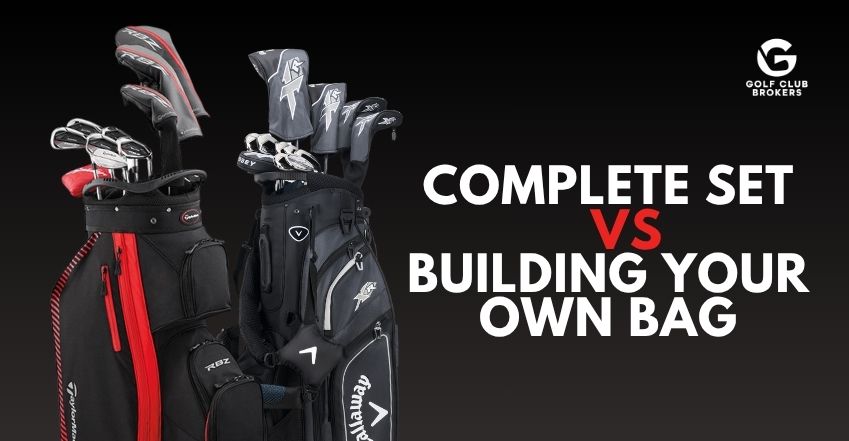
Complete Set vs. Building Your Own Bag: Which Path Is Smarter in 2026?
A guy walked into our shop last month. His wife had just bought him a Callaway Strata set for his birthday — nice gift, thoughtful choice. He'd hit it maybe six times at the range. And he wanted to know: should he keep it, or trade it in toward a used set built piece by piece?
Our honest answer surprised him. For someone who's completely brand new to golf and might bail out of the hobby within six months? Keep the Strata. That's exactly what it's designed for. But for someone who's pretty sure they're going to stick with the game? Trade it in and build a bag from individual used clubs. You'll end up with significantly better equipment at the same total cost — and you'll keep most of your resale value as you upgrade.
This guide walks through that exact decision. We'll cover what boxed sets actually give you, what they leave out, when they make real sense, and when building your own bag from the used market absolutely crushes the complete-set option. This is arguably the most important buying decision a new or returning golfer will make — so let's be honest about it.
TL;DR: Buy a complete set (like Callaway Strata or Top Flite XL) if you're truly uncertain whether you'll stick with golf, need clubs immediately at a fixed low budget, or are buying a gift for a true beginner. Build your own bag from the used market if you've played at least 10 rounds and know you'll keep playing, want meaningfully better performance, or plan to reach a 20-handicap or better. For about the same total dollars, a hand-picked used bag outperforms a boxed set across every club — and holds resale value as you upgrade.
What You Actually Get in a Boxed Complete Set
A complete set — also called a package set or boxed set — is exactly what it sounds like: a prepackaged bag of clubs sold as a single unit. The biggest players in this market are Callaway Strata, Top Flite XL, Wilson Profile SGI, Cobra Fly XL, Tour Edge Bazooka, and Callaway Edge (Costco-exclusive). Most are priced in the $200–$500 range for men's sets, and they typically include 10 to 14 clubs plus a bag.
What's Inside a Typical Strata 12-Piece Set
The Callaway Strata 12-Piece is the bestseller in the category, so it's a useful reference point. Here's what you get:
- 460cc titanium driver (graphite shaft, regular flex)
- 3-wood (steel shaft, regular flex)
- 5-hybrid (steel shaft, regular flex)
- 6-iron through 9-iron (steel shafts, regular flex)
- Pitching wedge
- Blade putter
- Lightweight stand bag
- Headcovers (driver, 3-wood, hybrid)
The Strata Ultimate 16-piece set adds a 5-wood, a 4-hybrid, a 5-iron, and a sand wedge — plus it usually includes graphite shafts in the woods and hybrid as well, not just the driver. That's worth knowing, because for slower swing speeds, graphite shafts in the woods make a real difference.
What Other Popular Boxed Sets Include
| Set | Clubs Included | Best For |
|---|---|---|
| Callaway Strata 12-Piece | Driver, 3W, 5H, 6–9 irons, PW, putter, bag | Most popular all-around beginner set |
| Callaway Strata Ultimate 16-Piece | + 5W, 4H, 5-iron, SW, graphite wood shafts | Beginners who want more club options |
| Top Flite XL 13-Piece | Driver, FW, hybrid, 6–9 irons, PW, SW, putter, bag | Absolute tightest budget, in-store availability |
| Callaway Edge (Costco) | Driver, 3W, 5H, 6-PW, SW, putter, bag | Best quality-to-price if you're a Costco member |
| Cobra Fly XL | Driver, FW, 2 hybrids, 6-PW, SW, putter, bag | Slower swing speeds, forgiveness focus |
| Wilson Profile SGI | Driver, 5W, hybrid, 6–9 irons, PW, SW, putter, bag | Available in multiple height fits |
| Tour Edge Bazooka 370/470 | Driver, FW, hybrids, 6-PW, SW, putter, bag | Senior golfers and slower swings |
The Real Advantages of a Boxed Set
Let's be fair — boxed sets exist for legitimate reasons and solve real problems. Here's where they genuinely shine.
- Simplicity. One decision, one transaction, everything arrives in a bag. No researching 14 separate clubs. No worrying about whether your driver's shaft flex matches your irons. No fitting sessions. For someone who just wants to play golf without becoming a gear nerd, this matters.
- Low total cost for entry. At $200–$300 for a complete 12-piece set including a bag, you're playing golf for less money than most people spend on a single pair of running shoes. That's a genuinely low bar to entry, and golf needs more of that, not less.
- Known-quantity brands. Callaway, Cobra, Wilson, Tour Edge — these are real companies with real manufacturing standards. A Strata driver isn't a Rogue ST driver, but it's a legitimate club from a legitimate brand, not a knockoff.
- Matched aesthetics. Some people genuinely care about having a bag that visually matches. Fair enough. A boxed set gives you that.
- Gift-ability. If someone's buying golf clubs for a family member as a gift, a boxed set removes the risk of getting the wrong shaft flex or wrong head design. One SKU, one decision.
- No hidden assembly work. You're not re-gripping anything, not matching shafts, not hunting down a missing 7-iron. It's ready to play the day it arrives.
Where Boxed Sets Fall Short
Now the honest part. We see boxed sets trade back into our shop constantly — usually within 6 to 18 months. Here's why they don't stay in bags for very long.
- Performance compromises across every club. A Strata driver is a good beginner driver, but it's not close to a current-generation Callaway Paradym or TaylorMade Qi35. The irons launch fine but don't have the forgiveness of a Ping G440 or the distance of a Callaway Elyte. When you outgrow the set — and you will — you'll want to upgrade every club, not just one.
- Basic putters. This is the consistent weak link. Even Golf Monthly's own testing calls out the Strata putter specifically as "a little basic" and an area where manufacturers cut cost. Putters account for around 40 percent of your strokes. A mediocre putter is the wrong place to save money.
- Limited shaft options. Most boxed sets come in standard regular flex only. If you have a slower swing and need senior flex, or a faster swing and need stiff, you're stuck — or you're buying a set that doesn't fit.
- No custom fitting. Lie angle, length, grip size — none of it is fitted. For someone 6'3" or 5'5", the standard-length clubs are going to feel wrong from day one.
- Poor resale value. Here's the one we see most often. A $300 boxed set sells used for $75–$125 on a good day. That's a massive value loss. Individual name-brand clubs depreciate far less in percentage terms.
- The iron set is often the weakest piece. Boxed-set irons use cast stainless heads with minimal perimeter weighting compared to current-generation game-improvement irons. On slower or less consistent swings, the difference in launch and forgiveness between boxed-set irons and, say, used Ping G425s is substantial.
Building Your Own Bag From the Used Market: The GCB Approach
Here's the pitch we make to anyone who's committed to golf beyond a trial period. Building a bag from individual used clubs isn't about spending more — it's about spending the same money (or less) and ending up with significantly better equipment. And you retain the flexibility to upgrade one club at a time as you figure out what you actually like.
Why Used Individual Clubs Beat New Boxed Sets
- Name-brand everything. For the price of a new Strata set, you can build a full bag of Ping, Callaway, TaylorMade, and Odyssey equipment — brands that perform measurably better and hold resale value.
- One-generation-back tech is excellent. A used Ping G425 from 2022 is essentially the same performance as a new G440. A used TaylorMade Stealth 2 driver is 95 percent of a new Qi35. You're buying proven, excellent equipment that's only "old" in marketing terms.
- Fitted shafts at no premium. The used market has senior flex, regular flex, stiff flex, and everything in between at the same prices. You can actually match shaft to swing instead of taking whatever comes in the box.
- Real putters. An Odyssey #7 or Scotty Cameron Newport 2 on the used market, even at premium prices, is in a different league from a boxed-set putter. And putters barely depreciate — you can sell it later for close to what you paid.
- Upgrade one club at a time. Don't love your hybrid? Sell it, buy a different one. With a boxed set, you either live with every weakness or you sell the whole thing at a loss.
- Keep most of your investment. Name-brand individual clubs hold 60–70 percent of their purchase price when resold, vs. 25–40 percent for boxed sets. When you upgrade in 2–3 years, you'll recoup significantly more.
How to Build Your First Bag From Scratch: A Step-by-Step Guide
If you're taking the build-your-own-bag route, don't try to fill all 14 slots at once. Start simple — 7 to 10 clubs is plenty for a beginner — and add as you develop preferences. Here's the order we recommend.
Step 1 — Start With the Putter (Yes, Really)
Counterintuitive, but this is where we always start new golfers. You'll hit more putts than any other shot. A good putter you love the feel of will give you immediate confidence on the greens and it won't need replacing in two years. Spend $60–$120 on a quality used mallet or blade from Odyssey, TaylorMade Spider, Ping, or Scotty Cameron.
Step 2 — Add a Forgiving Game-Improvement Iron Set
The irons are the largest single purchase, so getting this right matters. Look for used game-improvement or super-game-improvement irons from Ping, TaylorMade, Callaway, or Cleveland from one or two generations back. Target a 6-iron through pitching wedge set — that's six clubs — with the right shaft (graphite for slower swings, steel for faster). Budget $200–$450 for a quality used set.
Sleeper picks: Ping G425, TaylorMade SIM2 Max, Callaway Rogue ST Max, and Cleveland Launcher XL all perform within a few yards of their 2026 successors and sell used for half the price or less.
Step 3 — Add Two Wedges
A 52° gap wedge and a 56° sand wedge cover 90 percent of short-game situations for a beginner. Buy used Vokey SM7s, Cleveland CBX2s, or TaylorMade MG3s — all excellent options in the used market. Check groove condition carefully; fresh grooves matter more than model year. Budget $50–$90 per wedge. Our wedge groove technology guide walks through exactly what to look for.
Step 4 — Add a Driver You're Confident With
The driver is where new golfers most commonly over-spend. Don't chase the latest model. A used TaylorMade Stealth, Callaway Paradym, or Ping G425 driver will absolutely be enough club for the first several years of your golf life. Prioritize forgiveness (larger head, higher MOI) over pure distance. Budget $150–$275.
Step 5 — Add a Fairway Wood or Hybrid for Long Shots
For most beginners, a 5-wood or 4-hybrid is more useful than a 3-wood — higher launch, easier to hit. Pick one to start. You can add the other later if you actually need it. Budget $60–$120 used.
Step 6 — (Optional) Add a Second Hybrid or Fairway Wood
Only add this once you've played 10–15 rounds and can confidently say you're missing a yardage. Don't add clubs speculatively.
What You Skip (For Now)
- Long irons (3, 4, and often 5-iron). These are the hardest clubs in golf and you don't need them as a beginner. Ever.
- A second driver or "mini-driver." You don't need a backup driver.
- A 60° lob wedge. Add once you can reliably hit your 56° sand wedge. Not before.
- A premium tour ball. Play with decent mid-tier balls until you're consistently breaking 100. Tour balls don't help beginners — the performance gains are wasted on swing inconsistency.
Side-by-Side: Boxed Set vs. Built Bag at the Same Total Price
Let's get concrete. Here's what the same dollars actually buy you.
Option A: New Callaway Strata 12-Piece Set
- Callaway Strata 12-Piece with bag — roughly $280 new
- Total: ~$280
- Resale value in 2 years (typical): $75–$110
Option B: Built Bag From the Used Market
- Used Odyssey 2-Ball putter — $60
- Used Ping G425 irons, 6–PW, graphite shafts — $320
- Used Cleveland CBX2 52° wedge — $45
- Used Callaway Paradym driver — $160
- Used TaylorMade Stealth 2 5-wood — $85
- Used stand bag — $50
- Total: ~$720
Hold on — that's more than double the Strata price. Fair point. Here's the apples-to-apples comparison.
Option C: Built Bag at Strata Budget ($300)
- Used Odyssey White Hot putter — $45
- Used TaylorMade SIM2 Max irons, 7–PW (4 clubs) — $120
- Used Cleveland RTX 3 sand wedge — $30
- Used Cobra RadSpeed driver — $75
- Used Callaway Rogue 5-hybrid — $35
- Used stand bag — $20
- Total: ~$325
Now compare: for essentially the same money as the Strata set, you've got a Ping/TaylorMade/Callaway/Cobra/Odyssey lineup instead of a matched entry-level package. Every one of those used clubs will outperform its Strata equivalent. And the resale value in 2 years? Probably $180–$230, versus $75–$110 for the Strata. You lose less money per year of use.
This is why we push the used-market route for anyone committed to golf. Same dollars, better clubs, better resale. The only downside is you have to do a little more research — which is where a dealer like GCB comes in.
Which Path Is Right for You? A Decision Framework
Work through these questions honestly. Your answers point directly at the right choice.
Choose a Boxed Set If…
- You're genuinely uncertain whether you'll stick with golf past the first few months.
- You need clubs immediately and don't have time to piece a bag together.
- You're buying a gift for someone and want the simplest, lowest-risk purchase.
- Your total budget is firm at $200–$350 and you want a bag included.
- You're okay replacing the whole set if you become a serious player.
- You don't want to learn anything about shaft flex, lie angle, or club fitting — you just want to play.
Build Your Own Bag If…
- You've already played 10+ rounds and know you'll keep playing.
- You have a current handicap (even informal) between 15 and 35 and want to improve.
- You want to play name-brand clubs — Ping, TaylorMade, Callaway, Titleist, Cobra, Srixon.
- You care about resale value and upgrade flexibility.
- You're comfortable spending 30 minutes reading about what you're buying.
- You have any physical consideration (height, swing speed, injury history) that makes fitted clubs worth it.
- You're a senior golfer who needs specific graphite shafts or senior flex. Our graphite vs. steel shaft guide covers what to look for.
- You want meaningfully better performance than a boxed set can deliver.
Why the Used Market Works Better Than Ever in 2026
The used golf club market is probably the best it's been in 20 years, and here's why:
- Iron technology has plateaued. The gap between a 2022 game-improvement iron and a 2026 game-improvement iron is small enough that most amateurs won't detect it on the course. You're not getting meaningfully less iron by buying used.
- Driver depreciation is steep. A driver loses 40–50 percent of its value in the first two years despite the actual performance difference between generations being modest. That's your opportunity.
- Dealer authentication is now standard. Reputable dealers like Golf Club Brokers authenticate every club that comes through. Counterfeits are the biggest risk in the used market, and a dealer removes that risk. Our counterfeit identification guide walks through exactly why this matters.
- Easy to find senior and women's-spec clubs. Boxed sets almost never offer real fitting options. The used market is full of them, often from previous owners who were fit properly and then upgraded.
- Refund windows and grading are real. Buy from a boxed-set retailer and you usually have limited return rights. Buy from us and we grade every club honestly, with clear return policy.
When you shop a bag build at Golf Club Brokers, we're not trying to sell you the latest-model driver just because it's new. We'll build around your actual budget, your actual swing, and the clubs we genuinely recommend — even if that means a two-generation-old model that still outperforms its price. That's how bags should be built.
What to Do With Your Old Boxed Set
If you already own a Strata or Top Flite set and you're ready to upgrade to a real bag, don't just let it gather dust in the garage. You have options:
- Trade it in. Most used-club dealers, including GCB, will take a boxed set as part of a trade toward individual clubs. You won't get huge value back, but it's better than zero.
- Keep it as a loaner. Have a friend or kid who wants to try golf? A beat-up Strata set is perfect for introducing them to the game without you lending your gamer clubs.
- Donate it. Programs like First Tee and The Folds of Honor accept club donations. Your old set becomes a new golfer's entry point.
- Sell individual clubs. The putter, driver, and sand wedge from a boxed set will often sell individually on the used market for close to half the original boxed price combined. Splitting the set can actually net more than selling it whole.
Key Takeaways
- Boxed sets solve a specific problem: they get a true beginner on the course cheaply and simply. That's a real, valuable function — don't dismiss it.
- Individual used clubs outperform boxed sets at the same total budget. Every time, in every category. The only cost is a little more research.
- Start with 7–10 clubs, not 14. Even PGA teaching pros recommend beginners play with fewer clubs to simplify decisions and focus practice.
- The putter is where boxed sets fail most. A great putter is cheap on the used market and will give you immediate strokes back.
- Used name-brand clubs hold resale value far better than boxed sets. When you upgrade, you'll recoup 60–70 percent instead of 25–40 percent.
- Buy from a dealer that authenticates. The biggest risk in the used market is counterfeits. Dealer authentication eliminates that risk at no meaningful cost. For more on stretching a starter budget, see our guide to building a golf bag on a budget.
Frequently Asked Questions
Is the Callaway Strata set worth it in 2026?
Yes, for a specific kind of buyer. The Strata set is genuinely the best all-around boxed option for absolute beginners, left-handed golfers, or gift purchases where the recipient's swing and preferences are unknown. If you've already played 10+ rounds and know golf is a real hobby for you, building a used bag will outperform the Strata at similar budget.
How much should a beginner spend on their first set of clubs?
For most new golfers, $250–$500 is the right total-budget range — enough to get real equipment, not so much that you're losing money if you bail out. That budget buys a new Callaway Strata set, a Top Flite XL set, or (our preference) a hand-picked used bag from name-brand manufacturers. Spending more than $800 on a first set is usually wasted money until you know what you like.
How many golf clubs does a beginner actually need?
Seven to ten clubs is plenty for a beginner. A reasonable starter bag: driver, 5-wood or 4-hybrid, 6-iron through pitching wedge, a sand wedge, and a putter. That's nine clubs covering every situation on the course. The 14-club maximum is for experienced players with developed distance gaps — beginners don't yet have the consistency to exploit that range of yardages.
Are used golf clubs worth buying as a beginner?
Absolutely, as long as you buy from a reputable dealer. Used name-brand clubs from a dealer like Golf Club Brokers will be authenticated, inspected for groove and shaft condition, and graded honestly. The performance difference between a new 2026 model and a used 2023 model is small — the price difference is substantial. Counterfeits are the biggest risk, and that risk is eliminated by buying from a dealer rather than a random online listing.
What's the one club a beginner should never skimp on?
The putter. You'll hit 30–45 putts per round (roughly 40 percent of your strokes), and putter feel is deeply personal. A quality used putter costs $40–$120 and will stay in your bag for 5+ years without needing replacement. This is the single highest-ROI golf purchase any new player can make.
Can I mix and match brands in the same bag?
Yes, and most experienced golfers do. There's no performance penalty for having a Ping driver, Callaway irons, Vokey wedges, and an Odyssey putter in the same bag — that's actually a very common setup. Matching brands for visual consistency is purely aesthetic; play the clubs that actually perform best for you.
How long should a beginner set last before upgrading?
Plan to use your first bag for at least 2 full seasons before making major upgrades. By then you'll have developed preferences and swing characteristics that actually justify buying better equipment. Upgrading within the first year is almost always premature — you don't yet know what you need. If you want to upgrade sooner, start with the putter; it's the one club where personal preference develops fastest.
Trade In Your Old Set — or Build a Better One
Whether you're new to the game or ready to move up from a boxed set, we can help you build a bag that actually fits your game and your budget. Every used club at Golf Club Brokers is hand-inspected, authenticated, and graded honestly. If you've got an old set to trade in — even a well-used Strata or Top Flite — we'll factor that into your build to keep your total cost down.