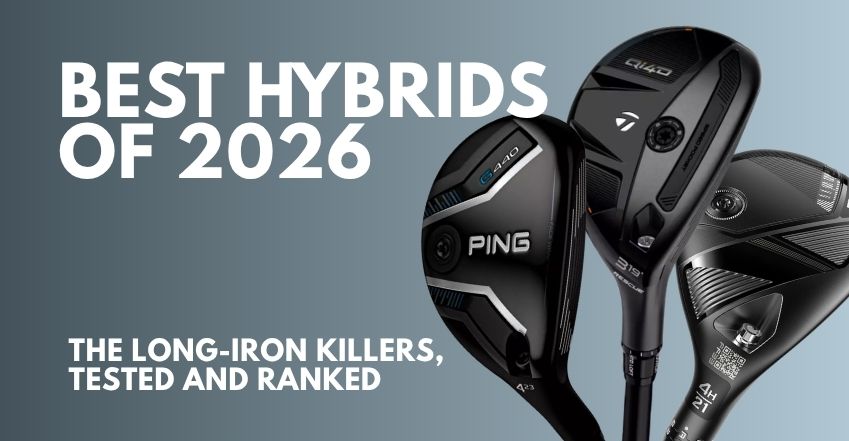
Best Hybrids of 2026: The Long-Iron Killers, Tested and Ranked
If you’re still gaming a 3-iron or a 4-iron because you think hybrids are for old guys, we need to have a conversation.
Tour pros are putting more hybrids in their bags every year, not fewer. The reason is simple — they fly higher, land softer, and produce more consistent results from the rough and uneven lies than long irons ever could. The 4-iron has become the most replaced club in golf, and the 3-iron isn’t far behind. That’s not a senior thing. That’s a math thing.
This guide breaks down the best hybrids of 2026 — what each model actually does well, who should buy it, and which used-market alternatives let you skip the latest-model premium without giving up much real-world performance. Hybrid technology has matured to a point where one-generation-back models often deliver 95%+ of current performance for a meaningful discount. We’ll show you exactly where those values are.
TL;DR: The top hybrids of 2026 are the TaylorMade Qi4D Rescue (best all-rounder with three model variants), Ping G440 (most forgiving and consistent), Cobra OPTM (most adjustability with 33 hosel settings), Callaway Quantum Max OS (best for high-handicappers), Titleist GT2 (highest MOI of any GT hybrid), and Mizuno JPX One (best off the ground, surprising forgiveness). For seniors and slower swing speeds, the new TaylorMade Qi4D Max Lite is the standout pick. Going one generation back to the Qi35, G430, or DS-Adapt produces near-identical performance for less money.
Why Hybrids Replaced Long Irons (And Why You Should Care)
Long irons are mechanically harder to hit. That’s not opinion — it’s physics. A 3-iron has roughly 21 degrees of loft, a small clubhead, a thin face, and a high center of gravity that makes the ball want to stay low. To launch one well, you need clubhead speed and a precise strike. Most amateurs have neither.
A hybrid in the same loft range has more mass distributed lower and farther back, a wider sole that glides through turf and rough, and a head shape that’s effectively a small fairway wood. Same intended yardage. Way easier to launch. Better from rough lies. More forgiving on mishits. Almost no downside outside of preference.
Look at the WITB lists from any tour event in 2026. Players who carried only irons through 5-iron a few years ago are now carrying 4-hybrid, 5-hybrid, or even 6-hybrid replacements. Tommy Fleetwood’s bag includes a mini-driver, 5-wood, and 9-wood combination instead of long irons. The pros aren’t doing this for show. They’re doing it because it works.
Shop floor observation: roughly 70% of the irons we take in trade-ins from amateur golfers are missing the 3-iron entirely — and another 15% have a 4-iron in the set that’s clearly never been used. The market voted with its bag. Long irons lost.
The Best Hybrids of 2026: Our Top Picks
Each pick below is grounded in independent test data from MyGolfSpy, Golf Monthly, Today’s Golfer, GolfWRX, and our own observations from clubs cycling through the GCB shop floor. We’ve ordered them by who they’re best for, not by raw distance numbers — because the right hybrid for you depends on what problem you’re trying to solve.
1. TaylorMade Qi4D Rescue — Best All-Around Performer
TaylorMade calls their hybrids “Rescues” and the name fits. The 2026 Qi4D family expands to three models — Core, Max, and a brand-new Max Lite — covering virtually every player type from low-handicap to senior. The Core (19°) is the all-rounder. The Max delivers more forgiveness with a slightly larger profile. The Max Lite is the speed-focused, senior-friendly option with higher MOI and rear weighting.
The Qi4D’s headline build is multi-material — 450 stainless steel body paired with an ultra-light carbon fiber crown. That weight savings up top frees mass for a lower CG and steeper landing angles, which means shots stop on greens instead of rolling out. Each loft (17°, 19°, 22°, 25°) features an 8g TAS (Trajectory Adjustment System) weight and a 3° loft sleeve. Twist Face technology carries over from the driver and fairway lines, helping to straighten out off-center hits.
Golf Monthly’s testing reported the Qi4D delivered higher ball speeds than any 2026 hybrid they tested. The standard 19° model produces a penetrating ball flight that’s exceptional from the tee. Best for: 5-20 handicap players who want flagship-level versatility and don’t mind a slightly more compact head shape.
Read more: TaylorMade Qi4D Driver Review
2. Ping G440 Hybrid — Best for Consistency
If your biggest frustration from 180 to 210 yards is that you never know what’s going to come out, the Ping G440 hybrid is the answer. Ping’s Spinsistency Technology pairs variable face thickness with internal geometry to stabilize spin rates across the entire face. Heel and toe strikes don’t produce the dramatic trajectory differences that plague most hybrids. That’s the whole story.
The G440 lineup also features a Free-Hosel Design that saves 4g of weight to lower the CG further, a Carbonfly Wrap (lightweight carbon crown), and the proven Trajectory Tuning 2.0 hosel that adjusts loft up or down 1.5°. Different hybrid lofts have different bias profiles — the 2-hybrid is slightly fade-biased for tee shots, while the 5, 6, and 7 hybrids are draw-biased to help with gapping into your iron set.
Best for: mid-handicappers who want predictable, repeatable performance over flashy peak numbers. The G440 is also one of the best hybrids for fitting — the broader Ping fitting network makes it easier to get truly dialed in than competitors.
Read more: Ping Brand Spotlight
3. Cobra OPTM Hybrid — Best Adjustability
Cobra simplified their 2026 hybrid line to a single model — the OPTM Hybrid — and made it adjustable enough to cover everyone. The FutureFit33 hosel system delivers 33 unique loft and lie combinations, more than double what most competitors offer. If you’re between a 3-hybrid and 4-hybrid, you can configure one club to bridge the gap precisely.
Cobra’s OPTM platform centers on POI (Product of Inertia) optimization rather than the more familiar MOI metric — POI accounts for stability across all three rotational axes, not just the horizontal heel-toe twist. The result is tighter dispersion on diagonal mishits, particularly toe-high or heel-low strikes that traditional MOI design doesn’t address as effectively.
The shape sits cleaner at address than the previous DS-Adapt platform, with a slightly larger profile and a shallower face that helps with easy launch from the deck. Best for: low-to-mid handicap players who want shot-shaping capability paired with elite forgiveness. Strong fitting candidate for anyone between standard hybrid lofts.
4. Callaway Quantum Max OS — Best for High-Handicappers
If raw forgiveness is what you need, the Callaway Quantum Max OS is the play. “OS” stands for oversize, and it lives up to the name — wider sole, larger head footprint, taller face. The AI-designed face uses Callaway’s neural network testing to optimize ball speed retention across a much wider strike zone than traditional designs.
Tour Edge data and independent testing both put the Quantum Max OS among the most forgiving hybrids in 2026, with off-center strikes preserving roughly 5-12 yards more carry distance than equivalent shots from competitor models. For golfers whose strike location varies dramatically swing-to-swing, that distance preservation means more greens hit and fewer punishing mis-hit penalties.
Best for: 15+ handicap players who consistently struggle to find the center of the face. Also strong for golfers transitioning from boxed-set hybrids who want a meaningful upgrade without overshooting their needs.
5. Titleist GT2 Hybrid — Best Highest-MOI Option
The GT2 hybrid actually has the highest MOI of any hybrid in the Titleist GT family — even higher than the GT1, which is the dedicated forgiveness model. Titleist built it to elevate the ball off the turf easily for higher launch and better stopping power into greens. The flatter sole design sits closer to the turf for cleaner contact, and the refined leading edge helps with turf interaction from tight lies.
This is a Titleist hybrid, so the build quality is excellent and the resale value is among the best in the category. The GT2 was launched in 2025 and continues into 2026 (the GTS line replaces the fairway woods, but the GT hybrid line is still current). Best for: low-to-mid handicap Titleist loyalists who want premium materials and steep landing angles for green attacks.
6. Mizuno JPX One Hybrid — Best Off the Ground
Mizuno’s JPX One hybrid is the dark horse of 2026. Independent reviewers consistently praise it as one of the best hybrids off the ground (i.e., from fairway lies, not the tee), with a smaller, more player-shaped profile that’s surprisingly forgiving. The Nanoalloy face gives it the classic Mizuno feel that brand loyalists love, and the slightly more compact head shape suits players who don’t want a hybrid that looks like a chunky rescue club.
The JPX One is also one of the better choices for slicers, despite Mizuno not branding it that way explicitly. The shape and weighting produce a slight draw bias from the deck without forcing a hook on solid strikes.
Best for: skilled players who want hybrid performance with classic player’s-iron aesthetics. Brand loyalists who already game Mizuno irons and want a coordinated bag.
Read more: Mizuno Brand Spotlight
7. Best for Seniors and Slow Swing Speeds: TaylorMade Qi4D Max Lite
The Qi4D Max Lite earns its own callout because it’s specifically engineered for slower swings. Higher MOI than the standard Max, more rear weighting for higher launch, and a lighter overall build that’s easier to swing through impact. For senior golfers and anyone with a 7-iron swing speed under 75 mph, this is the most forgiving and easiest-to-launch hybrid in the major-brand market today.
Pair it with a Qi4D Max Rescue in 22° or 25° loft to replace your 5-iron and 6-iron, and you’ve got a hybrid setup that’s optimized for what your swing actually does — not what it used to do.
Read more: Best Irons for Seniors 2026
2026 Hybrid Quick Reference
| Model | Best For | Standout Trait | Notable Tech |
|---|---|---|---|
| TaylorMade Qi4D Rescue | All-around (5-20 HCP) | Highest ball speeds in class | Multi-material, 8g TAS weight, Twist Face |
| TaylorMade Qi4D Max Lite | Seniors / slow swings | Easy launch, max forgiveness | Lighter build, rear weighting |
| Ping G440 | Mid-handicap consistency | Most stable spin across face | Spinsistency Tech, Free-Hosel |
| Cobra OPTM | Adjustability seekers | 33 loft/lie combinations | FutureFit33, POI optimization |
| Callaway Quantum Max OS | High handicappers | Forgiveness on off-center hits | AI-designed face, oversize head |
| Titleist GT2 | Titleist loyalists, low-mid HCP | Highest MOI in GT family | Refined sole, premium build |
| Mizuno JPX One | Skilled players, classic looks | Best off the ground | Nanoalloy face, compact shape |
Hybrid vs. Long Iron vs. Fairway Wood: When Each One Wins
Hybrids occupy a real gap between long irons and fairway woods, but they don’t replace either category outright. Here’s the actual decision framework:
Choose a Hybrid Over a Long Iron When…
- Your swing speed is below 90 mph driver
- You can’t reliably launch a 3-iron or 4-iron off the deck
- You play firm, links-style courses where stopping power matters
- You hit a lot of approach shots from rough or uneven lies
- You’re a mid or high handicapper (anything above ~12)
For nearly every amateur who fits one of those criteria, a hybrid is the smarter play. We see it in trade-in patterns every week — golfers who add hybrids and remove long irons rarely go back.
Choose a Hybrid Over a Fairway Wood When…
- You need a tighter, more controllable shot pattern
- You’re hitting from rough or uneven lies more than from teed positions
- You want a higher, softer-landing trajectory
- Your fairway wood is too long off the deck for the yardage you need
Hybrids at 22-25° lofts are particularly useful as 4-hybrid and 5-hybrid replacements for 4-iron and 5-iron. Hybrids at 18-21° serve as alternatives to fairway woods for second-shot par 5s and long approach shots.
Read more: Best Fairway Woods 2026
The Used-Market Hybrid Play: Where the Real Value Lives
Hybrid technology improvements year-over-year are real but small. The 2026 Qi4D Rescue feels and performs slightly better than the 2025 Qi35 Rescue, but the gap is far smaller than the price difference between them. For most amateur golfers, a one-generation-back hybrid in good condition delivers 95%+ of current performance at 30-50% off retail.
Best Used Hybrids for 2026 Buyers
- Used TaylorMade Qi35 Rescue: Direct predecessor to the Qi4D. Same Twist Face technology, same multi-material build, same general performance profile. Available used at meaningful discounts as the Qi4D rolls into wider distribution.
- Used Ping G430 Hybrid: Many independent reviewers note the G430 produces nearly identical numbers to the G440 in independent testing. The G430 hybrid was named one of the best hybrids of 2024 — that hasn’t changed because the model rolled over.
- Used Cobra DS-Adapt Hybrid: The 2025 platform that became the OPTM. Includes the FutureFit33 system the OPTM carries. Cobra’s used-market depreciation is steeper than the big three brands, which translates to better deals for buyers.
- Used Callaway Paradym Ai Smoke Hybrid: AI-designed face technology that’s essentially the same story as the Quantum’s. Strong distance and forgiveness numbers at significantly lower used prices than current Quantum models.
- Used Titleist TSi3 / TSR3 Hybrids: Two and three generations back from the GT2 — and still some of the best player-style hybrids ever made. Particularly strong values on the secondary market.
What we tell customers at the shop: if you’ve never owned a hybrid before and you’re worried about overspending on something you might not love, used is genuinely the smarter way in. A used Qi35 or G430 hybrid in good condition costs roughly half of a current-generation flagship, and the performance gap is small enough that you’ll know within five rounds whether the platform suits your game.
Key Takeaways: Building Your Hybrid Setup
- Replace long irons (3, 4, sometimes 5) with hybrids if your swing speed is below 90 mph driver. The math favors hybrids for nearly every amateur.
- Most golfers benefit from 1-2 hybrids in the bag, not three. Pair a 4-hybrid (22°) with either a 5-hybrid (25°) or a 7-wood depending on what gap you need to fill.
- Adjustability has become the differentiator. Cobra’s OPTM with FutureFit33 is the most adjustable hybrid available. TaylorMade and Ping offer 3° loft sleeves on most lofts.
- Build quality is now consistent across major brands. All flagship 2026 hybrids use multi-material construction with carbon crowns. Performance differences come from face technology and head shape, not basic engineering.
- Fitting matters more than year-over-year tech. The right loft, lie angle, and shaft for your swing produces bigger gains than upgrading from a 2024 model to a 2026 model.
- Used hybrids are some of the smartest equipment buys in golf. One-generation-back models from the same brands deliver 95%+ of current performance at 30-50% off retail.
Frequently Asked Questions
What is the best hybrid in 2026?
There isn’t a single best — it depends on your swing and what you need. The most consistent overall performer is the Ping G440 with its Spinsistency Technology. The most versatile flagship is the TaylorMade Qi4D Rescue, with three model variants covering different player types. The most adjustable is the Cobra OPTM with 33 loft/lie combinations. The most forgiving is the Callaway Quantum Max OS. Match the model to your specific need rather than chasing best-of lists.
What loft hybrid should I buy?
If you’re replacing a 4-iron, look for a 22° hybrid. Replacing a 5-iron means a 25° hybrid. Replacing a 3-iron means an 18-19° hybrid. For tee shots requiring less than driver, a 17-19° hybrid works well. The best approach: identify what club in your bag you struggle to hit consistently, and replace it with a hybrid in roughly the same loft range. Don’t add hybrids alongside long irons — replace them.
Are hybrids easier to hit than fairway woods?
Generally yes, especially from rough and uneven lies. Hybrids have shorter shafts than fairway woods, smaller heads, and tighter shot patterns — all of which make them easier to control on imperfect strikes. Fairway woods are typically longer off the tee and easier to launch from clean fairway lies. For approach shots from rough at 180-210 yards, hybrids almost always win.
Should seniors use hybrids instead of long irons?
Almost always yes. Seniors and slower-swing-speed golfers benefit dramatically from replacing 3-iron, 4-iron, and often 5-iron with hybrids. The lower center of gravity, wider sole, and easier launch profile make hybrids fundamentally easier to hit at slower swing speeds. The TaylorMade Qi4D Max Lite is purpose-built for senior golfers, but most game-improvement hybrids work well in this role.
How does the Cobra OPTM hybrid compare to the TaylorMade Qi4D?
The Cobra OPTM offers more adjustability (33 loft/lie settings vs. TaylorMade’s 3° loft sleeve and 8g TAS weight), while the Qi4D delivers slightly higher peak ball speeds in independent testing. The OPTM’s POI optimization produces tighter dispersion on diagonal mishits. The Qi4D offers three model variants (Core, Max, Max Lite) for different player types. Both are top-tier 2026 hybrids — choice comes down to whether you prioritize adjustability or distance.
Are 2026 hybrids worth upgrading from a 2-3 year old model?
For most amateur golfers, no. The performance differences between a 2024-2025 hybrid and a 2026 hybrid from the same brand are real but small — typically 1-3 yards of carry distance and minor improvements in dispersion. Unless you’re a high-swing-speed player who can detect small ball speed gains, a one-generation-back hybrid in good condition delivers nearly identical real-world performance for substantially less money.
How many hybrids should I have in my bag?
For most amateur golfers, one or two hybrids is the sweet spot. A 4-hybrid (22°) replacing your 4-iron, plus optionally a 5-hybrid (25°) or a 7-wood for slightly longer approach shots. Carrying three or more hybrids is unusual outside of senior bags — at that point, you’re typically better off replacing a hybrid with a fairway wood or utility iron for tee shot variety.
What’s the difference between a hybrid and a utility iron?
Hybrids have larger, hollow heads with a fairway-wood-like profile and a low center of gravity that promotes high launch. Utility irons have iron-shaped heads with hollow construction and slightly more forgiveness than traditional long irons but a lower trajectory than hybrids. Hybrids are easier for most amateur golfers; utility irons appeal to lower handicappers who want long-iron looks with extra forgiveness.
Trade In Your Old Long Irons
Whether you’re shopping the latest 2026 flagships or hunting for a smart used buy, we keep one of the deepest hybrid inventories in the country. Every club is authenticated, hand-inspected, and graded honestly. If you’re trading in old long irons or upgrading from a previous-generation hybrid, we pay fair market values based on what we actually see in the resale market — not lowball offers designed to start a negotiation.