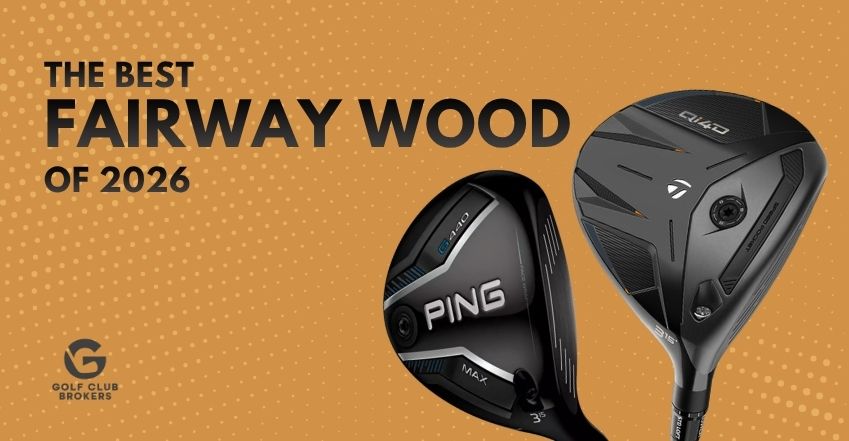
Best Fairway Woods of 2026: Our Top Picks (and the Smart Used-Market Alternatives)
Here's a stat we throw at customers all the time: more amateur golfers carry the wrong fairway wood than any other club in the bag. Bigger problem than poorly fit drivers. Bigger problem than the wedge gapping mess. Bigger problem than the ancient putters.
Why? Because a fairway wood is doing two completely different jobs — backup driver off the tee, attacking club from 220 yards out — and most golfers buy one club that's optimized for neither role. Or they grab a 3-wood out of habit when a 5-wood, 7-wood, or even 9-wood would actually serve them better.
This guide is the no-marketing-spin breakdown of the 2026 fairway wood market. We'll go through every flagship model that matters, what each one is actually best at, who should buy it, and — because this is GCB — which used-market alternatives deliver 90-95% of the performance for a meaningful discount. Because the truth is, fairway wood technology has plateaued in some places. The 2024 model often plays nearly identical to the 2026 model, and the resale gap is real.
TL;DR: The best fairway woods of 2026 are the TaylorMade Qi4D Max (best all-around forgiveness), Ping G440 Max (most consistent performance, best blend of forgiveness and accuracy), Callaway Quantum Max (longest carry distance), Titleist GTS 2 (best for moderate swing speeds with high launch), Cobra OPTM X (best balanced option), Srixon ZXi (best feel and underrated value), and Wilson Dynapwr Max+ (best budget-conscious flagship). For most golfers, the single best buying decision is one generation back — used 2024-2025 models from these same brands deliver virtually identical performance at significantly lower prices.
What Actually Changed in Fairway Woods for 2026
Three things matter in this year's fairway wood story:
- AI-designed faces are now standard. Every major brand is using AI to optimize face geometry — Callaway's AI 10x, Cobra's H.O.T. Face, TaylorMade's adaptive face structure. The era of uniform face thickness is gone, and the result is meaningfully better ball speed retention on off-center hits.
- Carbon crowns are in everything. TaylorMade's Infinity Carbon Crown, Cobra's matte black carbon crown, Titleist's Seamless Thermoform Crown — the lightweighting story is the same across brands. Less mass up top, more discretionary weight to push the center of gravity exactly where engineers want it.
- Adjustability has gone next-level. Cobra's FutureFit33 hosel system delivers 33 unique loft and lie settings. Most competitors offer 8-12. If fitting matters to you, the conversation has shifted dramatically.
Honest take from the shop floor: the differences between a 2026 flagship and a 2024 flagship from the same brand are real but small. Real enough that tour pros switch. Small enough that an amateur with a decent swing won't notice on the course. We'll come back to this when we hit the used-market section.
The 2026 Fairway Wood Lineup: Every Model That Matters
Here's the full landscape, ranked by who they're best for. Each pick is based on independent test data from MyGolfSpy, Golf Monthly, Today's Golfer, and our own observations from the shop.
1. TaylorMade Qi4D — Best All-Around for Mid-Handicappers
TaylorMade's Qi4D fairway wood replaces the Qi35 for 2026 and continues the brand's recent run as one of the top fairway wood makers in the game. Three models in the family: the Qi4D Core (185cc head, all-round performer), the Qi4D Max (squished-down profile, more forgiving, easier to launch), and the Qi4D Tour (lower-spinning tour-bias version).
The headline tech: a 4° adjustable loft sleeve (more range than competitors), Infinity Carbon Crown for weight savings, Twist Face technology that's been refined for fairway woods to help correct off-center hits, and the Thru-Slot Speed Pocket for face flexibility. Rory McIlroy switched into the Qi4D in both his 3-wood and 5-wood late in 2025 before the family was officially announced — early signal of how strong the platform was.
Best for: 8-20 handicap players who want a confidence-inspiring flagship with serious adjustability. The Max model in particular is one of the most forgiving fairway woods of 2026.
2. Ping G440 Max — Best Consistent Performance
Ping's G440 Max won MyGolfSpy's overall 2025 Most Wanted Fairway Wood title and remains a top-tier pick into 2026 because the platform hasn't been refreshed yet. Why it wins: it's not the longest fairway wood and it's not the most forgiving in any single category — but it's exceptional across all three Most Wanted categories (accuracy, distance, forgiveness).
The G440 family includes the Max (most popular, neutral bias), the LST (lower spin, tour-style), and the SFT (straight-flight technology, draw-bias for slicers). The Max removes 11.5g from strategic locations to maintain a low CG while creating a 4% taller face — that visual confidence at address actually shows up in performance data.
Best for: golfers across all skill levels who prioritize consistency over a single standout trait. The G440 SFT specifically is one of the best anti-slice fairway woods on the market, regardless of year.
Related reading: Ping G430 vs G440: Which Is Right for You?
3. Callaway Quantum Max — Best for Pure Distance
Callaway's Quantum line replaces the Elyte for 2026 and immediately took the longest carry distance crown in Today's Golfer's 2026 testing — the only fairway wood in their test to average over 260 yards of carry. The big tech story is Speed Wave 2.0, which positions up to 40 grams of tungsten low and forward to maintain ball speed on the low-face strikes that plague fairway wood play (something most golfers don't realize is an issue until it's measured).
The refined Step Sole geometry is the other quiet upgrade — particularly around the heel area, where it helps keep the face square through impact for tighter dispersion. The Max model sits squarely in the forgiveness category. The Max D adds aggressive heel weighting for slice fighters.
Best for: distance chasers and players who fight a low ball flight. The Quantum Max has more easy launch from the deck than most competitors, and the carry numbers back it up.
4. Titleist GTS 2 — Best for Moderate Swing Speeds
Titleist's GTS 2 launched in 2026 alongside the GTS 3 (the lower-spin Tour version) and replaces the popular GT2/GT3 generation. It's the high-launch, more-forgiving option in the GT family — larger, shallower 180cc head, very low center of gravity, and the Seamless Thermoform Crown that's letting Titleist push more weight where they want it.
In Today's Golfer's 2026 testing, the GTS 2 was the straightest fairway wood in the entire field. It also produced one of the steepest descent angles of any model tested (41.4° vs. test average of 38.2°), meaning approach shots stop quickly when attacking greens. Trade-off: it's not the longest in the test (240.1-yard carry vs. 245.9-yard average), but accuracy is the headline.
Best for: golfers with moderate swing speeds (90-100 mph driver) who want to attack greens with stopping power. Titleist players considering an upgrade. Skilled iron players who want a fairway wood that flies and stops like a long iron.
5. Cobra OPTM X — Best Balanced Option
Cobra's 2026 OPTM lineup is built around POI (Product of Inertia) — a less-discussed forgiveness metric that measures stability across all three axes of clubhead rotation, not just the horizontal heel-toe axis that traditional MOI focuses on. Whether the marketing is overhyped or not, the test data is real: OPTM fairway woods have produced some of the tightest dispersion numbers of any 2026 model.
The OPTM X is the middle child in the Cobra family — between the LS (low-spin tour version) and the Max (max forgiveness). Mid-CG location with 3g and 17g interchangeable weights lets you tune launch and spin. The FutureFit33 hosel offers 33 unique loft and lie settings — most adjustability in the category by a wide margin. Stock shafts are the Mitsubishi Kai'li Dark Waves Red and Blue.
Best for: fitting nerds and players who want one fairway wood that can be reconfigured as their game evolves. Also strong for golfers who want flagship performance without paying the very top of the market.
6. Srixon ZXi — Best Underrated Performer
Honest take: Srixon's ZXi fairway wood is one of the most underrated clubs of 2026. Smaller, more player-shaped head than the brand's previous ZX5 Mk II, but with i-Flex face technology and Rebound Frame internal structure that produced dispersion numbers comparable to the TaylorMade Qi35 in independent testing. Premium feel, premium looks, premium-adjacent performance — at typically lower price points than the bigger brands.
Srixon doesn't shout. They build clubs that quietly do the job. The ZXi falls squarely into that tradition. The ZXi MAX driver took home top accuracy honors in MyGolfSpy's slow-swing-speed driver testing, which is a strong signal for the full Srixon platform's design philosophy.
Best for: players who appreciate forged-iron-grade craftsmanship and don't need a brand name to validate performance. Strong used-market upside as Srixon clubs depreciate faster than the big four.
7. Wilson Dynapwr Max+ — Best Budget-Conscious Flagship
Wilson rarely gets airtime in fairway wood conversations. That's a mistake. The Dynapwr Max+ delivered exceptional stability and forgiveness in Golf Monthly's 2026 testing, with shots struck towards the toe or low on the face still launching high and holding their line impressively well. Golf Monthly's reviewer called it a top pick in the slow-swing category — not because it's the most aggressive performer, but because it does everything well at a meaningfully lower price point.
Best for: golfers who want flagship-level performance without flagship pricing. Particularly strong for slow-swing-speed players. Pairs well with Wilson Staff Model irons for a coordinated bag.
Related reading: Wilson Golf Brand Spotlight
2026 Fairway Wood Quick Reference
| Model | Best For | Standout Trait | Notable Tech |
|---|---|---|---|
| TaylorMade Qi4D / Max | Mid-handicappers, all-around | Versatile flagship | Twist Face, 4° loft sleeve, Infinity Carbon Crown |
| Ping G440 Max | All skill levels, consistency | Most balanced performance | Strategic 11.5g mass redistribution |
| Callaway Quantum Max | Distance chasers, low ball flight | Longest carry distance | Speed Wave 2.0 with 40g tungsten |
| Titleist GTS 2 | Moderate swing, approach play | Highest launch, tightest dispersion | Seamless Thermoform Crown |
| Cobra OPTM X | Fitting-focused players | 33 loft/lie settings, POI optimization | FutureFit33, H.O.T. Face |
| Srixon ZXi | Quality-over-name buyers | Premium feel, premium performance | i-Flex Face, Rebound Frame |
| Wilson Dynapwr Max+ | Value-focused players | Strong stability, lower retail | Multi-material construction |
Do You Actually Need a 3-Wood? The Loft Decision That Changes Everything
This is where most amateurs leave strokes on the table. The default "driver, 3-wood, hybrid" bag setup that most boxed sets are built around is genuinely wrong for a huge percentage of golfers.
Here's the math. A 3-wood is roughly 13-15° of loft. To launch a 3-wood properly off the deck, you need around 95+ mph of clubhead speed and a relatively shallow attack angle. If your driver swing speed is under 95 mph, your 3-wood off the deck is producing low launch, weak carry, and trouble holding greens — even though the same club is fine off the tee.
The fix is simple. Most golfers are better served by:
- A 16-18° fairway wood (a 4-wood or strong 5-wood) for tee shots requiring less than driver
- A 19-21° fairway wood (a 5-wood or 7-wood) for fairway approach shots from 200+ yards
- A 23-26° fairway wood (a 9-wood or 11-wood, increasingly common) for approach shots from 175-200 yards in place of a long iron or hybrid
Tour data point: Tommy Fleetwood carries a mini-driver, 5-wood, and 9-wood combination — no traditional 3-wood. Brooks Koepka games a 16.5° 4-wood. The pros are increasingly building lofted, easier-to-launch fairway wood setups, even at tour swing speeds. There's no trophy for carrying clubs that are hard to hit.
If you don't know your fairway wood loft for sure, look at the sole — it's stamped right there. If you've been gaming a 13.5° 3-wood for years and you're under 95 mph driver speed, the single best fairway wood upgrade you can make is loft, not a new model.
The Used-Market Play: Why One Generation Back Is the Smart Move
Here's the part the manufacturers don't want to advertise. Fairway wood technology has plateaued. The generation-to-generation differences in raw ball speed and carry distance are now smaller than the differences caused by getting fitted properly with the right shaft. Real testing data backs this up — most independent reviewers note that 2026 fairway woods perform remarkably similarly to 2024-2025 models when conditions are controlled.
What that means for buyers: a used TaylorMade Qi35, Callaway Elyte, Ping G430, or Titleist GT2 from 2024-2025 will play almost identically to its 2026 successor for most amateur golfers. The price difference is anywhere from 30-50% off retail. The performance difference is small enough that even careful launch monitor testing struggles to separate them.
Best Used Fairway Wood Values for 2026
- Used TaylorMade Qi35 / Qi35 Max: Direct predecessor to the Qi4D. Same Twist Face technology, same Thru-Slot Speed Pocket, same Infinity Carbon Crown architecture. Buy in good condition and you're getting tour-validated performance at a meaningful discount.
- Used Callaway Elyte / Paradym Ai Smoke: AI-designed face technology on these is essentially the same story as Quantum's Speed Wave. Strong distance numbers, refined feel.
- Used Ping G430 fairway: Many independent reviewers note the G430 actually outperforms the G440 in raw distance numbers. Worth strongly considering even today.
- Used Titleist GT2: One generation back from the GTS 2. Carbon crown technology, refined head shape, premium Titleist build quality. Strong used value.
- Used Cobra DS-Adapt: The 2025 platform that became the OPTM. Includes most of the adjustability the OPTM X carries, at a steeper used discount because Cobra's brand cachet on the used market is lower than the big three.
What we tell customers at the shop: if you're buying a fairway wood and you don't have a specific need for the latest technology, going one generation back saves you real money for performance that's effectively identical. The exception is if you're an aggressive player chasing the absolute newest face technology — the Qi4D and Quantum genuinely do produce slight ball speed gains on tour-level swing speeds.
Key Takeaways: How to Choose a Fairway Wood in 2026
- Loft matters more than model. Most amateur golfers benefit from a 16-18° fairway wood, a 19-21° fairway wood, or both. The traditional 13-15° 3-wood is increasingly the wrong choice for sub-95 mph driver swings.
- AI faces are standard now. Every flagship has them. Performance differences between brands at the face level are small.
- Carbon crowns and Cobra's POI are the real innovations. Crown materials let designers move CG more aggressively. POI optimization is a meaningful step forward in fairway-wood forgiveness.
- Adjustability is now genuinely useful. The Cobra OPTM's FutureFit33 system gives you 33 distinct loft and lie configurations. If you're between specs, adjustability finally matters.
- The used market is where most amateurs should buy. One-generation-back models deliver 90-95% of current performance at 30-50% off retail.
- Get fit. More than any club in the bag, fairway woods reward proper fitting. Loft, lie, shaft flex, weight, and head shape interact in ways that off-the-shelf purchases rarely optimize.
Frequently Asked Questions
What is the best fairway wood for 2026?
There's no single best — it depends on your swing speed, ball flight tendencies, and what you need the club to do. The most consistent overall performer is the Ping G440 Max, which excels across distance, accuracy, and forgiveness. The longest is the Callaway Quantum Max. The most forgiving with the shallowest profile is the TaylorMade Qi4D Max. The straightest in 2026 testing was the Titleist GTS 2. Match the model to your specific need rather than chasing best-of lists.
Should I get a 3-wood, 5-wood, or 7-wood?
For most amateur golfers, a 5-wood (18-19° loft) is more useful than a traditional 3-wood (13-15° loft). The 3-wood is hard to launch off the deck unless your swing speed is over 95 mph driver. A 5-wood launches more easily, holds greens better on approach shots, and works fine off the tee on tight par 4s. If you're between a 3-wood and 5-wood and your driver swing speed is below 95 mph, take the 5-wood.
How does the Ping G440 compare to the TaylorMade Qi4D?
Both are flagship 2026 fairway woods, but they target different priorities. The Ping G440 Max wins on consistency — it's exceptional across all performance categories without leading in any single one. The TaylorMade Qi4D Max wins on adjustability and feel, with its 4° loft sleeve and Twist Face technology. In direct user testing, both produced similar overall numbers, with the Qi4D slightly favored on raw distance and the G440 slightly favored on forgiveness.
Are 2026 fairway woods worth upgrading from a 2-3 year old model?
Honestly, for most amateur golfers, no. Fairway wood technology has plateaued enough that performance gains generation-over-generation are small. A 2024 TaylorMade Qi10 or Callaway Paradym Ai Smoke fairway wood plays nearly identically to its 2026 successor for most golfers. The exception is if you have a specific fitting need (e.g., the new model offers better adjustability for your swing) or you're a high swing speed player who can detect small ball speed gains.
What's the difference between a 4-wood and a 3-wood?
A 4-wood is typically 16-17° of loft, sitting between a traditional 3-wood (13-15°) and 5-wood (18-19°). The added loft makes the 4-wood significantly easier to launch off the deck while only sacrificing a small amount of carry distance off the tee. For golfers who use their fairway wood primarily off the tee for accuracy, a 4-wood is often the better choice. Brooks Koepka games a 16.5° 4-wood as his only fairway metal.
Do high handicappers need a fairway wood?
Yes — and they should consider carrying two. Most high-handicap golfers are better served with a 5-wood (for fairway approach shots and tight tee shots) and a 7-wood or 9-wood (replacing long irons that are difficult to hit consistently). High-handicap golfers should generally avoid traditional 3-woods, which are the hardest fairway woods to launch off the deck. Lofted fairway woods are forgiveness machines for inconsistent strikes.
What's POI in a Cobra fairway wood?
POI stands for Product of Inertia, and it's a measure of clubhead stability across all three axes of rotation rather than just the horizontal axis that traditional MOI measures. Cobra's 2026 OPTM line is the first major fairway wood family designed primarily around POI optimization. The result is tighter dispersion, particularly on diagonal mishits (toe-high or heel-low strikes) that traditional MOI optimization doesn't address as effectively.
Are used fairway woods a smart buy?
Absolutely, especially one or two generations back from current. Used Qi35, Elyte, G430, GT2, and DS-Adapt fairway woods deliver 90-95% of 2026 performance at 30-50% lower prices. The only group that benefits meaningfully from the latest model year is high-swing-speed players who can detect small ball speed gains. For most amateurs, used name-brand fairway woods are one of the best values in golf equipment.
Sell or Trade In Your Old Fairway Wood
Whether you're shopping the latest 2026 flagships or hunting for a smart-money one-generation-back gem, we keep one of the deepest used inventories of fairway woods in the country. Every club is authenticated, hand-inspected, and graded honestly — none of that "good condition" fluff. If you've got a fairway wood to trade in or sell outright, we pay fair market values based on what we actually see in the resale market.