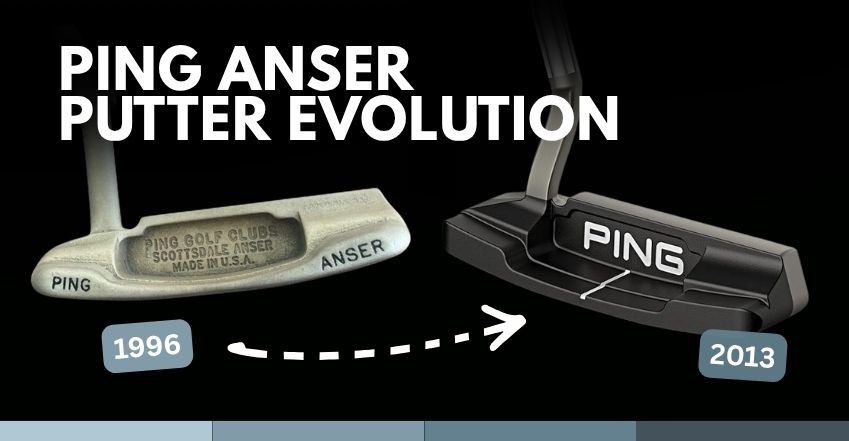
Ping Anser Putter Evolution: From a Record Sleeve in 1966 to the Modern PLD Lineup
On January 13, 1966, a Norwegian-born jet engineer named Karsten Solheim sketched a putter design on the dust jacket of a 78 rpm record. He was a frustrated amateur golfer trying to fix his own putting. He had no idea he was about to invent the most copied club in the history of golf.
That sketch became the Ping Anser. Sixty years later, every major putter manufacturer on earth makes some version of it. Scotty Cameron Newport. TaylorMade Spider TourZ. Odyssey White Hot OG #1. Bettinardi BB1. The shape, the heel-toe weighting, the offset hosel — all of it traces directly back to a piece of cardboard in a 1966 Solheim family living room.
There are over 3,200 winning putters enshrined in Ping's Gold Putter Vault, and more than 500 of them are Ansers. The original 1966 design has been refined, re-imagined, and re-released across at least 15 different generations. Today's PLD Milled Anser is a CNC-machined art piece that takes more than four hours per head to produce. The blueprint is essentially unchanged.
This is the full Anser story — every major variant, the design innovations that mattered, what each Anser is good for today, and how to find a great one on the used market. Whether you've never owned an Anser or you've gamed five of them, this is the model deep dive Ping deserves.
TL;DR: The Ping Anser is a heel-toe weighted blade putter designed by Karsten Solheim in January 1966. It introduced the offset plumber's-neck hosel and perimeter weighting that became the foundation of nearly every modern putter design. The Anser has won over 500 professional events including multiple major championships, and it continues today across Ping's Scottsdale, 2024, and PLD Milled lineups. The current premium version is the PLD Milled Anser — a CNC-machined 303 stainless steel putter that takes more than four hours per head to produce.
The Story of the Anser: How One Garage Putter Changed the Game
Karsten Solheim wasn't a golf insider. He was a Norwegian-born engineer who'd worked on jet fighters and missile guidance systems for General Electric after World War II. Golf was his hobby, not his profession. And like a lot of weekend golfers, he was a bad putter who had decided his equipment was the problem.
Solheim's first putter design — the 1A — came in 1959. Built in his garage, it featured the first true heel-toe weighting in a putter, which dramatically reduced face twisting on off-center strikes. When the ball struck the sweet spot, the putter made a distinct "PING" sound. Solheim had a name for his company.
The 1A was an interesting curiosity. The Anser was the revolution.
January 13, 1966 — The Record Sleeve Sketch
Solheim was determined to design a putter that would "answer" the flaws of the era's blade putters. He'd been refining the perimeter-weighting concept for years. The day before he produced the prototype, he was at the engravers with his wife Louise discussing details. Louise suggested he call the putter "the Answer."
Solheim balked. The name wouldn't fit on the toe of the putter. Louise's solution was elegantly simple: drop the "w." The Anser was named that day. The next day, Solheim sketched the design on a 78 rpm record sleeve. Within weeks, the prototype was in his hands.
This is the kind of origin story that sounds made up — but it's not. The original record sleeve, hand-drawn, still exists in Ping's company archives. The Solheims kept everything. John Solheim, Karsten's youngest son and current Ping CEO, was a teenager at the time and witnessed the whole sequence.
1966 Phoenix Open — The Tour Debut
Solheim brought a few prototype Ansers to the 1966 Phoenix Open and let tour players try them. George Archer, Kermit Zarley, and Gene Littler all picked them up. Within weeks, Ansers were in tour bags.
The first PGA Tour win came at the 1966 Florida Citrus Open — barely a month after the Phoenix Open debut. Demand exploded. Solheim's garage couldn't keep up. The family relocated production to a small building in north Phoenix to handle volume. That building still sits on Ping's 50-acre headquarters today.
1967 — The Patent and the First Major Domino
Patent number D-207227 was granted to Karsten Solheim on March 21, 1967, protecting the Anser design through 1984. Two years later — at the 1969 Masters — George Archer became the first player to win a major championship with a Ping putter. Archer's Anser launched a flood of tour adoption that hasn't slowed down since.
Karsten Solheim eventually became the only golf equipment manufacturer ever inducted into the World Golf Hall of Fame. The Anser was a major reason why.
The Anser Family Tree: Every Major Variant Explained
Over six decades, Ping has produced more than 15 distinct Anser variants. Some were small refinements. Others were significant departures. Here's the story of the most important versions — the ones you're most likely to encounter on the used market or in modern Ping lineups.
Original Anser (1966)
The grandfather of modern putters. Cast bronze head, simple plumber's-neck hosel, heel-toe weighting with two distinct ballasts behind the face, single sight line on the topline. Roughly 350 grams. Designed for a slight-arc putting stroke with mild face rotation.
Originals from 1966-1967 are among the most collected putters in the game. A clean original Anser in playable condition can carry serious collector value, particularly if it has the original "Scottsdale" stamping (the address of Ping's first commercial production facility).
Anser 2 (Late 1960s-1970s)
The Anser 2 came shortly after the original and remains the most popular Anser variant ever made. Key difference: a slightly wider footprint with more heel-toe mass distribution. The Anser 2 is what most people picture when they hear "Ping Anser" — even though the original Anser preceded it.
If you've ever putted with a Scotty Cameron Newport 2, a Bettinardi BB1, or any modern "classic blade," you've used a putter that's a direct descendant of the Anser 2. The shape became the industry standard once Solheim's patent expired in 1984.
Anser 3 (1970s)
Variations on the same shape with different hosel configurations. The Anser 3 introduced a different neck profile that produced more toe hang for stronger-arc players. The shape laid the groundwork for what would become the modern Anser 3-style hosel found on putters across the industry today.
Anser 5 / 6 / 7 / etc. — The Numbered Variants
Through the 1970s and 1980s, Ping produced numerous numbered Anser variants — different sole geometries, different topline thickness, different hosel offsets, different mass distributions. Each was tour-validated and aimed at slightly different player preferences. These older Ansers are common on the used market and many remain excellent putters today, particularly for players who want a true vintage Ping experience.
1984 — The Patent Expires
This is the moment the Anser design became public domain. Within months, every major putter manufacturer began producing Anser-style putters. By the late 1980s, the Anser shape dominated tour bags regardless of brand name. Ping's response wasn't to fight it — it was to keep refining the shape and let the market validate the design over and over.
Honest take from the shop floor: when a customer asks us "is the Newport 2 worth it," the underlying truth is that they're buying an Anser-shape putter built by Cameron. The performance gap between a high-end Anser-style putter from any premium brand and a precision-milled Ping PLD Anser is genuinely small. The differences come down to feel, finish, and brand cachet — not fundamental design.
Scottsdale TR (2010-2013)
In 2010, Ping introduced the Scottsdale TR putters — the TR standing for True Roll. The Anser shape came back to the lineup with variable-depth grooves milled into the face, designed to produce more consistent ball speeds on off-center strikes. This was the first time the Anser face had been substantially re-engineered since the original.
The Scottsdale TR Anser is a great example of where modern technology met classic design. The shape was unchanged. The face was completely new. The combination produced one of the better putters of its era.
2016 — The 50th Anniversary Anser
To mark the Anser's 50th anniversary, Ping released a limited-edition Anser produced from the original molds Karsten had hand-machined. The 50th Anniversary Anser was hand-finished by Allan Solheim (Karsten's son) to mimic the way Karsten produced the originals. Components were sourced in the United States from the same vendors who supplied the 1966 originals where possible.
A clean 50th Anniversary Anser is a serious collector piece. Production was limited. Quality is exceptional. These show up on the secondary market occasionally and command real premiums.
2022 — The PLD Milled Program Goes Public
For decades, Ping's tour staff (Tony Finau, Bubba Watson, Viktor Hovland, etc.) had access to custom-milled Anser putters that weren't available to retail customers. In 2022, Ping opened the PLD (Putting Lab Design) Milled program to the public. Four initial models — Anser, Anser 2, ds72, and Kushin 4 — set the foundation.
Each PLD putter is precision-machined from a solid block of 303 forged stainless steel. More than four hours of milling time per head. Deep AMP (Aggressive Milling Pattern) face grooves produce a tour-preferred soft feel. Gunmetal finish. The PLD Milled Anser is genuinely one of the best blade putters ever produced — and arguably the most direct successor to Karsten's original 1966 vision.
For more on Ping's broader equipment philosophy, see our Ping Brand Spotlight.
2024-2025 — The Current PLD Anser Family
The current PLD Milled lineup includes multiple Anser variants:
- PLD Milled Anser: The classic. Plumber's-neck hosel, slight toe hang, single sight line. Best for players who want the truest Anser experience in a modern milled package.
- PLD Milled Anser 2: Slightly wider profile than the standard Anser, more heel-toe mass. The most copied shape in golf history, milled to tour spec.
- PLD Milled Anser 2D: Tony Finau's preferred design. Deeper, more perimeter-weighted blade with clean heel-toe ballasts. Bridges the gap between classic blade and mid-mallet.
- PLD Milled Anser 4D: Precision-milled version of the classic Anser with high MOI. Built for slight-arc players with right-miss tendencies.
- PLD Milled Anser 30: Perimeter-weighted blade with the forgiveness of a mid-mallet. Clean ballasts, ball-width cavity, alignment line. Confidence-inspiring at address.
Anser Variants at a Glance
| Variant | Era / Source | Key Difference | Best For |
|---|---|---|---|
| Original Anser | 1966 (current PLD) | Single sight line, classic shape, mild toe hang | Slight-arc traditionalists |
| Anser 2 | Late 1960s+ (current PLD) | Slightly wider, more heel-toe mass | All-around classic blade players |
| Anser 2D | Modern (current PLD) | Deeper, perimeter-weighted, mid-mallet feel | Players wanting forgiveness in a blade |
| Anser 3 | 1970s+ (modern hosel variants) | Different hosel for more toe hang | Strong-arc players |
| Anser 4D | 2024 PLD | Precision-milled with high MOI | Slight-arc players who miss right |
| Anser 30 | 2024 PLD | Forgiveness of mid-mallet in blade frame | Confidence-seekers, alignment-focused |
| Scottsdale TR Anser | 2010-2013 | True Roll variable-depth grooves | Used-market value buyers |
| 50th Anniversary Anser | 2016 limited | Original mold, hand-finished | Collectors only |
Beyond the Anser: Other Iconic Ping Putters
Ping has released other influential putter lines over the years that deserve their own callouts:
- Pal Series: Smaller-than-Anser blade, mid-1970s era. Jeff Sluman won the 1988 PGA Championship with a Pal 2.
- B60 / B63: Capital-B-shaped blade with flow neck. Different aesthetic, similar performance principles.
- Karsten Series: Mallet putter line named after the founder, modern adjustable weighting.
- Sigma 2: Adjustable-length putters, dual-durometer face inserts.
- DS72: Mid-mallet with face-balanced design. Viktor Hovland's preferred putter shape (he won the FedExCup with one).
- Oslo / Oslo 3: Mallet-style with wide top rail and clean alignment. Tyrrell Hatton-influenced design.
- Ketsch / Ketsch G: Wing-shape MOI mallet for stability seekers.
- Tyne / Fetch / Cadence: Various Ping mallet designs across recent years, each with their own followings.
The Anser is the icon, but Ping's full putter catalog has serious depth. Many players who don't fit the Anser shape find their gamer in the Sigma 2, Karsten, DS72, or Ketsch lineups instead.
For comparisons across other putter families, see our TaylorMade Spider Putter Evolution and Scotty Cameron Model Guide.
Buying a Used Ping Anser: What to Know
Anser-shape putters are some of the most plentiful premium putters on the used market. Production has been continuous for 60 years. Finding one is easy. Finding the right one for you is the harder part.
What Drives Used Anser Value
- Generation matters less than condition. Unlike most clubs, Ping Ansers from the 1970s-1990s often play just as well as modern variants for everyday golfers. The face technology has improved — but the fundamental geometry hasn't changed. Don't dismiss older Ansers.
- PLD Milled is its own tier. PLD putters trade at notable premiums to standard production Ansers because of the precision milling. A used PLD Anser in clean condition holds value extraordinarily well.
- Tour-issue and limited editions are collector territory. 50th Anniversary Ansers, Tony Finau-stamped models, Hovland Edition DS72s, and similar limited releases command premiums and appreciate over time.
- Stampings and dot codes matter. Ping's color-dot system indicates lie angle. The wrong dot for your stance can be bent (Ping's network handles this easily), but verify before buying. Original Scottsdale stampings on early Ansers add collector value.
- Headcover match. Ansers traditionally come with simple sock-style covers. Original headcovers in good condition add modest resale value. A wrong cover doesn't matter functionally.
Where the Best Used Anser Values Are
- Scottsdale TR Anser (2010-2013): Variable-depth grooves, true classic shape, available on the used market at strong values. Performance-to-price ratio is exceptional.
- Anser 2 (any era): The most prevalent and most copied shape. Plenty of used inventory across decades. Buy one in clean condition that fits your stroke and you've got a putter for life.
- PLD Milled Anser (older generations): When a tour player switches putters, their old PLD often hits the secondary market. Even older PLD models from 2022-2023 are excellent values for buyers who want milled precision.
- 1990s vintage Ansers: Often dismissed because they're older — but the shapes and face geometry are essentially the same as modern Ansers. Available used for very reasonable money.
What we tell customers at the shop: if you've never owned an Anser and you want to try one, don't start with a PLD. Start with a used Scottsdale TR or a 2024 production Anser-style putter. You'll learn whether the shape suits your eye and your stroke without overspending. Once you know you love it, then upgrade to PLD Milled.
Key Takeaways: Why the Anser Still Matters
- Karsten Solheim sketched the Anser in January 1966 on a 78 rpm record sleeve. His wife Louise named it. The patent was issued in March 1967.
- The first PGA Tour win came at the 1966 Florida Citrus Open — a month after the Anser debuted at Phoenix. The first major win came at the 1969 Masters with George Archer.
- Over 500 of the 3,200+ winning putters in Ping's Gold Putter Vault are Ansers — making it the winningest putter shape in golf history.
- The Anser patent expired in 1984. Every major putter brand has produced Anser-style putters since — Cameron Newport, Bettinardi BB1, Odyssey #1, Spider TourZ. They all trace back to Karsten's design.
- Modern PLD Milled Ansers are precision-machined from solid 303 stainless steel and require more than four hours per head to produce.
- Used Ansers are some of the best putter values in golf. Older variants from the 1980s-2010s often play essentially identically to modern versions at significantly lower prices.
- Karsten Solheim is the only equipment manufacturer ever inducted into the World Golf Hall of Fame. The Anser is a major reason why.
Frequently Asked Questions
What does Anser mean in golf?
"Anser" is the deliberately misspelled version of "Answer" — the name Karsten Solheim's wife Louise suggested for his 1966 putter design. Karsten worried the full word "Answer" wouldn't fit on the back of the putter, so Louise suggested dropping the "w." The name Anser stuck. Solheim sketched the original design on a 78 rpm record sleeve on January 13, 1966.
Why is the Ping Anser so famous?
The Anser introduced two design innovations — heel-toe perimeter weighting and the offset plumber's-neck hosel — that became the foundation of nearly every modern blade putter. After Karsten Solheim's patent expired in 1984, the Anser shape was copied by virtually every major putter manufacturer. It remains the most copied putter design in golf history, with Anser-style putters winning thousands of professional events worldwide.
What is the difference between Anser and Anser 2?
The original 1966 Anser has a slightly more compact heel-toe footprint with two distinct ballasts behind the face. The Anser 2 (introduced shortly after) is slightly wider with more heel-toe mass distribution. The Anser 2 became more popular than the original and is the shape most modern "Anser-style" putters from other brands actually copy. Both are still in production today via Ping's PLD Milled lineup.
Are Ping Anser putters good for beginners?
Yes — the Anser is genuinely one of the best putter shapes for new golfers. The heel-toe perimeter weighting forgives off-center strikes much better than older blade designs. The plumber's neck encourages proper hand position at address. The single alignment line keeps things visually simple. Ping's color-dot fitting system also makes it easy to get the correct lie angle for your stance. For beginners who don't want a mallet, the Anser is the smart starting point.
How much is a vintage Ping Anser worth?
Vintage Ansers vary significantly based on era, condition, and rarity. Common 1980s-1990s Ansers in good condition trade at modest prices on the used market. Earlier 1960s-1970s originals — particularly with original Scottsdale stampings — can carry serious collector premiums. The 2016 50th Anniversary Anser and limited tour editions also command premiums. Sell from a verified dealer if you want fair pricing on either side of the transaction.
What's the difference between a Ping Anser and a PLD Anser?
The PLD (Putting Lab Design) Milled Anser is a premium tier of the Anser line. PLD putters are precision-machined from solid 303 stainless steel and require more than four hours of milling time per head, with deep AMP face grooves for tour-preferred feel. Standard production Ansers (like those in the Scottsdale and 2024 lineups) are typically cast or milled with less aggressive specifications. Performance is similar; PLD offers more refined feel, finish, and resale value.
Which pros use Ping Anser putters?
Tony Finau gamed an Anser 2D for multiple tour wins. Viktor Hovland won the FedExCup with a Ping DS72 (technically a different shape, but in the same family). Bubba Watson played PLD Milled putters for years. Historic Anser users include George Archer (1969 Masters), Julius Boros (1967 Phoenix Open), and dozens of other major champions. The Anser shape continues to appear in tour bags every week.
Should I buy a used or new Ping Anser?
Used is almost always the smarter purchase. Anser shapes haven't fundamentally changed in 60 years, which means a used Anser from the 1990s, 2000s, or 2010s plays essentially identically to a current production model for most golfers. The PLD Milled tier is the exception — those are premium-finished, premium-priced putters where the milling and feel justify the cost. For everything else, used Ansers from a verified dealer are one of the best premium putter values in golf.
Buy, Sell, or Trade Your Ping Anser
Whether you're shopping the latest PLD Milled lineup or hunting for a clean Anser 2 from the 1990s, we keep one of the country's deepest used Ping putter inventories. Every putter is authenticated, hand-inspected, and graded honestly. If you've got an Anser to trade in or sell outright, we know what they're actually worth — including the difference between standard production Ansers, Scottsdale TR variants, PLD Milled tier, and limited collector editions.