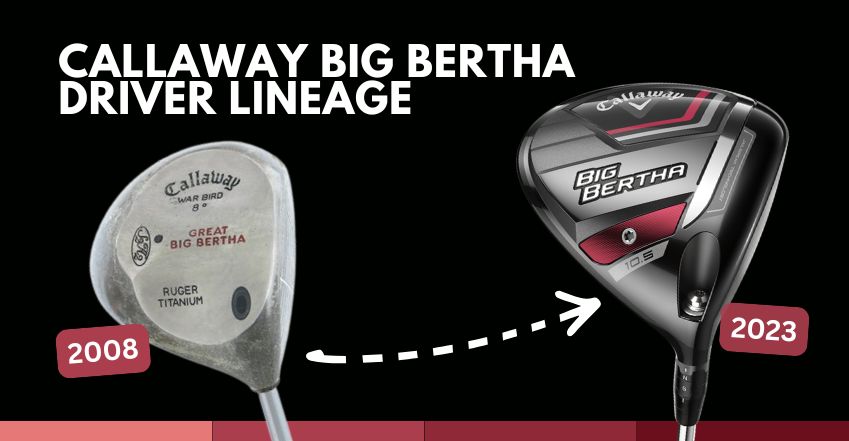
Callaway Big Bertha Driver Lineage: 35 Years of the Driver That Changed Golf
Ely Callaway's son Nicholas hated the name. Reportedly told his dad it was "the worst name for a product I've ever heard."
That product was the original 1991 Big Bertha. Within five years, it had transformed Callaway from a small startup operating out of a back office into one of the dominant golf equipment companies on earth. The name turned out to be fine.
If you're a golfer over 30, the words "Big Bertha" probably trigger a specific memory. The first time you saw one. The first time you hit one. The way that giant stainless steel head looked next to the persimmon woods your dad still played. Big Bertha didn't just become a driver — it became the driver. The shorthand for everything golf equipment was about to become.
Thirty-five years later, Callaway still uses the Big Bertha name. The current era of flagships goes by Quantum, Elyte, Paradym Ai Smoke. But the Big Bertha line continues as Callaway's dedicated game-improvement and anti-slice family. This is the full story — every major Big Bertha driver, what each one mattered for, and which ones are actually worth owning today on the used market.
Quick Answer: Big Bertha is Callaway's flagship driver lineage, launched in 1991 with the original 190cc stainless steel oversized driver that revolutionized golf equipment. Named by founder Ely Callaway after a WWI German howitzer, the line has produced over 30 driver models across 35 years — including the Great Big Bertha (1995, first titanium head), Hawk Eye (1999, first tungsten weight), Big Bertha 460 (2006, max-size legal head), and the modern B21 (2020, dedicated anti-slice). The Big Bertha name now anchors Callaway's game-improvement category, while flagship models go by Quantum, Elyte, Paradym Ai Smoke.
1991: The Driver That Started a Revolution
Ely Callaway founded Callaway Hickory Stick USA in 1982, selling refurbished hickory-shaft clubs out of his car. By 1988, the company had released its first proprietary driver design — the S2H2, which stood for "Short, Straight, Hollow Hosel." The S2H2 eliminated the traditional hosel by extending the shaft directly into the clubhead, an approach that redistributed weight and influenced the industry for decades.
But the S2H2 was just the warmup. The real revolution came three years later.
Why Big Bertha Mattered
In 1991, the typical driver had a clubhead of around 150cc. Most golfers — even tour pros — were still playing persimmon woods, with metal drivers slowly gaining acceptance among players who could swing fast enough to launch them properly. Drivers were small, hard to hit, and unforgiving. Off-center strikes were brutal.
Callaway's R&D team, led by Richard Helmstetter, pushed the original Big Bertha to 190cc — about 25% larger than the standard. They redistributed weight to the perimeter using the S2H2 hosel design, which allowed for a thinner, more forgiving face. The sweet spot grew dramatically. Off-center strikes maintained more ball speed. The whole experience of hitting a driver changed.
Ely Callaway's pricing philosophy mattered as much as the engineering. The Big Bertha launched at roughly twice the price of competing drivers. Callaway later said: "If I had gone to consumers in 1991 and asked them whether they would buy a driver that was 25% bigger than the one they already had, looked different from anything they'd ever hit, was priced twice as high, made a peculiar sound on impact, and had a funny-sounding name, they would say no." He didn't ask. He just made it. The customers showed up anyway.
Why the Name?
Big Bertha was the nickname of a German WWI howitzer — a massive artillery cannon known for its size and destructive power. Ely Callaway thought the name perfectly captured what his oversized driver was meant to do. He told his son Nicholas about the prototype before launch. Nicholas hated the name. The General Electric Pension Fund (Callaway's largest investor at the time) reportedly suggested a different name. Ely refused to budge.
By the end of 1991, Big Bertha was the bestselling driver in golf. Within three years, Callaway had grown from a niche startup to one of the largest equipment manufacturers in the world. Every major brand was working on its own oversized stainless steel driver. The persimmon era was effectively over.
For the full company story, see our Callaway brand guide.
The Big Bertha Driver Timeline: Every Major Era
Here's the full lineage, organized by era. We'll cover what each model meant at the time and which ones still hold up today.
| Year | Model | Key Innovation |
|---|---|---|
| 1991 | Big Bertha (Original) | 190cc stainless steel head — the original oversize driver |
| 1995 | Great Big Bertha + War Bird | First titanium head (250cc) + War Bird sole geometry |
| 1997 | Biggest Big Bertha | Larger titanium head, increased forgiveness |
| 1999 | Great Big Bertha Hawk Eye | First tungsten weight, beginning of draw-bias engineering |
| 2000 | Big Bertha Steelhead Plus | Variable Face Thickness (VFT) introduced |
| 2002 | Great Big Bertha II | Larger face, higher MOI |
| 2003 | ERC Fusion | First titanium face + carbon composite body |
| 2004 | Big Bertha Titanium | Modern titanium head with refined CG positioning |
| 2005 | Big Bertha Titanium 454 + FT-3 | 454cc head — longest legal driver of its era |
| 2006 | Big Bertha 460 | Maximum legal 460cc head, peak forgiveness |
| 2014 | Big Bertha + Alpha + V Series | Comeback after 8-year hiatus, first adjustability |
| 2015 | Great Big Bertha + Mini 1.5 + Alpha 816 | Continued refinement, mini driver concept |
| 2016 | Big Bertha Fusion | Triangular shape, refined draw bias |
| 2017 | Great Big Bertha Epic + Star + SZ | Jailbreak technology launched |
| 2020 | Big Bertha B21 | Dedicated anti-slice driver, AI Flash Face SS21 |
| 2023 | Great Big Bertha (re-release) | Return to slow-swing focus, refined draw bias |
Era 1 (1991-1997): The Pioneer Years
The original 1991 Big Bertha was 190cc of stainless steel. The 1995 Great Big Bertha jumped to 250cc and introduced titanium — the material that would define driver construction for the next two decades. The Great Big Bertha was such a smash hit that Callaway sold over 100,000 sets of the matched iron set in just three weeks. The 1995 War Bird used a unique sole shape with internal weighting that increased forgiveness further. The 1997 Biggest Big Bertha pushed the head size envelope again.
Used market reality: original 1991 Big Berthas in clean condition are collector items, not playable clubs by modern standards. Same with the early Great Big Berthas. If you're shopping for a club to actually hit on the course, this era is more about nostalgia than performance.
Era 2 (1999-2006): Tungsten, Titanium, and the 460cc Cap
The 1999 Great Big Bertha Hawk Eye introduced tungsten weighting — a heel-side weight that lowered the center of gravity and created a draw bias. This is a quiet but historically important moment. Almost every modern game-improvement driver uses tungsten weighting somewhere. Hawk Eye was where it started for Callaway.
By 2005, the Big Bertha Titanium 454 was Callaway's largest driver ever made — 454cc, the maximum head size before the USGA's 460cc rule kicked in. The Fusion FT-3 in the same year combined a titanium face with a carbon composite body, predicting the multi-material construction that's now standard across the industry.
The 2006 Big Bertha 460 finally hit the legal maximum head size. After this, the conversation in driver design shifted from "how big can we make this" to "how can we make a 460cc head perform better."
Used market truth: Big Berthas from 2000-2006 are extremely cheap on the used market. Performance is dated, but they're playable. They make decent backup drivers or starter clubs for absolute beginners — but for any serious player, the technology is too far behind to recommend over a more recent used driver.
Era 3 (2014-2017): The Comeback
After 2006's Big Bertha 460, Callaway went 8 years without releasing a driver under the Big Bertha name. Through this period, Callaway's flagship drivers were the Diablo Edge, RAZR Hawk, RAZR Fit, X Hot — all good clubs, but no Big Bertha branding.
The 2014 comeback was deliberate. Callaway released a full Big Bertha family — Big Bertha Driver, Big Bertha Alpha (with adjustable gravity core), Alpha 815 (refined version), and Big Bertha V Series (lightweight build). Adjustability was the headline tech. The Alpha's adjustable internal weighting let you customize spin and trajectory in ways no previous Big Bertha had offered.
2017's Great Big Bertha Epic was the most important driver of this era. It introduced Jailbreak technology — two internal titanium bars connecting the crown and sole that stiffened the body and let more energy transfer through the face at impact. Jailbreak became one of the most influential driver technologies of the modern era. Most Callaway drivers from 2017 onward use some version of it, including current Elyte and Quantum models.
For the full modern Callaway driver story from Epic forward, see our Callaway driver history: Epic to Quantum.
Era 4 (2020-Present): The B21 and the Anti-Slice Identity
In 2020, Callaway released the Big Bertha B21 — and this is where the brand identity shifted. Big Bertha was no longer Callaway's flagship driver. Flagship status had moved to Mavrik (and later Paradym, Ai Smoke, Elyte, Quantum). Big Bertha became Callaway's dedicated anti-slice and game-improvement line.
The B21 has built a genuinely strong reputation. Independent reviewers have called it "the most effective anti-slice driver tested." The triangular footprint, internal draw-bias weighting, AI-designed Flash Face SS21, Jailbreak architecture, and ultra-low forward CG combine to produce 5-10 yards of consistent draw bias for slicers. For 15-25 handicap players who lose shots to the right, the B21 is one of the best fairway-finding drivers ever made.
The 2023 Great Big Bertha continued this identity — focused on slow swing speeds, lighter overall build, refined draw bias. Both the B21 and 2023 Great Big Bertha remain available on the used market and are absolutely worth considering for the right player type.
Which Big Bertha Driver Is Actually Worth Buying Today?
Honest take from the shop floor: most Big Berthas from before 2014 are not worth buying for actual play. Driver technology has moved too far. Even the best 2005-2006 Big Berthas are giving up significant ball speed and forgiveness to modern equipment, and the price difference no longer justifies the gap.
That said, here's where Big Berthas do hold up:
- Big Bertha B21 (2020): Still one of the best anti-slice drivers in the entire used market. If you fight a chronic slice and aren't ready to invest in a current-generation Quantum Max D, the B21 is a smart used buy. Performance is genuinely strong, and the slice-correction effect is real.
- 2023 Great Big Bertha: Newer than the B21 with a similar slow-swing focus. Available on the used market at meaningful discounts to the latest Elyte X or Quantum Max.
- Great Big Bertha Epic (2017): First Jailbreak driver. Performance has aged surprisingly well. Cheap on the used market. Solid choice for budget-conscious mid-handicap players.
- Big Bertha Alpha 815/816 (2014-2015): First adjustable Big Berthas. Still functional, though now showing their age. Better as a secondary or backup driver than a primary gamer.
- Vintage 1991 Original or Great Big Bertha 1995: Collector territory only. Not for actually hitting balls. Display pieces or nostalgia purchases.
What we tell customers at the shop: if you genuinely have a slice, the Big Bertha B21 is worth its used price all day. If you don't have a slice, look at Callaway's flagship lines instead — Paradym, Ai Smoke, or current Elyte/Quantum. The Big Bertha brand isn't where modern Callaway's best technology lives anymore. If slow swing speed is the bigger issue, our best drivers for slow swing speeds guide breaks down the current options.
Why the Big Bertha Lineage Still Matters
Even golfers who've never owned a Big Bertha owe their current driver to it. Three foundational ideas that the original Big Bertha pioneered:
- Oversized stainless steel construction. Every modern driver traces directly back to the 1991 Big Bertha's 190cc stainless steel head. The shift from persimmon to metal happened almost overnight after Big Bertha launched.
- Perimeter weighting in metalwoods. The original Big Bertha pushed mass to the head's perimeter to enlarge the sweet spot. This is now baked into every game-improvement driver and most flagship drivers as well.
- S2H2 hosel design. Eliminating the traditional hosel and extending the shaft into the head freed up weight for redistribution. Modern drivers don't all use S2H2 explicitly, but the weight-redistribution principle is everywhere.
Beyond the engineering, the Big Bertha launch changed the economics of golf equipment. It demonstrated that golfers would pay premium prices for genuinely better technology. Every premium driver release since 1991 — including the current Quantum, Elyte, Qi4D, GTS, G440, and OPTM — operates within a market that the original Big Bertha created.
Key Takeaways: The Big Bertha Story
- Ely Callaway launched the original Big Bertha in 1991 at 190cc — about 25% larger than the standard driver of the era. The name comes from a German WWI howitzer.
- The S2H2 hosel design (Callaway's first proprietary driver, 1988) was the engineering foundation that made Big Bertha possible.
- Great Big Bertha (1995) introduced titanium construction at 250cc — material that defined driver-building for the next 20+ years.
- Big Bertha Hawk Eye (1999) introduced tungsten weighting for draw bias. Almost every modern game-improvement driver uses some version of this concept.
- Big Bertha 460 (2006) hit the USGA's maximum legal head size. After this, driver innovation moved to face technology and CG positioning.
- Great Big Bertha Epic (2017) introduced Jailbreak technology — still in use across current Callaway flagships.
- Big Bertha B21 (2020) redefined the brand identity — Big Bertha became Callaway's dedicated anti-slice line, with flagship status moving to Paradym, Ai Smoke, Elyte, and Quantum.
- Most pre-2014 Big Berthas are collector pieces, not playable clubs. The B21, 2017 Epic, and 2023 Great Big Bertha are the used-market models actually worth playing today.
Frequently Asked Questions: Big Bertha Drivers
Why is the Callaway driver called Big Bertha?
Big Bertha was the nickname of a German WWI howitzer — a massive artillery cannon known for its size and destructive power. Callaway founder Ely Callaway chose the name in 1991 because he felt it captured what the oversized 190cc driver was meant to do. The name was reportedly disliked by his son Nicholas and Callaway's main investor (the General Electric Pension Fund), but Ely insisted. The driver became the bestselling driver in golf within its first year.
What was the first Big Bertha driver?
The original Big Bertha launched in 1991 as a 190cc stainless steel oversized driver — about 25% larger than the standard driver of the era. It introduced perimeter weighting and the S2H2 hosel design (where the shaft extends through the clubhead). The original Big Bertha is widely credited with ending the persimmon-wood era and establishing the modern oversized-metal-driver industry.
Are Big Bertha drivers still made?
Yes, but the brand identity has shifted. Big Bertha is no longer Callaway's flagship driver line — that role is now held by Quantum, Elyte, Paradym Ai Smoke, and similar models. Big Bertha now anchors Callaway's dedicated anti-slice and game-improvement category. The most recent Big Bertha drivers are the Big Bertha B21 (2020) and the Great Big Bertha re-release (2023).
Is the Big Bertha B21 a good driver?
Yes — for the right player. The B21 is genuinely one of the best anti-slice drivers ever made. Independent reviewers consistently call it the most effective slice-correcting driver tested. Internal draw-bias weighting, low forward center of gravity, and AI-designed Flash Face SS21 combine to produce 5-10 yards of consistent draw bias. Best for 15-25 handicap players who fight a chronic slice. Not recommended for low handicappers or players who fight a hook.
How many Big Bertha drivers are there?
Callaway has released over 30 distinct Big Bertha driver models since 1991. Major eras include the original (1991), Great Big Bertha (1995), Hawk Eye (1999), Steelhead Plus (2000), Titanium series (2004-2006), the 8-year hiatus (2007-2013), the comeback era (2014-2017 Big Bertha, Alpha, V Series, Epic), and the modern game-improvement era (B21 in 2020, Great Big Bertha re-release in 2023).
What is the difference between Big Bertha and Great Big Bertha?
The original Big Bertha (1991) was Callaway's first oversized stainless steel driver. The Great Big Bertha (1995) was its successor — Callaway's first titanium-head driver, with a larger 250cc head. Throughout the 2000s and 2010s, "Great Big Bertha" was used for premium iterations of the line, often distinguishing them from the standard Big Bertha. The 2017 Great Big Bertha Epic and the 2023 Great Big Bertha are the most recent uses of the "Great Big Bertha" name.
Are old Big Bertha drivers worth anything?
It depends on which one and what condition. The original 1991 Big Bertha and 1995 Great Big Bertha can hold collector value if they're in clean condition with original headcovers and packaging. Most other vintage Big Berthas (1997-2013 era) trade for very modest prices on the used market. The B21, 2017 Epic, and 2023 Great Big Bertha hold the most current playable value. For accurate pricing, work with a verified used-club dealer rather than relying on online listings.
Should I buy a used Big Bertha B21?
If you fight a slice and want fairway-finding help, yes. The B21 is one of the few used drivers we consistently recommend to slicers at the GCB shop. Performance is genuinely strong, the slice correction is real, and used pricing makes it a serious value compared to current-generation anti-slice drivers like the Quantum Max D or Ping G440 SFT. Just make sure you actually fight a slice — if you don't, the draw bias becomes a problem rather than a solution.
Related Articles
- Callaway: The Complete Brand Guide
- Callaway Driver History: From Epic to Quantum
- Best Drivers for Slow Swing Speeds
- TaylorMade Spider Putter Evolution
- Ping Anser Putter Evolution
Whether you're hunting for a B21 to cure a slice, a 2023 Great Big Bertha for slow-swing performance, or a vintage Big Bertha for nostalgia, we keep used Callaway drivers from across the lineage in rotation. Every club is authenticated, hand-inspected, and graded honestly. If you're trading in an older Big Bertha, we know what each generation is actually worth — and we won't lowball you on a club that has real used-market demand.